


by
Wybalenna’s new pavilion supports Aboriginal communities returning to Country in Tasmania
A new washing facility on Tasmania’s Flinders Island supports Aboriginal-led cultural reconnection and the restoration of Wybalenna, showing how a modest architectural project can serve a wider community purpose
The first wholly new building at Wybalenna in more than a century addresses a practical obstacle to cultural return. Washing, bathing and toilet facilities allow Palawa community members to camp and spend time at a place where inadequate amenities had long restricted visits. The pavilion
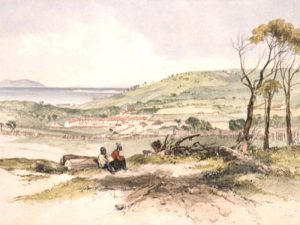
John Skinner Prout’s nineteenth-century depiction of the Aboriginal establishment at Wybalenna, established in 1833 as a site of forced detention for Tasmanian Aboriginal people | Credit: John Skinner Prout / National Gallery of Victoria, via Wikimedia Commons. Public domain.
forms part of a wider programme directed by the Aboriginal Land Council of Tasmania (ALCT).
Designed by Taylor and Hinds Architects with ALCT, The Ablutions at Wybalenna received a 2026 National Award for Small Project Architecture, announced on 29 October. The jury recorded that the project was delivered pro bono and realised through donated materials, placing its delivery model alongside its design as a reason for recognition.
At Wybalenna, washing facilities help make time on Country possible, giving a modest building a role in cultural continuity.
Established in the nineteenth century as a place of forced detention for Tasmanian Aboriginal people, Wybalenna remains a site of loss, resistance and survival. ALCT’s ongoing work supports community gathering and Aboriginal-led truth-telling through building repairs, essential services and interpretation. Volunteers began restoring the old shearing shed in 2023; subsequent work has included refurbishing the homestead, installing water tanks and renewing the chapel’s interpretation.
The pavilion’s weathering-steel construction carries cultural references as well as practical value. Its curved walls draw on traditions of circular scarification, while the oxidised surface recalls ochre denied to people detained here. The awards jury identifies these connections as integral to the building’s meaning.
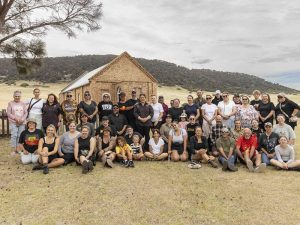
Members of the Palawa community gathered at Wybalenna in February 2026 to mark the site’s ongoing restoration and new truth-telling installation | Credit: Courtesy Aboriginal Land Council of Tasmania
The commission also grew from an existing relationship. Taylor and Hinds had previously worked with the Aboriginal community on krakani lumi, a standing camp completed in 2017. At Wybalenna, community members determined their priorities through their own consultation before the architects helped translate them into built work. Low-maintenance design was essential given the limited resources available for upkeep.
The architectural brief emerged from the community’s own deliberations, with the practice helping to realise priorities already defined by its client.
For practices elsewhere, the transferable lesson concerns how work begins and whose intentions shape it. Existing relationships, community authority and attention to everyday needs can reveal consequential commissions at a small scale. Wybalenna also makes the funding challenge visible: donated expertise and materials have enabled progress, while ALCT continues to seek support for the work ahead.
Further information
Aboriginal Land Council of Tasmania – Truth Telling at Wybalenna
National Award for Small Project Architecture – jury citation
 English
 Spanish
 Portuguese
 French
 German
 Italian
 Japanese
 Arabic
 Chinese