


by
At Sharjah’s Architecture Triennial, temporary structures rethink public space
The 2026 edition brings installations and public activities into schools, markets and historic sites, exploring how architecture can strengthen social connections, collective life and the everyday use of urban spaces
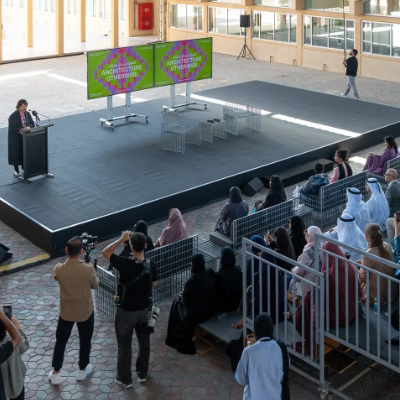
Opening of the 3rd Sharjah Architecture Triennale, via sharjah24.ae
The third Sharjah Architecture Triennial opened on 14 November, bringing together international architects, artists and researchers to examine how architecture can respond to the social and cultural challenges of contemporary cities. Rather than focusing exclusively on buildings, the event explores the relationships, activities and shared spaces that sustain communities.
Running until 14 April 2027, Architecture Otherwise: Building Civic Infrastructure for Collective Futures features 35 participants and is curated by Vyjayanthi Rao, with Tau Tavengwa as associate curator. Installations, films, performances and workshops occupy locations across Sharjah, including Al Qasimiyah School, the former Al Jubail Vegetable Market and other historic urban sites.
The programme addresses migration, displacement, collective memory and environmental change, examining how communities adapt their surroundings to everyday needs. By using existing public spaces as exhibition venues, the Triennial also brings architectural discussions beyond galleries and professional institutions, encouraging encounters between visitors, local residents and the urban environments they already inhabit.
Several installations translate these questions into physical interventions. At Al Khan Beach, Lalla Alwyia, Khalwa, developed by L.E.FT Architects and collaborators, uses palm-frond enclosures to create intimate spaces for reflection within a public landscape. Meanwhile, ABARI’s Weaving Spaces explores bamboo construction and traditional craftsmanship, highlighting the potential of locally rooted building knowledge in contemporary architectural practice.
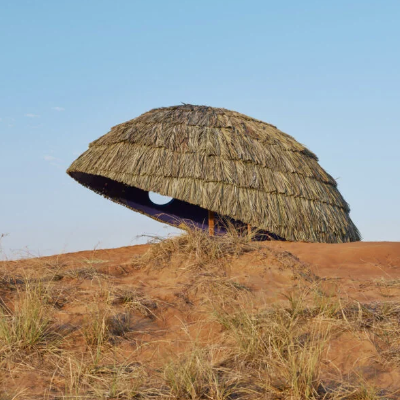
“After the Night There Is Nothing” at the Sharjah Architecture Triennale. Photo by Edmund Sumner, via ordinarychaos.co.uk
Other projects investigate the relationship between education, public infrastructure and collective memory. Curry J Hackett’s Open the School, presented at the former Al Jubail Vegetable Market, explores how architecture can support alternative forms of gathering and learning, using a temporary installation to reconsider the social possibilities of an existing urban structure.
By transforming familiar urban settings into spaces for experimentation, the Triennial demonstrates how architecture can emerge from community practices, cultural traditions and the creative reuse of existing environments.
The exhibition also challenges conventional approaches to architectural practice by recognizing communities as active participants in shaping their surroundings. Through collaborations involving designers, researchers and local groups, it presents architecture as an evolving process rather than a finished object, offering perspectives on temporary interventions, participatory design and the social responsibilities of contemporary architecture.
For architectural practices, the event highlights opportunities to work beyond conventional building commissions, including cultural programming, experimental public installations and community-led transformations. Its emphasis on existing spaces and modest interventions suggests that meaningful architectural change does not always depend on major construction, but can begin by reconsidering how places are used, shared and experienced.
Further Information
Sharjah Architecture Triennial – Official programme
Sharjah24 – Inauguration of the third edition
AD Middle East — Installations at the 2026 Triennial
 English
 Spanish
 Portuguese
 French
 German
 Italian
 Japanese
 Arabic
 Chinese