


by
Nigeria breaks ground on $3.5bn Bakassi deep-water seaport project
After more than a decade of planning, a proposed deep-water port in Cross River State reaches a major development milestone, opening new possibilities for maritime trade, industrial infrastructure and regional economic growth
Nigeria has held a groundbreaking ceremony for the US$3.5 billion Bakassi Deep Seaport, advancing a major infrastructure project that has been under development for more than a decade.
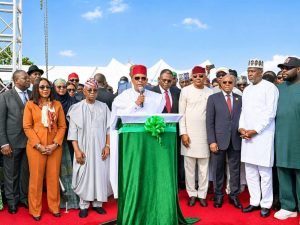
Vice-President Kashim Shettima addresses officials at the groundbreaking ceremony for the proposed Bakassi Deep Seaport in Cross River State, Nigeria, on 13 November 2026 | Image: Cross River State Government
Vice-President Kashim Shettima attended the ceremony on 13 November on behalf of President Bola Tinubu, marking the latest stage in Cross River State’s efforts to establish a new maritime and industrial corridor along Nigeria’s southeastern coastline.
First conceived in 2014, the project is intended to accommodate large cargo vessels and expand the region’s capacity for international trade. Its proposed 20-metre draft would allow it to receive vessels that cannot currently access some of Nigeria’s existing ports.
The port is also expected to support agricultural exports, logistics and industrial activity, connecting maritime infrastructure with the wider economic development of Cross River State.
Bakassi’s groundbreaking comes more than a decade after the project was conceived, illustrating the long route from infrastructure planning to physical delivery.
The development has progressed through environmental assessments, technical studies, investment negotiations and public-private partnership arrangements. In February 2025, the Cross River State Executive Council ratified a shareholders’ agreement for the project company, Bakassi Deep Seaport Ltd.
Under the agreement, private infrastructure partner ARISE IPP was to acquire an 80% stake, with the state government retaining 20%. The structure is intended to support private financing and delivery, with the African Export-Import Bank previously identified as a financing partner.
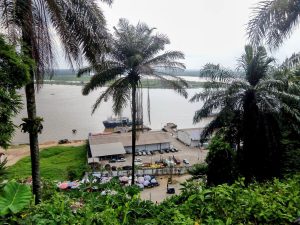
Calabar Harbour in Cross River State, Nigeria. The proposed Bakassi Deep Seaport is intended to expand maritime capacity and support industrial development in the region | Image: Utibe Noah Silas / Wikimedia Commons
The November ceremony is an important political and development milestone, although it does not establish the full construction timetable or confirm the award of every technical and design package.
For the state government, Bakassi forms part of a broader ambition to attract manufacturing, trade and investment to a region whose industrial potential has long been constrained by infrastructure limitations.
The architectural implications extend beyond the port itself. Large maritime developments can create demand for logistics facilities, warehousing, industrial buildings, administrative accommodation, worker housing and supporting urban infrastructure.
The wider architectural opportunity lies in the industrial and urban development that a functioning port could enable, rather than its marine infrastructure alone.
Much will depend on how the port’s transport connections, industrial facilities and surrounding settlements are planned and delivered. The implementation of the ownership agreement, confirmation of financing arrangements and release of subsequent procurement packages will be important indicators of progress.
For practices considering emerging infrastructure markets, Bakassi provides a useful example of the extended development process behind major projects. Its progress also demonstrates why understanding project ownership, funding structures and delivery partnerships can be as important as identifying the construction opportunity itself.
Further information
Cross River State Government – Bakassi groundbreaking
Cross River State Government – Shareholders’ agreement
Infrastructure Concession Regulatory Commission – Project financing and PPP
 English
 Spanish
 Portuguese
 French
 German
 Italian
 Japanese
 Arabic
 Chinese