


by
Guinea puts $3.8bn infrastructure pipeline before international investors
Five transport and energy projects show how Guinea hopes to extend investment around Simandou into wider urban and economic development, creating potential opportunities for infrastructure, planning and architectural practices
Guinea is presenting an infrastructure pipeline valued at around US$3.8 billion to investors at the Simandou Mining Summit in Conakry, linking one of the world’s largest mining developments to a broader programme of transport and energy investment.
The summit, running from 11 to 14 November, forms part of the government’s Simandou 2040 strategy, which aims to use investment associated with the country’s iron ore resources to support development beyond the mining sector.
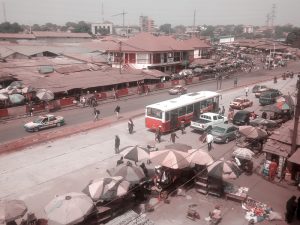
Traffic congestion at Enta Marché, Conakry, in 2020. The government’s proposed infrastructure pipeline includes new BRT and urban rail systems for Greater Conakry. | Source: Ousmane Diallo OsmanLeo / Wikimedia Commons
According to Guinean business publication Ecofinance, five projects are being presented to potential partners. They include a 43km southern coastal road estimated at approximately US$2.6 billion, a 39km bus rapid transit system with 51 stations and a 35km urban railway with 15 stations. Solar generation and storage projects in Dabola and Faranah are also included.
The figures describe estimated investment requirements rather than committed funding or awarded construction contracts. The significance lies instead in the scale and range of infrastructure being placed in front of investors while commercial relationships around Simandou are still developing.
The government is seeking to turn investment around Simandou into a wider pipeline of transport, energy and urban infrastructure.
For Conakry in particular, the transport proposals point towards substantial changes in how the metropolitan area could develop. New rapid transit, rail and road infrastructure would bring questions of station planning, interchange design, public realm and development around transport corridors alongside the engineering challenge itself.
The approach also illustrates how architectural markets can begin forming before conventional building commissions appear. Major infrastructure programmes assemble governments, investors, operators, engineers and delivery partners first, with opportunities for architects, planners and landscape consultants emerging as projects become more defined.
For practices looking at emerging markets, the institutions assembling an infrastructure programme can be as important to track as the eventual projects.
Whether all five proposals progress will depend on financing, procurement and government priorities. But Guinea’s attempt to connect mining investment with metropolitan transport and energy development makes Simandou relevant beyond the extraction sector. For international practices, the programme is worth watching as an example of how a major resource project can begin creating a much wider development market.
Further information
Guinea Ministry of Mines – Simandou Mining Summit
Simandou 2040 development programme
Ecofinance Guinée – infrastructure projects seeking partners
 English
 Spanish
 Portuguese
 French
 German
 Italian
 Japanese
 Arabic
 Chinese