


by
Fortitude Valley plans for a denser future while protecting its cultural identity
Brisbane is proposing more housing and development in its nightlife district while seeking to protect live music venues, heritage buildings and the cultural economy that gives the area its distinctive character
A former railway reserve in Mansfield, Victoria, is being transformed into a cultural and public recreation precinct, with the fit-out of its new Heritage Museum completed ahead of a planned 2027 opening. Announced by Mansfield Shire Council on 6 November, the milestone allows historic objects and collections to move into a dedicated museum developed through years of local advocacy.
The museum’s exhibitions, organised around the theme Tracks Through Time, will trace the region’s history from its natural and geological past through Taungurung culture and subsequent settlement and development. The project brings together the Mansfield Historical Society, community contributors and representatives of the Taungurung people, whose knowledge and cultural heritage form an important part of the museum’s interpretation.
A railway reserve once used to connect Mansfield with other towns is becoming a place where the community can preserve and share its own history.
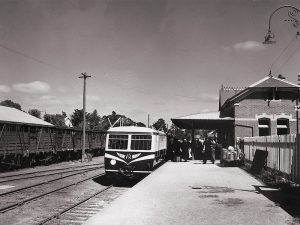
A Walker railmotor at Mansfield railway station in November 1954, documenting the former transport role of the Station Precinct | source: Victorian Railways / Wikimedia Commons
The museum’s design incorporates locally significant materials. Its reception desk, for example, has been constructed using timber reclaimed from the former Mansfield Sale Yards, giving an everyday piece of furniture a direct relationship with the town’s working history.
The wider development extends beyond the museum. A A$14.1 million grant from the Australian Government’s Regional Precincts and Partnerships Program supports the transformation of the Station Precinct, including recreational facilities, restoration of railway structures, improvements to the Mullum Wetlands and a Taungurung Arts Track. The funding supports the broader precinct rather than the museum fit-out alone.
The redevelopment combines several forms of public infrastructure within a single site. Heritage interpretation sits alongside environmental improvements, visitor facilities, accessible recreation and public space, bringing together different groups whose priorities have shaped the programme.
Mansfield’s approach treats heritage as part of a functioning public precinct, connecting historic collections with recreation, Indigenous cultural interpretation and environmental restoration.
The museum is expected to open in 2027, approximately 50 years after the final passenger railway service on the Mansfield line. That coincidence gives the project a further connection to the site’s former role in the town’s development.
For architects and exhibition designers, Mansfield illustrates how smaller municipal commissions can emerge from partnerships between historical societies, Indigenous communities, local government and public funding programmes. The professional work may be modest compared with major metropolitan museums, but its scope can encompass heritage conservation, interpretation, landscape and community facilities.
The project offers a useful example of how existing public land and locally held collections can become the basis for a broader civic development.
Further information
 English
 Spanish
 Portuguese
 French
 German
 Italian
 Japanese
 Arabic
 Chinese