


by
ETH Zurich uses bacteria to turn 3D-printed sand into architectural elements
Researchers in Switzerland are combining microorganisms with digital fabrication to produce solid building components without conventional cement firing, exploring new possibilities for lower-energy construction materials
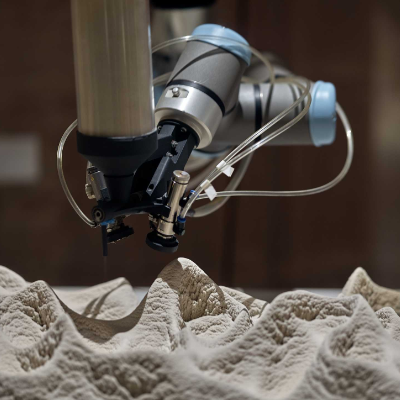
A robotic arm applies bacteria, mineralizing substances, and sand to a surface repeatedly in layers. Photo by Gerhard Bliedung / ETH Zurich, via ethz.ch
At ETH Zurich, researchers have developed a method of producing architectural elements using bacteria to bind grains of sand together, introducing a potential alternative to conventional cement-based manufacturing. The experimental process combines biological mineralisation with 3D printing and robotic fabrication, allowing complex components to harden without the high temperatures normally required in cement production.
Presented by the university in October 2026, the research is led by architect Karen Antorveza Paez, who has investigated how microorganisms can become part of architectural manufacturing. Her work builds on an established biological process known as microbially induced calcite precipitation, in which bacteria produce calcium carbonate crystals that bind loose mineral particles together.
Instead of relying on conventional cement to hold construction materials together, the process uses living microorganisms to create a mineral bond between grains of sand.
One technique involves developing a printable mixture of sand, bacteria and a water-based gel made from natural substances. The material is shaped using a 3D printer before being immersed in a solution containing calcium chloride and urea, allowing the microorganisms to produce the mineral crystals that gradually solidify the component.
The process takes between two and five days, depending on the required strength. Because the material hardens at room temperature, it eliminates the need for high-temperature firing during this production stage.
The researchers have already used the technique to produce a freestanding architectural façade element, demonstrating its potential for applications such as solar shading and interior partitions. These remain experimental uses rather than certified commercial building products.
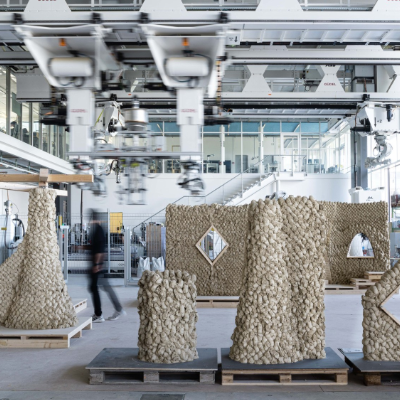
Structures created from bacteria, via baublatt.ch
A second manufacturing method replaces printing and immersion with robotic spraying. In this approach, a robotic arm deposits layers of sand, bacteria and mineralising substances directly onto a surface, gradually building up solid material.
The technique was demonstrated during the 2025 Venice Architecture Biennale, where the automated process operated over six months, allowing visitors to observe the gradual formation of a mineral structure.
The research opens possibilities for architectural components whose form and material properties can be developed through digital design and biological processes working together.
For architectural practices, the project offers an early indication of how construction materials could evolve through collaboration between architects, material scientists, microbiologists and robotics specialists. It also suggests that future design processes may involve greater control over how materials are produced, rather than simply selecting products from established manufacturers.
Significant challenges remain. The researchers are still investigating mechanical performance, production scale and the environmental consequences of the process, particularly the ammonium generated during mineralisation. Structural load-bearing applications remain a longer-term possibility.
Nevertheless, ETH Zurich’s experiment illustrates a different direction for construction research. By treating microorganisms as active participants in material production, the project challenges conventional assumptions about manufacturing and the relationship between biology, architecture and digital technology.
Further information
ETH Zurich – When bacteria become masons
ETH Zurich – 3D printing of microbial bio-cement: Design and Computation of Living Materials
Archinect – ETH Zurich researcher develops bacteria-based 3D-printing method
 English
 Spanish
 Portuguese
 French
 German
 Italian
 Japanese
 Arabic
 Chinese