


by
Doha tests traditional cooling techniques in new public-space installations
Five architectural installations at Design Doha 2026 reinterpret regional materials and building traditions, exploring how ceramics, water and natural shading can improve outdoor spaces in Qatar's hot climate
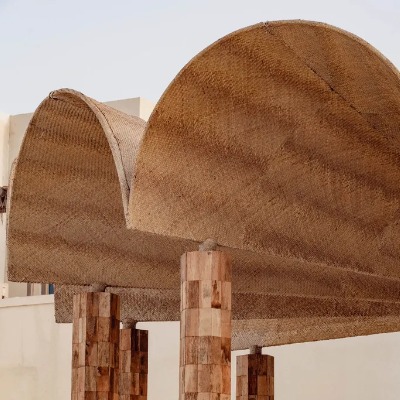
‘Palm Construct’ by Abdalla Almulla. Photo by Design Doha, via wallpaper.com
In Doha, a series of public installations is exploring how traditional building knowledge can help create more comfortable outdoor spaces in hot climates. Presented as part of Design Doha 2026, the projects combine regional materials, passive cooling principles and contemporary architectural design, turning parts of the city’s historic Fereej Al Asmakh neighbourhood into spaces for experimentation.
The five Public Design Commissions opened with the biennial on 5 November and will remain on display until 31 January 2027. Curated by Javier Peña Ibáñez and supported by Qatar’s Public Works Authority, Ashghal, the programme brings together architects, designers and craftspeople from across the Middle East, North Africa and South Asia.
Rather than treating climate control as a purely technological challenge, the installations investigate how traditional materials and environmental knowledge can influence contemporary public-space design.
Among the projects is Salsabil, designed by architect Meriem Chabani of NEW SOUTH. The installation reinterprets traditional water-cooling systems through a structure made from ceramic spheres functioning as architectural bricks. Arranged into columns and curved screens, the components incorporate water misting to create cooler areas for pedestrians and gathering.
Another installation, Cooling Pots, developed by Haitam Daoudi and Óscar Cruz of +.atelier, explores evaporative cooling through suspended terracotta vessels. The pots, arranged at different heights and diameters, form a canopy that filters sunlight while using the absorption and gradual release of water to moderate the immediate environment.
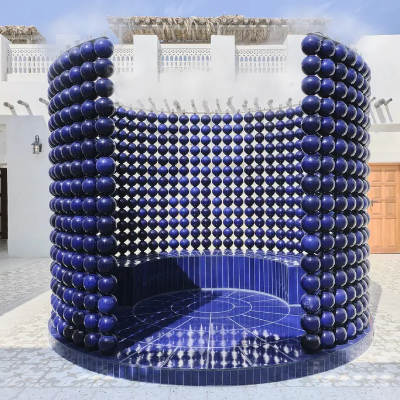
‘Salsabil’ by Meriem Chabani. Photo by Luc Bertrand, via wallpaper.com
The programme also includes Falajscape, by Studio By Three, which adapts traditional gravity-fed irrigation systems into a contemporary public installation. Water moves through stainless-steel channels, creating opportunities for cooling, planting and interaction within the urban landscape.
Two additional projects investigate the relationship between local materials and public life. Palm Construct, by Abdalla Almulla, revisits traditional date-palm construction techniques, while Shoreline, by Lebanese studio Platau, draws on wooden boatbuilding traditions to create a shaded gathering space reflecting Doha’s changing coastline.
The projects demonstrate how familiar regional materials can be reconsidered as architectural resources for addressing heat, public comfort and the everyday use of urban spaces.
The five commissions were selected through an international process that received more than 320 applications from 45 nationalities across 32 countries. Their development involved collaboration between designers, manufacturers, fabricators and local specialists, placing the processes behind each installation alongside the finished work.
For architectural practices, the programme offers an example of how small-scale public commissions can support material research and new professional partnerships. It also highlights the potential of temporary installations to test ideas that may inform future streets, courtyards, parks and other outdoor environments.
The projects remain experimental interventions rather than proven alternatives to conventional urban cooling infrastructure. Their wider application would require further assessment of thermal performance, water consumption, maintenance and suitability for different public settings.
Nevertheless, Design Doha’s approach offers a relevant direction for climate-responsive architecture. By combining contemporary design with knowledge developed over generations, the installations suggest that adapting cities to rising temperatures may depend as much on reconsidering existing traditions as on introducing new technologies.
Further information
Design Doha – 2026 Public Design Commissions
Wallpaper – Design Doha’s public commissions look to the past to design for the future
Qatar Tribune – Design Doha reveals five public design commissions
 English
 Spanish
 Portuguese
 French
 German
 Italian
 Japanese
 Arabic
 Chinese