


by
A UAE studio turns discarded date pits into cement-free architectural materials
Datecrete Studio & Lab is transforming agricultural waste into tiles, surfaces and architectural products, combining traditional regional building knowledge with material research and new manufacturing possibilities
In the United Arab Emirates, a design and research studio is developing architectural materials from an unexpected resource: the pits discarded by the region’s date industry. Created by Datecrete Studio & Lab, the cement- and resin-free composite offers an alternative approach to architectural finishes, using agricultural byproducts and a natural binder inspired by traditional building technologies.
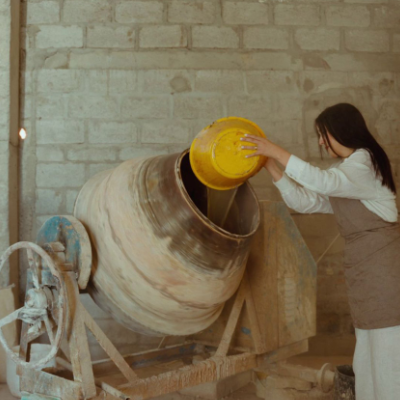
Datacrete creation process, via seouldesignaward.or.kr
Developed by material researchers Sara Farha and Khaled Shalkha, Datecrete emerged from research initiated in 2022. The material received renewed international attention in October 2026 through the Seoul Design Award, where it was selected for a designboom Special Prize recognising innovative approaches to material reuse and environmental design.
The production process begins with date pits collected from local processing facilities. After drying and grinding, the seeds are combined with a specially developed natural binder and cast into moulds, producing surfaces with different colours, textures and finishes.
The material demonstrates how agricultural waste and traditional construction knowledge can be combined to develop architectural products rooted in local resources.
Unlike conventional cement-based products, Datecrete does not rely on Portland cement or petrochemical resins. Its binder system draws on regional construction methods developed before the widespread use of modern cement, adapted through contemporary material testing and manufacturing research.
The resulting composite can be moulded into tiles, panels, furniture and other architectural elements. The size and arrangement of date-pit particles influence the appearance of each surface, allowing the material’s agricultural origin to remain visible in the finished product.
The research has already moved beyond small laboratory samples. At Expo 2025 Osaka, approximately 35 tonnes of Datecrete pavers were used in the UAE Pavilion’s landscape design, providing a full-scale application of the material. The studio has also supplied floor and wall finishes for interior projects, testing its potential within different architectural settings.

Datacrete design, via seouldesignaward.or.kr
Its development reflects a growing interest in construction products that respond to regional material availability rather than depending exclusively on conventional industrial supply chains. In the Gulf, where date cultivation has a long cultural and economic history, the project introduces a new relationship between agricultural production and the built environment.
For architectural practices, Datecrete offers an example of how material experimentation can create new opportunities for collaboration between designers, researchers, manufacturers and local industries.
The studio is now exploring how its production methods could support more repeatable architectural applications, including modular surfaces and cladding systems. Broader adoption will depend on production capacity, technical requirements and the suitability of the material for specific building conditions.
Although Datecrete is not yet a direct replacement for conventional structural concrete, its development demonstrates the potential of rethinking familiar waste streams as resources for architectural production.
By connecting contemporary material science with regional craft knowledge and agriculture, the initiative offers a different starting point for sustainable design: investigating what a place already produces before deciding what materials a building should use.
Further information
Datecrete Studio & Lab – Official material research and development
Seoul Design Award – Datecrete project profile
MaterialDistrict – Sara Farha and Khaled Shalkha turn date pits into pavers
 English
 Spanish
 Portuguese
 French
 German
 Italian
 Japanese
 Arabic
 Chinese