


von
South Africa builds a US$210m tourism project pipeline
Fifteen tourism developments spanning heritage, hospitality, cultural infrastructure and new visitor attractions are being presented to investors as South Africa looks to turn growing tourism demand into new projects.
South Africa has put 15 tourism infrastructure projects worth a combined approximately US$210 million in front of investors, creating a pipeline that could generate opportunities across architecture, hospitality, heritage, landscape and urban development.
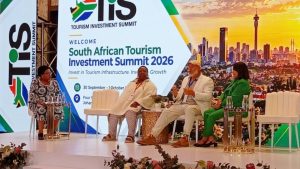
The projects were presented at the second South African Tourism Infrastructure Investment Summit in Johannesburg on 1 October. They include public and privately owned developments across the country, ranging from the redevelopment of Johannesburg Art Gallery and heritage projects in Cape Town to resorts, entertainment facilities and new tourism infrastructure.

Entrance of Johannesburg Art Gallery. Janek Szymanowski, CC BY-SA 3.0, via Wikimedia Commons
Among the projects are the redevelopment of Johannesburg Art Gallery; Tokai Manor in Table Mountain National Park; the Groote Schuur Estate Tea Room and Restaurant; the Strand Street Quarry tourism development; the Hole-in-the-Wall Resort in the Eastern Cape; and the Groenkloof Precinct in Pretoria.
More commercially driven proposals include a Durban amusement park, Water World Fun Park and East London Race Track, alongside new hospitality developments in Limpopo, Gqeberha and the Northern Cape. Cape Town proposals include Miniature World and Project Inkunzi, currently described as an ultra-luxury floating hotel.
The breadth of the pipeline suggests that South Africa’s tourism investment push is creating opportunities well beyond conventional hotel development.
Infrastructure is also part of the programme. The planned expansion of Cape Winelands Airport and development of an aerotropolis around it appear among the 15 opportunities. The airport itself forms part of a much larger development valued at approximately US$480 million, already taking shape outside Cape Town.
The investment push follows growing visitor numbers. South Africa recorded 10.5 million international arrivals in 2025, while 7.5 million visitors arrived between January and August 2026, an increase of 11.7% compared with the same period a year earlier. Government is positioning new infrastructure and visitor experiences as a way to convert that demand into investment and employment.
A new Tourism Infrastructure Facilitation Unit has also been established to help move priority projects towards implementation. A three-year agreement with Infrastructure South Africa will provide investment expertise and transaction support intended to improve project readiness and attract private capital.
For architectural practices, this is where the programme becomes particularly relevant. Tourism investment is being defined broadly: heritage buildings, cultural institutions, public attractions, hospitality, infrastructure and destination development all sit within the same pipeline.
A panel discussion, moderated by Maggie Sotyu (Deputy Minister of Tourism), included Gloria Serobe (Chairperson of the Industrial Development Corporation), Ron McKenzie (Chief Wandering Officer of the Safari Guys) and Patricia de Lille (Minister of Tourism). Via tourismupdate.com
Rather than pointing to a single major commission, the programme reveals a developing market where architecture, heritage, hospitality and infrastructure are increasingly being considered together.
There are reasons for caution. Four of the projects presented this year — Water World Fun Park, Tokai Manor, Groote Schuur Estate Tea Room and Hole-in-the-Wall Resort — were already included in the 2025 investment summit. Of last year’s eight projects, three have since secured funding commitments, but the Department of Tourism has not publicly identified which ones.
The pipeline should therefore be read as a map of potential development rather than 15 confirmed construction projects. But it is becoming larger. Eleven additional proposals from North West province, worth approximately US$72 million, were submitted at this year’s summit and will now be screened for possible inclusion in the investment programme.
For practices looking at emerging international opportunities, South Africa offers a useful signal. Increasing visitor demand is being accompanied by an organised effort to turn tourism assets into investment-ready projects — potentially creating work not only for hospitality specialists, but for architects working across adaptive reuse, conservation, cultural projects, public realm and destination planning.
Weitere Informationen
South African Department of Tourism – Tourism Investment Summit (SATIS) 2026
South African Government – Minister Patricia de Lille’s SATIS 2026 addres
Tourism Update – full list of the 15 tourism investment projects
 English
 Spanish
 Portuguese
 French
 German
 Italian
 Japanese
 Arabic
 Chinese