


by
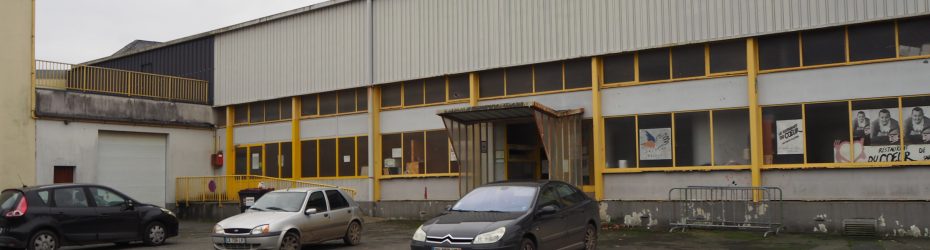
Solidarity House, Saint-Lô
Rehabilitation of the Yser site in Saint-Lô, France, to create a socially focused, community-based Maison des Solidarités bringing multiple support services together.
The City of Saint-Lô has launched a tender for the transformation of the Yser site into a Maison des Solidarities, a new civic facility designed to consolidate and enhance local social support services. Located at Rue de l’Yser, close to the town centre, the project seeks to replace or comprehensively refurbish an ageing complex currently occupied by various charitable organisations and municipal services. The proposal brings together a wide range of programmes, including a solidarity café and reception hub, food distribution centre, solidarity shop (ressourcerie), consultation and advice spaces, shared workshops, and emergency accommodation, into a single, legible and welcoming building. Conceived as an inclusive and non-stigmatising environment, the project aims to provide a clear point of entry for vulnerable users while strengthening coordination between public bodies and voluntary organisations.
Rooted in a strong social brief, the scheme is driven by principles of dignity, accessibility, and co-design, with future users, staff and partners actively involved in shaping both the spatial and operational strategy. The project is expected to deliver approximately 1,425 m² of internal area, with a reconfigured site that improves public access, logistical flows and integration into the surrounding neighbourhood, while addressing technical constraints such as flood risk and the limitations of the existing structure. Beyond the architectural response, the Maison des Solidarities is envisioned as a dynamic third place, part civic infrastructure, part community anchor, supporting social inclusion, fostering collaboration, and reinforcing the role of architecture as a catalyst for collective care and urban regeneration.
Location
Sector
Civic Community
Intervention
Renovation
Website
Tender Portal
Tender Stage
Two stage tender
Deadline
24 Apr 2026
Project Value/Scale
0-5-million
Consultant Team
Architect (mandatory lead)
Assistance to user briefing / co-construction specialist (AMU)
Landscape designer
Structural engineer
Building services / fluids engineer
Thermal engineer
Energy engineer
Cost consultant / economist
Kitchen designer / catering specialist (cuisiniste)
Assistance to user briefing / co-construction specialist (AMU)
Landscape designer
Structural engineer
Building services / fluids engineer
Thermal engineer
Energy engineer
Cost consultant / economist
Kitchen designer / catering specialist (cuisiniste)
Submission Criteria
4 candidates will be shortlisted to the second phase.
Qualification Deliverables:
– Letter of Application (DC1)
– Declaration of the Candidate (DC2)
– Turnover for the last 3 financial years
– Legal and financial status information
– Team structure and organisation
– CVs and professional qualifications
– Average annual staffing levels (last 3 years)
– Number of management staff
– Description of team capacity to deliver the project
– Description of technical tools, equipment, and capabilities
– Demonstration of ability to deliver comparable projects
– Relevant professional accreditations (or equivalent evidence)
– Team presentation document – max. 2 A4 pages (excluding CV annexes)
References – maximum 9 references total, including:
– Format: max. 2 A4 pages or 1 A3 page per reference
– 3 architectural references (lead consultant)
– 2 references in user engagement / co-design (AMU)
– Up to 4 additional references covering other disciplines
2nd Stage Deliverables:
– Design methodology
– Functional response
– Fee proposal
– Cost control approach
Architectural concept – initial design proposals responding to:
– Functional brief (~1,425 m² programme)
– Spatial organisation (internal + external flows)
– Public / private / logistics separation
Likely deliverables:
– Diagrams
– Sketch plans
– Massing / spatial strategies
User engagement / co-design methodology (AMU):
Methodology for:
– Stakeholder workshops
– User participation
– Iterative design process
– Tools and governance for co-construction
– Phasing and continuity of services during Works
– Coordination of stakeholders
– Risk management
– Project management and programme
Explanation of delivery across all phases:
– Diagnostic (DIA)
– Concept / Outline Design (APS)
– Developed Design (APD)
– Planning Permission (PC)
– Technical Design (PRO)
– Tendering and construction phases (AMT, DET, OPC, AOR, etc.)
Confirmation of compliance with:
– Contractual requirements (CCAP)
– Programme and brief
Potential additional deliverables (typical for this procedure):
– Risk register
– Design narrative report
– Sustainability / environmental approach (if requested in ITT)