


par
Senegalese architect proposes a new administrative capital for Guinea
Senegalese architecture and engineering group ATEPA has presented an ambitious proposal for a new city in Guinea, combining urban planning, infrastructure development and an alternative strategy for financing its construction
Rather than responding to an architectural commission, Senegalese architecture and engineering group ATEPA has approached the Guinean government with a proposition for an entirely new city.
Led by architect Pierre Goudiaby Atépa, the group presented its proposal for a new administrative capital, named Nimba, to Prime Minister Amadou Oury Bah on 19 November.
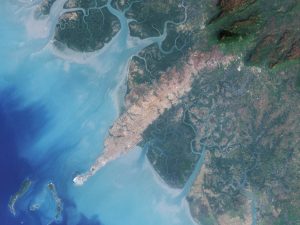
Guinea, satellite view of Conakry’s urban development along the Kaloum Peninsula, December 2000 | NASA Earth Observatory, Jesse Allen and USGS
Covering approximately 30,000 hectares, the proposal brings together government buildings, residential neighbourhoods, an international airport, industrial facilities, agricultural development and renewable energy infrastructure.
ATEPA estimates that the development could require between €20 billion and €30 billion over twenty years. Its proposed financing strategy would draw partly on increases in land value generated by the development itself.
ATEPA is proposing not only the architecture of a new capital, but also the economic framework through which it might be delivered.
The initiative aligns with Guinea’s Simandou 2040 development strategy, which encompasses investment in infrastructure, economic diversification and the development of new urban centres.
Conakry, where much of the country’s administrative activity is concentrated, occupies a geographically constrained coastal peninsula. A new administrative centre could redistribute some of these functions while creating opportunities for housing, employment and public infrastructure elsewhere.
However, the proposal remains at an exploratory stage. The government has not confirmed a definitive location, investment budget or construction timetable, and further studies have been requested to establish the project’s viability.
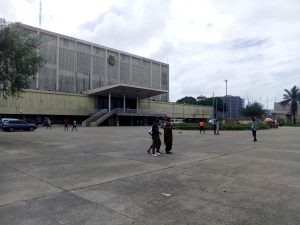
Conakry, western elevation of the Palais du Peuple, Guinea’s parliamentary building, 2018 | Aboubacarkhoraa, Wikimedia Commons, CC BY-SA 4.0
Land ownership, consultation with existing communities, infrastructure provision and the distribution of financial risk will be central to determining whether the proposition can advance beyond its initial presentation.
For architectural practices, Nimba offers an interesting example of business development extending beyond competitions, tenders and conventional client relationships. ATEPA is attempting to connect architectural expertise with government priorities, land economics and investment strategy at the earliest stages of project formation.
The opportunity for architects may lie not only in securing commissions, but in helping establish the conditions from which commissions emerge.
Whether or not Nimba proceeds in its proposed form, the initiative illustrates how practices with an understanding of development economics and institutional relationships can participate in shaping future markets, rather than entering them only once a brief has been established.
Informations complémentaires
MAAN Media – Nimba proposal and government response
 English
 Spanish
 Portuguese
 French
 German
 Italian
 Japanese
 Arabic
 Chinese