


What London Museum can teach us about launching a major project
A major project launch is not simply about announcing an opening. With London Museum nearing completion, Stanton Williams’ Roberta Marcaccio explains how practices can use a major launch to communicate ideas that extend well beyond the building itself

Roberta Marcaccio, Marketing and Communications Manager at Stanton Williams
As marketing and communications manager of Stanton Williams, Roberta Marcaccio is currently working towards the launch of London Museum on 28 November, designed by the practice with Asif Khan Studio as collaborating architect and Julian Harrap Architects as conservation architect. Beedier spoke to her about how practices can get the most out of a major project completion.
The opening also marks a new chapter for Smithfield’s General Market, whose preservation Beedier recently examined through the campaign that helped prevent its demolition.
Beedier: How long do you typically prepare in advance?
Roberta Marcaccio (RM): We’d typically allow about six months to shape the messaging and pitch, but for significant projects we start much earlier, sometimes years before completion. With a project as significant as London Museum, the strategy has developed alongside the project itself, with different campaigns and communications through the design and construction to bring particular stories and milestones into focus.
Beedier: How do you approach the marketing strategy?
RM: Before we get into the detail of an individual project, it is about understanding what we want to say more broadly about our approach to an urban problem, a sector or a particular typology. With London Museum, for instance, we’ve worked with the wider team to deliver a new type of cultural and civic institution, one that is open to the public and genuinely embedded in the life of the city. At the same time, the project gives us an opportunity to talk about our approach to adaptive reuse of historic buildings and culture-led regeneration, which are themes that run through our portfolio.
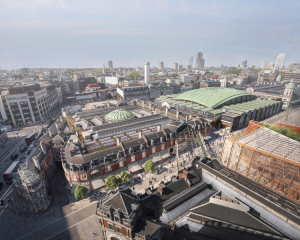
London Museum at Smithfield, showing the General Market and surrounding market buildings | © Secchi Smith
You also want to map the challenges and opportunities in a project and gather the visuals and stories that have accumulated over its life. There is always a surprising amount of material when a team has worked on something so closely for so long. With London Museum, we’ve had around 15 people on the project over the past ten years, each with a different perspective: from the painstaking work of salvaging and reusing the original Victorian floorboards, to how and why the masterplan evolved since competition stage, bringing together a different set of buildings around a former market street running between them.
You have to look at everything, almost take the project apart and reconstruct it, building a hierarchy between the fragments so you know which stories matter most to which audiences and channels.
That narrative then breaks down into smaller pieces: material stories, specific design decisions, profiles of the people involved, so the project can continue to generate stories across different media, not just press. Social media, tours, lectures and awards can all give you a different way into the project and allow it to keep generating new conversations long after the initial launch, including an opportunity to talk about how a building performs and is actually inhabited even years after its launch.
Beedier: What are the challenges?
RM: There are many. One is making sure everyone, from the client’s team and the stakeholders to the contractor, suppliers and collaborators, is aligned on key messages, key moments of the campaign and who’s responsible for what. Different parties may have different agendas and audiences, and there’s a lot of work behind the scenes to keep everyone on the same page. On a project the scale of London Museum, that’s a substantial group, with well over 40 subcontractor firms alone.

Visualisation of London Museum’s train window in the Past Time galleries | © Secchi Smith / Atelier Brückner
Another challenge is striking a balance between the instinct to talk about the building, the material result of everything that has gone into it, and what is really at stake. As architects (with due exceptions), we don’t make mass-produced objects; every response is bespoke, tailored to a client, a site, a programme and a particular social, architectural or urban problem.
What needs communicating, and where our value as architects ultimately lies, are our ideas, our ways of thinking and approaching a problem that can indeed be applied to different situations.
We have to find a level of abstraction that allows us to talk about the thinking, with the building as evidence of it rather than the centre of it.
That’s also one of the most interesting parts of the job: collecting these stories is how you start to see the unexpected connections that make you more aware of the ideas and design methods underpinning the work. Looking at London Museum recently, for example, we realised a recurring question runs through our work: what can the street unlock, not just spatially, but as a tool for regeneration, a way of making an institution, and the area around it, thrive?
West Poultry Avenue, the former market street running through the Smithfield site, has become the spine of the scheme: naturally ventilated, bringing light and air into the buildings either side of it, and unlocking them to hold both the museum’s collection and its civic ambitions. Its reopening is itself a catalyst for the wider regeneration of Smithfield. The same idea recurs across projects that are otherwise very different.
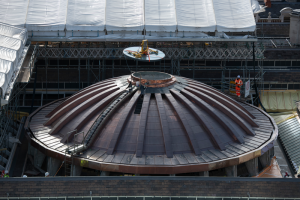
Installation of the oculus to the General Market dome | © London Museum
A Central Saint Martins, an internal street brought together disciplines that had previously worked in isolation. At UCL East Marshgate, streets and squares are drawn inside the building to encourage the kind of collaboration between academics, students and the public a university campus usually keeps at arm’s length. In each case, the street does the same job: turning a building into a piece of city and making the life inside and around it more likely to thrive. What is interesting is not that we suddenly discovered a new idea, but that the process gave us a way of seeing something that had been present in the work for a long time.
Individual project experience was turned into a more conscious body of knowledge: something the practice can carry forward to the next project.
Beedier: Do you ever work with external agencies?
RM: It depends on the project. We have a lot happening at any one time, so it’s a case of how much we can handle ourselves and where external help would be most effective. It’s particularly valuable on projects that are highly complex, or where there’s a specific agenda for what we want the project to achieve. When we launched UCL Marshgate, our first new-build academic project of that scale and significance, we brought in an agency to help us reach audiences beyond our usual channels and bring a different perspective to the campaign.

Visualisation of London Museum’s Past Time galleries | © Secchi Smith / Atelier Brückner
Beedier: How do you judge the success of a campaign?
RM: For me, part of the value is in helping a practice articulate what it stands for. This connects to an idea we explored in Architects After Architecture (Routledge, 2019), the book I co-edited with Rory Hyde and Harriet Harriss: that the value architects bring is not simply the buildings they produce, but the knowledge and ways of thinking, the “spatial intelligence”, required to coordinate the different forces and disciplines that converge to make a building. These skills amount to a certain flexibility of mind, a visionary capacity to show us where to go, combined with a pragmatic ability to show us how to get there. That combination is increasingly important in addressing the multiple crises of our time.
A good campaign can make those ideas more visible, both externally, to clients and the wider industry, and internally, by helping the practice understand and articulate its own work more clearly.
In that sense, it can help create a place for the practice in the conversations that shape the future of the built environment and of society more broadly, rather than simply generating attention around an individual project. That is harder to measure than a media hit, but ultimately much more valuable.

London Museum at Smithfield at night | © Asif Khan Studio / MIR
Beedier: Is London Museum one of your biggest launches?
RM: Certainly one of the most anticipated, given the scale and significance of the project. It is also an unusually complex building, with a former market street running through the site, a train line, multiple entrances and a public space the size of Oxford Circus at its heart.
And this is only Phase One: the General Market opens on 28 November, with Phase Two, the Poultry Market, scheduled to open in 2028.
Aside from London Museum, this is an especially busy year: we’ve just completed two new boarding houses for girls at Winchester College, the first for girls in the college’s nearly 650-year history, and after the Museum’s launch comes another major project: the conversion of the historic Hôtel-Dieu hospital into a regional library and cultural centre in Clermont-Ferrand, France, due to open in 2027.
About Roberta Marcaccio
Roberta Marcaccio is an experienced London-based research and communications consultant, educator, and editor whose work centers on alternative and emerging forms of design practice, research, and pedagogy. She currently serves as the Marketing & Communications Manager for the award-winning architecture practice Stanton Williams.
 English
  Spanish
  Portuguese
  French
  German
  Italian
  Japanese
  Arabic
  Chinese