


por
Yemen restores historic homes while rebuilding local livelihoods
A UNESCO-supported restoration programme has repaired hundreds of traditional buildings while creating employment and training opportunities, linking architectural conservation with the recovery of communities affected by years of conflict
In Yemen, the restoration of historic buildings is becoming part of a broader effort to improve living conditions, preserve traditional construction knowledge and create employment in communities affected by prolonged conflict.
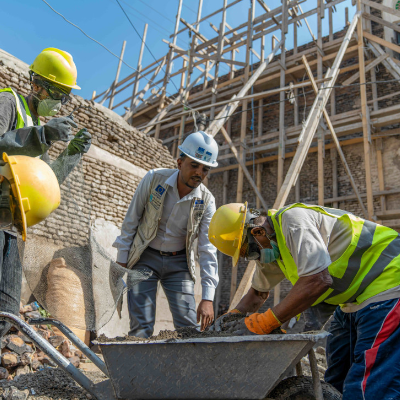
Workers involved in the rehabilitation of Yemen’s cultural heritage. Photo by UNESCO, via eeas.europa.eu
A new report published by UNESCO on 2 November 2026 documents the progress of a heritage rehabilitation programme developed with European Union support. Since its launch in 2018, the initiative has contributed to the restoration of approximately 900 residential buildings, while generating short-term employment for more than 11,000 people.
The work extends across several of Yemen’s historic cities, including Aden, Sana’a, Shibam and Zabid, where traditional architecture has been damaged by conflict, heavy rainfall, flooding and years of insufficient maintenance.
One example is a nearly century-old house in Aden’s historic Crater district. Its deteriorating timber roof and staircase had exposed the family living there to persistent water infiltration, with repairs beyond the household’s financial means.
In early 2026, a UNESCO-supported intervention replaced the damaged roof, staircase and entrance door, alongside repairs to the building’s walls. The project allowed the family to remain in a historic home that had become increasingly difficult to inhabit.
The programme demonstrates how conserving traditional architecture can address immediate housing needs while keeping historic neighbourhoods in everyday use.
Across the country, the initiative combines physical restoration with training and paid work. According to UNESCO, more than 450 architects and engineers have acquired technical restoration skills through successive rehabilitation projects.
This approach is particularly relevant in places such as Shibam, whose distinctive multi-storey mud-brick buildings form one of the world’s best-known examples of traditional vertical urbanism.
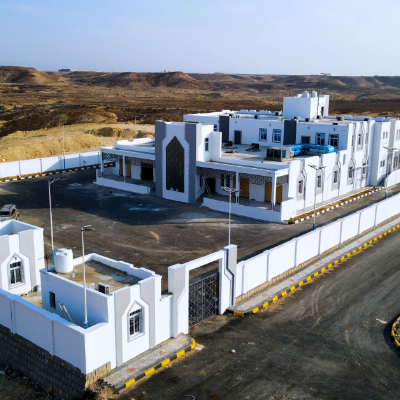
The Fish Export Center, located in Ghail Bawazir. Photo by UNDP, via eeas.europa.eu
After severe flooding in 2020, UNESCO and its partners supported the restoration of more than 100 historic houses in the city, helping residents return to buildings threatened by structural damage and deterioration.
The programme also supports craftspeople whose knowledge is essential to maintaining traditional construction systems. In Shibam, a local woodcarver who had previously abandoned his trade has returned to producing decorative architectural elements after receiving training and support. His business now employs nine people.
Beyond residential buildings, restoration has reached more than 25 public spaces and cultural sites, including museums and monuments. At the historic Al-Qaiti Palace in Mukalla, conservation work has also provided opportunities for young engineers to acquire practical experience in architectural documentation and the restoration of decorative interiors.
The project connects heritage conservation with the wider economy of historic cities, where the survival of traditional buildings depends partly on the continued availability of skilled workers, specialist crafts and local knowledge.
For architectural practice, Yemen’s experience illustrates a model in which restoration is not only about preserving buildings, but also about strengthening the communities and skills needed to sustain them.
The initiative represents a shift away from conservation programmes focused exclusively on individual monuments. By incorporating residential buildings, public spaces, vocational training and employment, it approaches architectural heritage as part of a living urban environment.
UNESCO is also seeking approximately US$50 million in further support for recovery activities, including museums, cultural industries and efforts to protect heritage from illicit trafficking.
Although the programme began several years ago, its latest results offer a timely view of how community participation and heritage restoration can reinforce one another.
In Yemen’s historic cities, the recovery of architecture is closely connected to the ability of residents to maintain their homes, preserve specialised skills and sustain the urban cultures that give these places their meaning.
Further Information
The UNESCO Courier – In Yemen, rebuilding with the people
European External Action Service – Yemeni Livelihoods: Resilience at Work
 English
 Spanish
 Portuguese
 French
 German
 Italian
 Japanese
 Arabic
 Chinese