


通过
Singapore plans pilot facility to turn waste and CO₂ into construction materials
A new partnership between Cora Environment and A*STAR will test a process that transforms incineration ash and captured carbon dioxide into mineral-based materials for future construction applications
Singapore is preparing to establish a pilot facility that will transform waste from incineration plants and captured carbon dioxide into materials with potential applications in construction. The project brings together waste-management company Cora Environment and the Agency for Science, Technology and Research (A*STAR), advancing a technology that could create new uses for materials normally destined for disposal.
Announced on 23 October 2026, the partnership will establish a carbon mineralisation facility on Jurong Island, Singapore’s major industrial and energy hub. The installation is intended to test whether a process already demonstrated under laboratory conditions can operate effectively at an industrial scale.
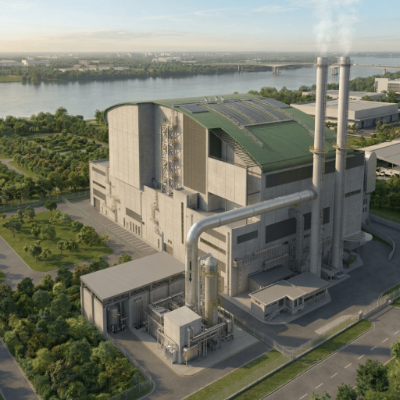
Representation of the Energy-from-Waste (WtE) plant, a project by Cora Environment in partnership with A*STAR in Singapore, via coraenv.co
The technology, known as Carbonated Incineration Bottom Ash (C-Ash), combines treated incineration bottom ash with captured carbon dioxide through a mineralisation process. By incorporating CO₂ into mineral compounds, the process produces a stable material that could potentially be used in construction, land reclamation and coastal protection.
The project investigates whether two industrial waste streams can become a source of construction materials, connecting resource recovery with the development of lower-carbon building products.
Cora Environment and A*STAR’s Institute of Sustainability for Chemicals, Energy and Environment will develop and operate the facility, which is designed to process up to one tonne of incineration bottom ash per day.
The technology has already undergone laboratory testing and independent validation. During its initial phase, the research team demonstrated the processing of incineration ash and an integrated carbon capture and mineralisation process using simulated industrial emissions.
The new pilot will investigate technical performance, operating requirements and commercial viability under conditions closer to those encountered in industrial production.
Unlike some carbon utilisation processes that require elevated temperatures and pressures, C-Ash operates under ambient conditions, potentially reducing the energy required for its production. Whether this translates into competitive environmental and economic performance will be examined as the technology progresses.
The collaboration also involves JTC, Singapore’s public industrial infrastructure agency, which has expressed interest in exploring potential applications for C-Ash within its own developments.
This connection between research, manufacturing and a potential institutional user is significant. New construction materials need more than successful laboratory results to enter the building market. They must demonstrate consistent performance, meet technical standards and establish reliable production and supply processes.
For architectural practices, the initiative offers an early view of how industrial partnerships could influence future material specifications and expand the sources of construction products.
The project also highlights the changing role of industrial districts as places where environmental technologies are tested and developed. Jurong Island already accommodates research and infrastructure associated with Singapore’s transition towards lower-carbon industrial activity, providing a setting in which new processes can be evaluated alongside existing operations.
Supported by Singapore’s Low Carbon Energy Research Scale-up Grant, the C-Ash initiative remains at the pilot-development stage. No commercial construction application has yet been confirmed, and broader adoption will depend on the results of industrial testing and subsequent technical approval.
Nevertheless, the project introduces a relevant direction for the construction industry: building materials may increasingly originate from partnerships between waste-management operators, industrial researchers and property developers rather than conventional material manufacturers alone.
Further Information
Cora Environment – Partnership with A*STAR to develop C-Ash technology
JTC – Cora Environment advances resource recovery through public-private partnership
 English
 Spanish
 Portuguese
 French
 German
 Italian
 Japanese
 Arabic
 Chinese