


通过
India’s Toda community develops cultural centre inspired by ancestral building traditions
A community-led project in the Nilgiris Hills combines traditional barrel-vaulted architecture, regenerative materials and shared cultural spaces to preserve Toda construction knowledge and support local activities
An Indigenous community in the Nilgiris Hills of southern India is working with architects and local authorities to develop a new cultural centre inspired by the traditional buildings of the Toda people. Located in Bekkapathi Mund, near Ooty in Tamil Nadu, the project reinterprets the community’s distinctive barrel-vaulted architecture while introducing facilities for education, cultural activities and collective gatherings.
Designed with Manasaram Architects and the Centre for Green Building Materials and Technology, the initiative began development in 2025 and remains under construction. It has been organised with the involvement of Toda community members, whose traditional knowledge and cultural practices inform the building’s architectural approach.

Toda Community Center in Bekkapathi Mund, Nilgiris, via manasaramarchitects.com
The Toda are an Indigenous pastoral community historically associated with the grasslands and forests of the Nilgiris. Their traditional settlements, known as munds, consist of small groups of buildings closely connected to their environment and social organisation.
One of the community’s most recognisable architectural traditions is the arsh, a compact barrel-vaulted structure traditionally built using natural materials. Its curved roof, low entrance and carefully arranged interior respond to local climatic conditions and cultural practices.
In recent decades, these buildings have become less common as conventional construction methods and materials have gradually replaced traditional techniques. Restrictions on access to forest resources have also affected the availability of materials historically used by the community.
The new cultural centre seeks to keep Toda architectural knowledge in active use, adapting traditional construction methods to contemporary needs rather than preserving them only as historical references.
The project draws on the proportions and curved profile of traditional Toda structures, translating their architectural language into a larger communal building capable of accommodating different activities.
Its construction incorporates locally available bamboo, mud and natural fibres, alongside techniques intended to reduce the environmental impact of the building. The structural system includes bamboo rafters and purlins, with bamboo-based composite materials proposed for the vaulted roof.
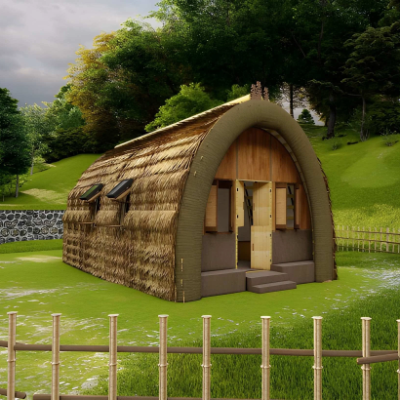
Toda 2.0: Housing Prototype, via manasaramarchitects.com
The architects have also developed the design around natural ventilation, daylight and thermal comfort. Small insulated openings are intended to regulate the interior environment, while the building’s form maintains a relationship with the traditional architecture of the surrounding settlements.
The materials and construction systems are being considered in relation to maintenance and local availability, with the intention of making the building practical for long-term community use.
Beyond its architectural form, the cultural centre will accommodate rituals, gatherings, craft workshops, educational programmes and other collective activities.
The project also aims to support the transmission of Toda language, oral histories, traditional embroidery and cultural practices between generations.
These activities are important to the building’s purpose. Rather than operating exclusively as a museum or exhibition space, the centre is intended to function as part of everyday community life.
Its programme includes opportunities for skills training and community-led enterprises, potentially connecting cultural preservation with economic activities such as craft production and educational visits.
Community participation has been incorporated into the development process, with the building’s organisation and intended activities informed by existing Toda institutions and traditional leadership.
The architectural team describes its role as supporting this process through technical expertise, material research and the adaptation of established building practices.
A related initiative, Toda 2.0 – A Collective Return to Heritage, is also exploring how traditional Toda houses could be adapted using regenerative materials and modern sanitation and energy systems.

Housing Prototype, via manasaramarchitects.com
That housing research addresses a connected challenge: how to maintain traditional residential forms while providing the infrastructure and comfort expected in contemporary homes.
The work involves architect Neelam Manjunath and the Centre for Green Building Materials and Technology, with an emphasis on community training, renewable materials and the possibility of enabling residents to participate directly in construction.
The cultural centre itself is being developed through cooperation with the Nilgiris district administration, with the Tamil Nadu Public Works Department identified as the contractor.
The project remains in progress, and its final completion date has not been confirmed in the available architectural documentation.
By combining ancestral construction techniques with cultural programming and contemporary building requirements, the project demonstrates how architecture can support the continuity of Indigenous knowledge through everyday use.
For architectural practice, the Toda Community Centre offers an example of collaboration in which local building traditions inform both the design process and the programme of a public facility. Its development raises wider questions about the role of architects in supporting cultural autonomy, material knowledge and community-led construction without replacing the expertise already present within a community.
更多信息
Manasaram Architects – Toda Community Centre, project documentation and architectural details
Architecture in Development – Toda 2.0: A Collective Return to Heritage
Architecture in Development – Toda 2.0 project progress and updates
 English
 Spanish
 Portuguese
 French
 German
 Italian
 Japanese
 Arabic
 Chinese