


What do we know so far about the UK Government’s New Towns proposals?
Beedier reviews the UK government’s ambitious new towns pledge, weighing bold promises against political fragility, financial hurdles, and uncertain design leadership in a generational housing experiment
When the Labour government pledged in its 2024 manifesto to deliver 1.5 million homes in five years, one phrase stood out: “a commitment to build a new generation of new towns”. Ministers framed them as settlements of at least 10,000 homes each, designed to be sustainable, well-connected, and supplied with infrastructure from day one. The language deliberately evoked the optimism of the post-war new towns programme, when places like Stevenage and Milton Keynes were created under the New Towns Act 1946.
The message was clear. This was not to be another cycle of incremental planning reforms or piecemeal developments. It was pitched as a national mission, both practical and symbolic: housing as a visible legacy.
Following the election, the government began putting flesh on the bones of the pledge. A Policy Statement on New Towns, published in July 2024, laid out the broad principles: scale, stewardship, early infrastructure, and an openness to both standalone towns and major urban extensions.
In September, the New Towns Taskforce was established, chaired by Sir Michael Lyons and Dame Kate Barker. The Taskforce includes economists, planners and designers, among them Wei Yang, past president of the RTPI. Its role is to advise on site selection, governance, and delivery models.
By February 2025, the Taskforce had published Building New Towns for the Future, reporting that more than 100 proposals had been received through a national call for evidence. The call invited submissions from councils, developers, landowners and consortia. But the report revealed that most were not truly new towns in the classic sense, but large-scale extensions to existing settlements.
Who Has Put Sites Forward?
Some of those submissions have since become public. In Essex, Rochford and Southend-on-Sea submitted a joint expression of interest in late 2024. By the summer of 2025, Rochford had withdrawn amid political opposition, leaving Southend exposed. Colchester City Council initially submitted a proposal around Marks Tey but pulled out in August 2025. Brentwood, Basildon, Thurrock and Essex County Council lodged a joint bid for a site near West Horndon. In Gloucestershire, Tewkesbury confirmed it had put forward a proposal tied to its Garden Communities agenda.
These disclosures show how fragile the programme already is. Even before sites are shortlisted, councils are retreating under local pressure, exposing the political risks that surround any attempt to deliver large-scale housing. And little is known at this stage about the commercial proposals on the shortlist.
What the Experts Are Saying
 The RIBA has welcomed the ambition but issued a stark warning. In its statement on the Taskforce’s report, RIBA argued that government must involve architects from the earliest stages. Without design leadership, it said, “the mistakes of the past – poorly connected, identikit housing estates – risk being repeated”
“For RIBA, new towns must not be reduced to numbers but should set new standards for sustainable, well-designed living.”
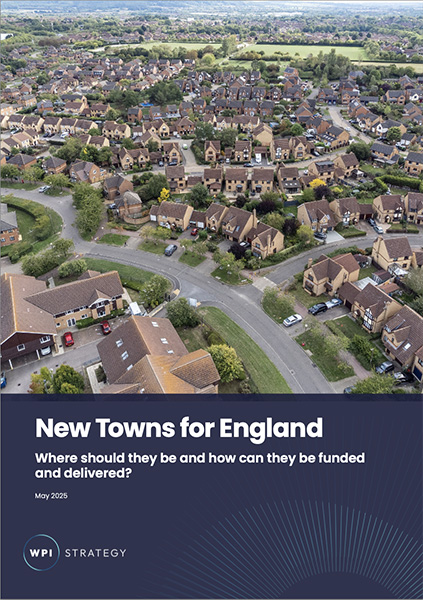
WPI’s New Towns for England report argued that delivery will fail without bold state leadership. “The history of the new towns is that they worked when the state was bold enough to lead,” it noted. The report called for Development Corporations with the ability to assemble land and capture land value uplift for reinvestment. Without such models, WPI warned, new towns risk becoming little more than speculative developer-led sprawl.
The Royal Institution of Chartered Surveyors brought the debate back to cold financial reality. In its viability report, RICS set out “Four Tests of Viability” – economic, delivery, infrastructure and investment – and warned that each site must pass them before moving forward. The report observed that “new towns themselves will contribute very little to the current government’s 1.5 million homes target within its term” because of long lead-in times
It also noted that without significant public investment, private lenders’ demand for high returns could prevent projects from stacking up financially, with payback periods stretching half a century
A report from the Community Land Trust Network and Community Led Housing offered a different lens. It argued that unless communities are given a direct role in shaping and stewarding new towns, through models like community land trusts and co-ops, the opportunity to lock in long-term affordability will be lost. Without this, the report warned, new towns risk becoming “dormitory suburbs” rather than genuine communities.
What will these new towns look like?
This is anyone’s guess, as the proposal thus far have been constructed by the planners, politicians, and financiers.
Of course, Poundbury, on Duchy of Cornwall land outside Dorchester, is often invoked by ministers and commentators as a model. It embodies King Charles’s vision: traditional architecture, mixed uses, walkability, and 35% affordable housing, and it would be surprising if the monarch does not get involved in some way as the plans profress. The government has even used visits to Nansledan (Poundbury’s sister development in Cornwall) to talk about the ethos of new towns. But Poundbury is unusual. It sits on Duchy land, free from the fragmented ownerships and politics that will complicate most new town sites. It is delivered slowly, with a high degree of design control, something not easily compatible with government pressure to scale rapidly. Replicating “ten Poundburys” is unlikely; what we may see are nods to Poundbury’s principles – design codes, walkability, a mix of uses – rather than full replicas.
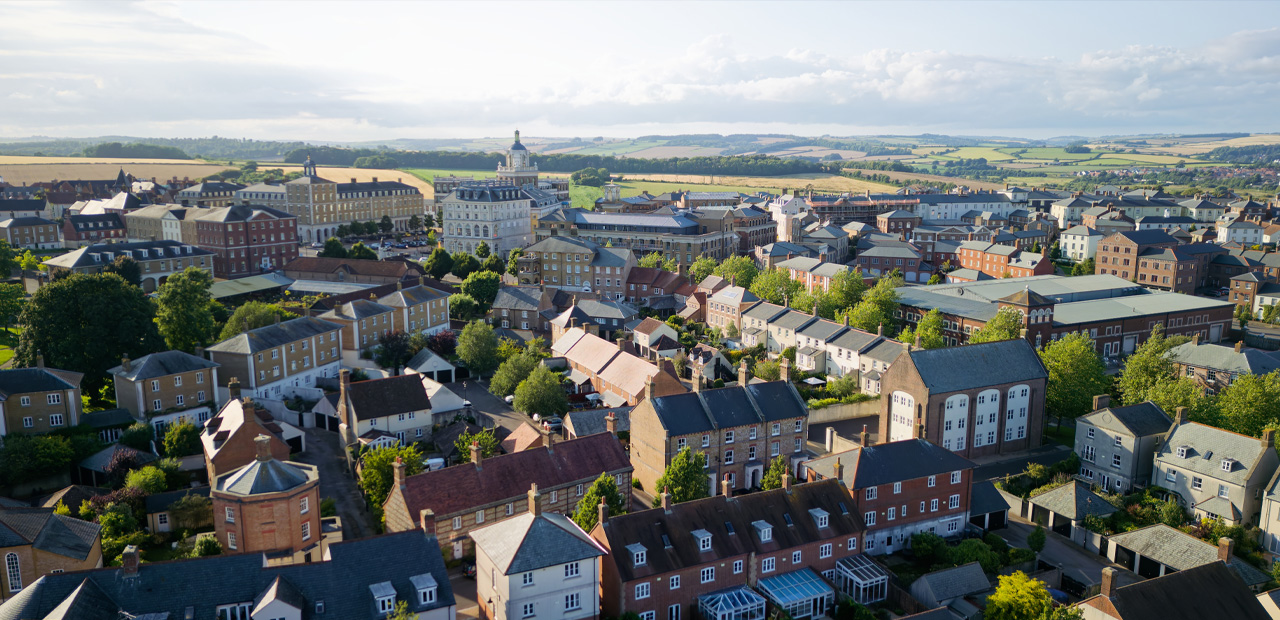
Poundbury, Dorchester | Shutterstock, Raddss (2614430239)
In comparison, the “eco-town” wave of the late 2000s, promoted by Gordon Brown’s government, provides another touchstone. Most failed, but a few sustainable neighbourhoods emerged. Around Cambridge, projects such as Accordia (a Stirling Prize winner) and Knights Park demonstrate how design-led, high-density, sustainable housing can succeed within a strong planning framework. These schemes emphasise modern architecture, integration with existing urban form, and cutting-edge sustainability standards.
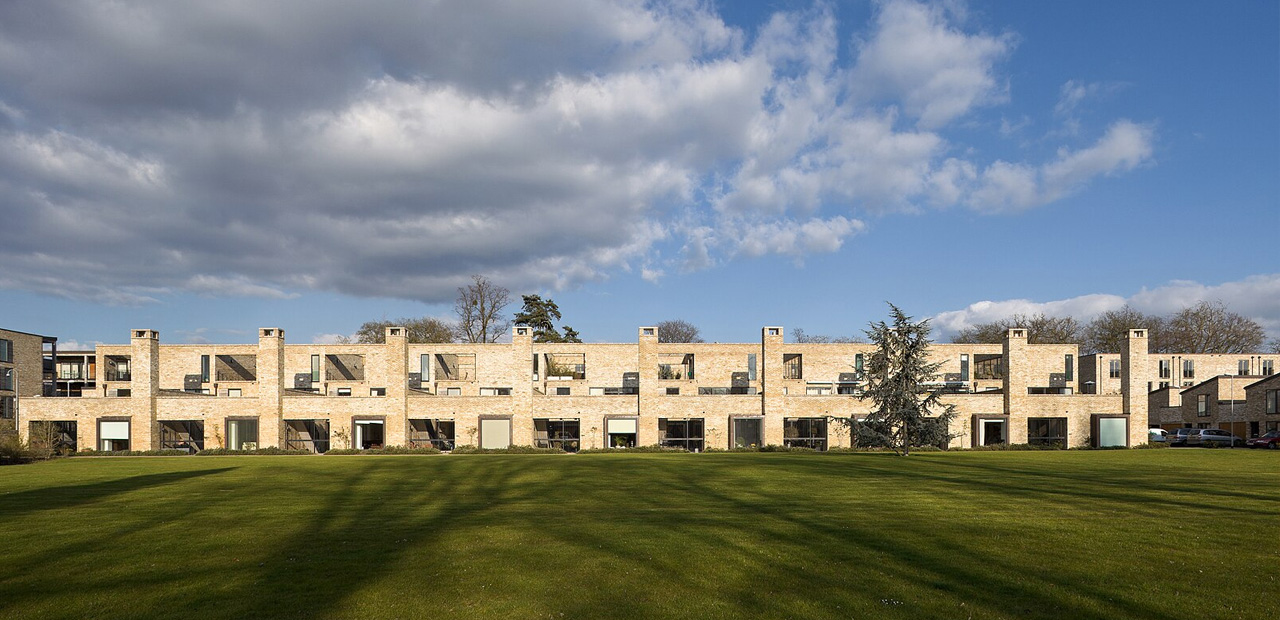
Accordia, Cambridge | Tim Crocker, CC BY-SA 4.0, via Wikimedia Commons
The question is whether the current programme will embrace this “eco-town” ethos – low-carbon construction, energy efficiency, integrated transport – or lean more on traditional aesthetics (Poundbury-style) to win public support. RICS has already flagged that new towns offer an opportunity to “apply innovative, low-carbon build technologies” at scale, suggesting that sustainability may be a necessary baseline.
The government’s own documents stress flexibility: new towns may not mean single typologies but a portfolio of approaches, from Poundbury-style traditionalism to high-density eco-neighbourhoods, depending on local context. But unless governance and funding are bold, the likeliest outcome is urban extensions packaged in the language of new towns.
The Timeline Problem
The programme’s timeline underlines the tension between political ambition and delivery reality. The call for evidence ran in late 2024; the Taskforce’s interim report followed in February 2025. A shortlist of sites is expected by the end of 2025. But the actual construction horizon is far longer. Even under optimistic assumptions, land assembly, planning, and infrastructure work will take years. First homes are unlikely to be occupied until the early 2030s. That means the new towns will contribute little to the 1.5 million homes target promised for this Parliament.
This inbuilt fragility is not just technical, it is political. The government is trailing badly in opinion polls and its recent party conference was widely seen as lacklustre. There is a real possibility that it will not be in office by 2029, long before the first bricks are laid in any new town. That raises a stark question: what happens if a new government takes over? Without bipartisan consensus, the risk is that the whole programme is paused, reshaped or abandoned. RICS has already noted that these projects demand patience over decades, not electoral cycles:
WPI insists that only a bold state-led model can endure shifts in government. And community organisations warn that without trust and legitimacy at the grassroots, local resistance will only deepen.
The danger is clear. The new towns agenda may be remembered less for the communities it creates than for the gap it exposes between rhetoric and reality. Unless ministers can secure cross-party support, put in place robust delivery vehicles, and commit to funding and design quality, the promise risks becoming another casualty of Britain’s turbulent housing politics: bold in vision, fragile in execution, and fatally vulnerable to electoral change.
While the government’s new towns programme is both ambitious and welcome. It signals a willingness to think at scale and to revisit the big ideas of post-war planning. Yet the truth is that this is not a single-term initiative. With long lead times for land, infrastructure, and governance, it is the sort of project that requires the stability of two or three governments in succession to see through.
The financial hurdles are severe. Reports from RICS and others underline that without significant public investment and new models of land value capture, many schemes will struggle to reach viability. At the same time, opportunities for meaningful architectural involvement appear limited so far. Most of the work to date has been led by planners, economists and policy advisers, with architects often confined to commentary rather than embedded decision-making.
And yet, there is hope. The conversation around new towns has reawakened a national appetite for thinking beyond the next housing estate. If the government can lock in cross-party consensus, commit to the necessary investment, and invite genuine design leadership, these projects could still deliver the sort of places we might one day be proud to call our new generation of towns. Until then, all we can do is watch closely as the story develops.
This article was researched, and written by Beedier’s editor, Robert Woodburn Park.
 English
  Spanish
  Portuguese
  French
  German
  Italian
  Japanese
  Arabic
  Chinese