


RIBA Regional Awards 2025: the stats and insights
As the 2025 edition of the RIBA Regional Awards draws to a close at the end of May, we now have a fresh set of architectural projects of excellence to analyse and review
This year’s awards saw a total of 116 Regional Award winners, from 204 shortlisted projects, and across all 12 RIBA regions and their equivalent bodies (RIAS in Scotland, RSUA in Northern Ireland, RSAW in Wales), with dozens of projects also receiving Special Awards for sustainability, conservation, and design excellence.
While we have not direct statistics of how many applications were made, in past years this has been anything between 700 and 1000 applications – so simply being shortlisted is a great achievement. Below is a breakdown of the data and trends from this year’s winners.
Studio performances: familiar names dominate, fresh voices emerge
Among the 2025 RIBA Regional Award winners, several architectural practices once again demonstrated their consistency at the top of the profession. Not unexpectedly, Allford Hall Monaghan Morris and Hawkins\Brown emerged as this year’s top-performing studios, each taking home three awards. Both are perennial fixtures on RIBA’s awards circuit over the past five years, as can bee seen in the chart below.
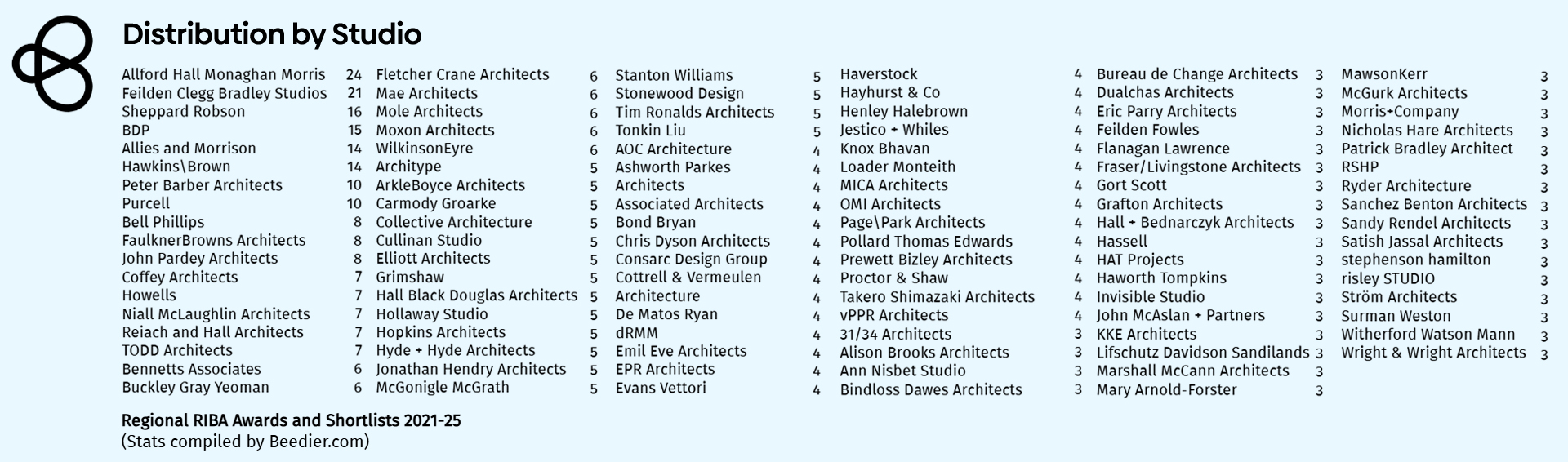
Trailing just behind are ten studios that each notched up two awards. These include: Archio, ArkleBoyce, BDP, Cullinan Studio, Feilden Clegg Bradley Studios, Howells, Pricegore, Sheppard Robson, and Stanton Williams. For ArkleBoyce, this marks a notable milestone – their fourth Regional Award since 2021, solidifying their growing national stature.
Hey scenesters!
A name on the rise is London based Takero Shimazaki Architects, with four Awards over the past three years, a trajectory that positions them as one of the most watched new practices heading into future award cycles. Last year the studio won a National Award for their Royal Academy of Dance project, and this year set to repeat the accolade with a Regional Award for Niwa House, a Japanese inspired residence in South London for a young family.
Another maturing studio that have received five awards since 2021 are Corsham based Stonewood Design in the west country. The Story of Emily Museum, which celebrates the life of humanitarian Emily Hobhouse, who campaigned against the UK’s use of concentration camps in the Boer War, also looks like a strong contender for a National Award.
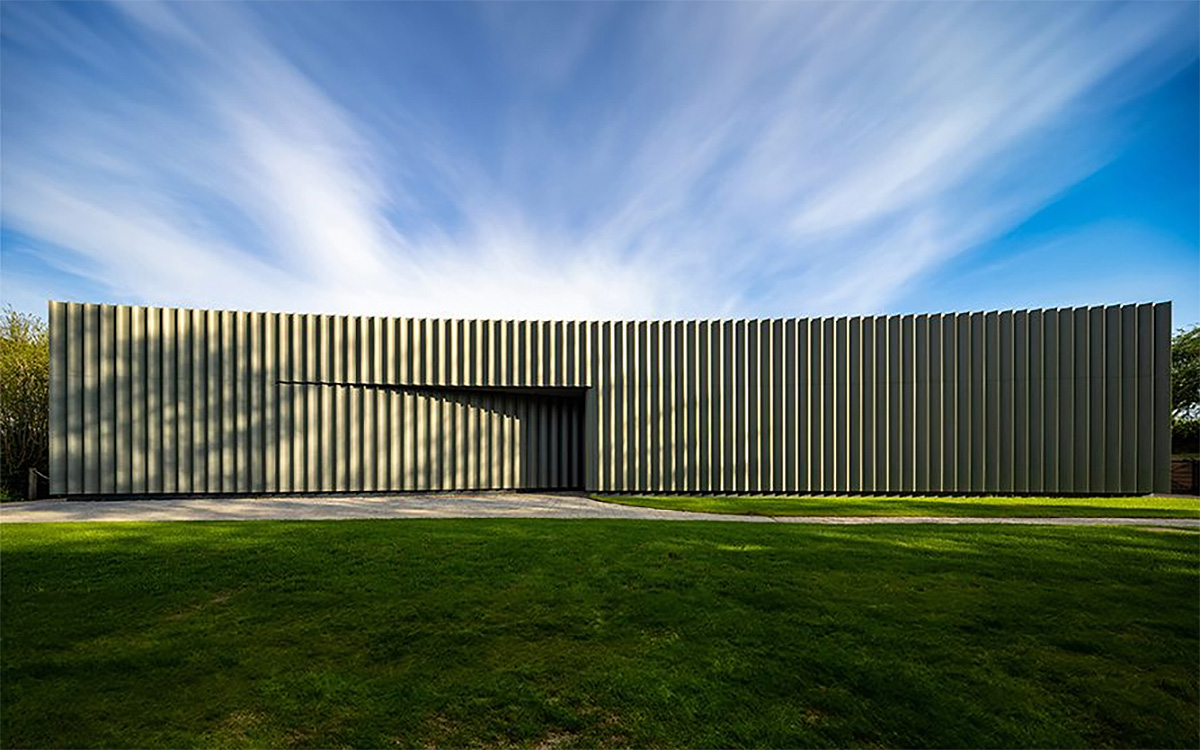
Story of Emily Museum | Stonewood Architects / Photography by Craig Auckland @fotohaus
New names on the RIBA stage
One of the more compelling stories of this year’s awards is the impressive number of first-time winners. The 2025 edition has expanded the map of emerging talent, welcoming fresh voices such as: Artefact, Ashton Architecture and Rebecca Milton Architect, AWW, Brisco Loran and Arrant Industries, EDable Architecture, Elphick Associates, Forgeworks Architects, Grafted, GRAS, Izat Arundell, Manalo & White, MLA, Poulson Architecture, Quinn Architects, and rak architecture.
Southampton based SNUG Architects won their first RIBA Regional Award for Hope Street an innovative project for the women’s trauma charity, One Small Thing – which also won the RIBA’s McEwen Award last year for “architecture for the common good”. They were previously shortlisted in 2017 for the Woodlands retirement living project in Poole.
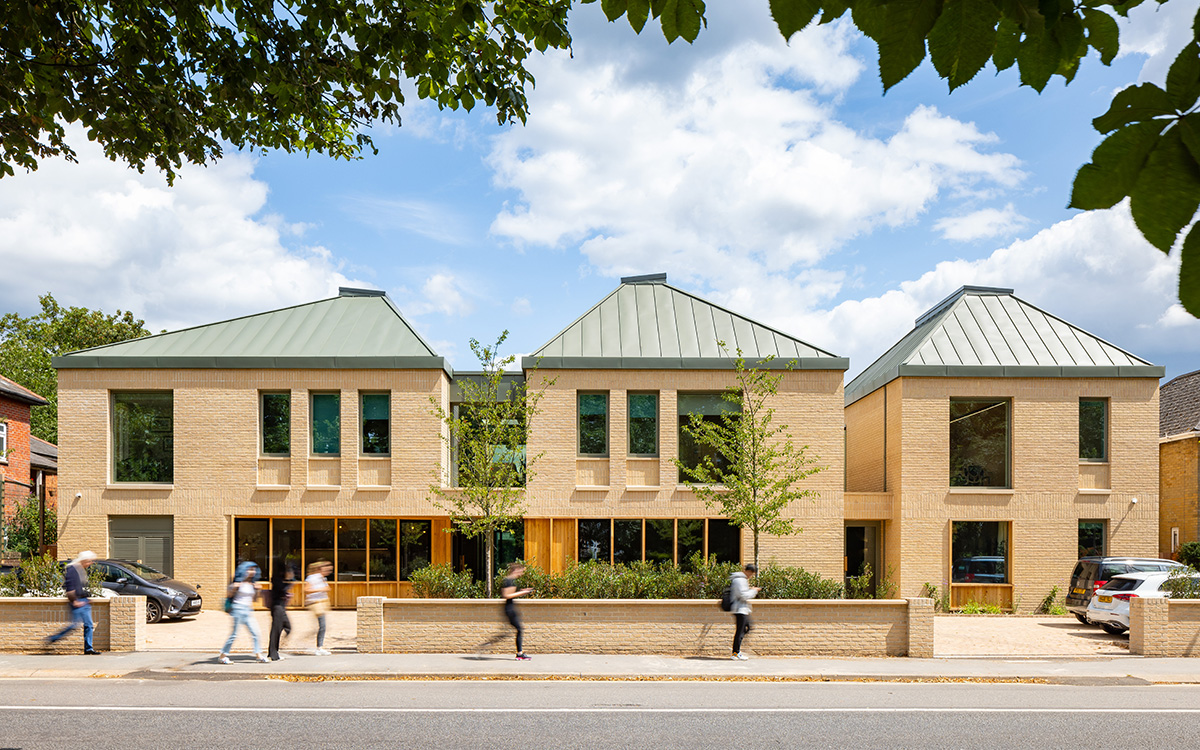
Hope Street | Snug Architects / Photography by fotohaus
SIRS Architects achieve their first award this year for the Gilbert and George Centre, a project that had been shortlisted in 2024, however the judges visit was deferred to 2025, since the gallery was in-between shows – so after another year of waiting patiently, the project has received its recognition.
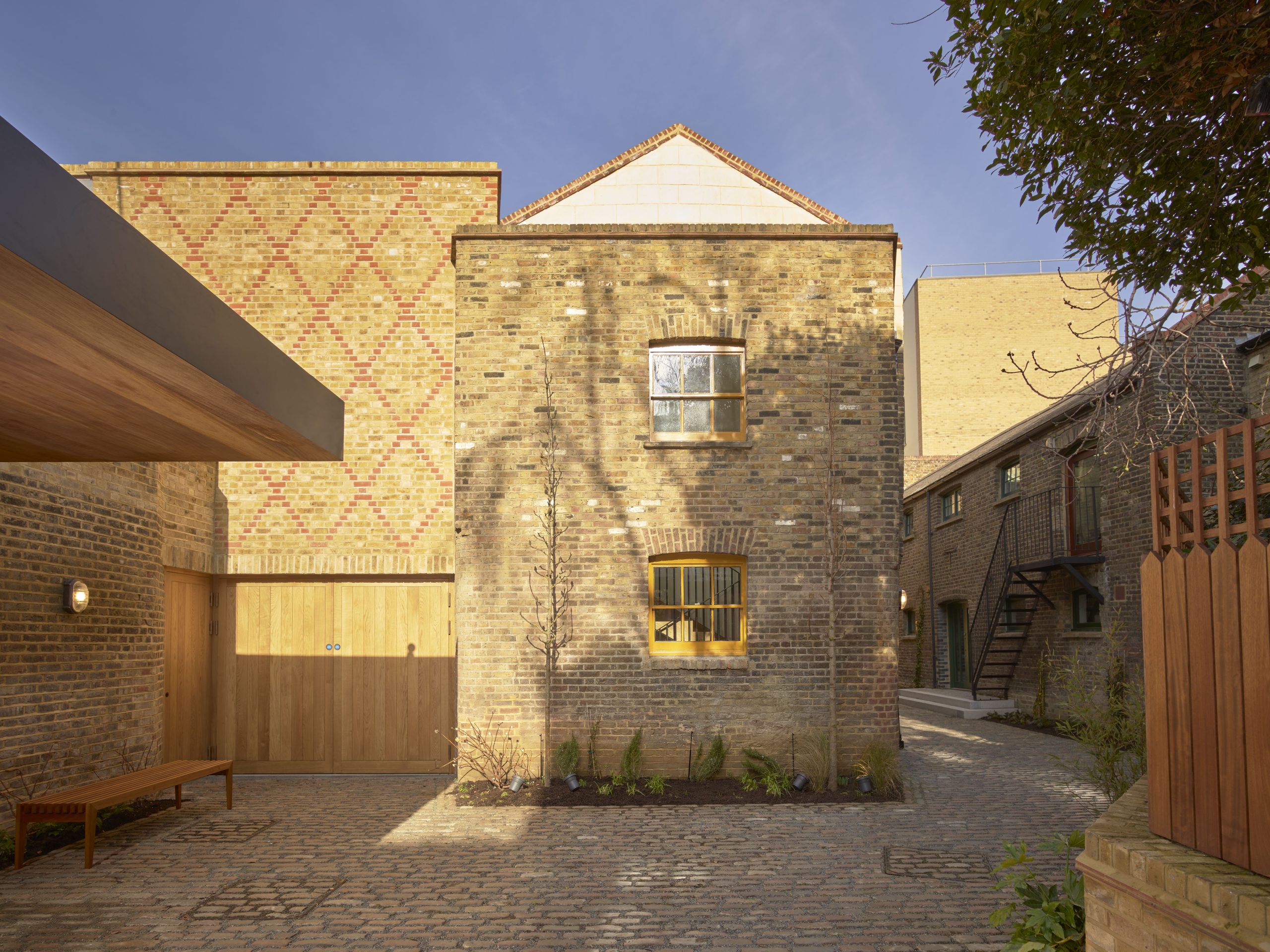
The Gilbert & George Centre | Photo by Prudence Cuming © The Gilbert & George Centre
Collaboration nation
Several first time winners achieved the honour through collaboration with more established studios, including 10 Architect and ECE Westworks alongside Cullinan Studio on two different projects, Gibson Thornley with Purcell, and Space Architects with Elliot Architects. And there was also success for collaborations on smaller projects between up-and-coming studios: Poulsom/Middlehurst, Yard Architects and New Makers Bureau all picked up awards for their joint project at Blenheim Grove in Peckham, a development of five new build houses on vacant infill site. These award winning projects underline how cross-studio partnerships are shaping the future of architectural success.
Shortlisted but unlucky
Every awards cycle has its disappointments, and for Bell Phillips, 2025 was a year of near misses. Despite having two lovely residential projects shortlisted, the studio left empty-handed – a reminder of just how competitive and fine-grained the selection process can be. We would definitely suggest resubmitting next year, as they are both strong projects. Likewise, newcomers Cooke Fawcett Architects had two shortlisted projects, including Cockpit Arts in Deptford, a vibrant retrofit of a 1960’s council building into a centre for arts and making – either of which could, and probably should have given them their first RIBA Regional Award – but not this year.
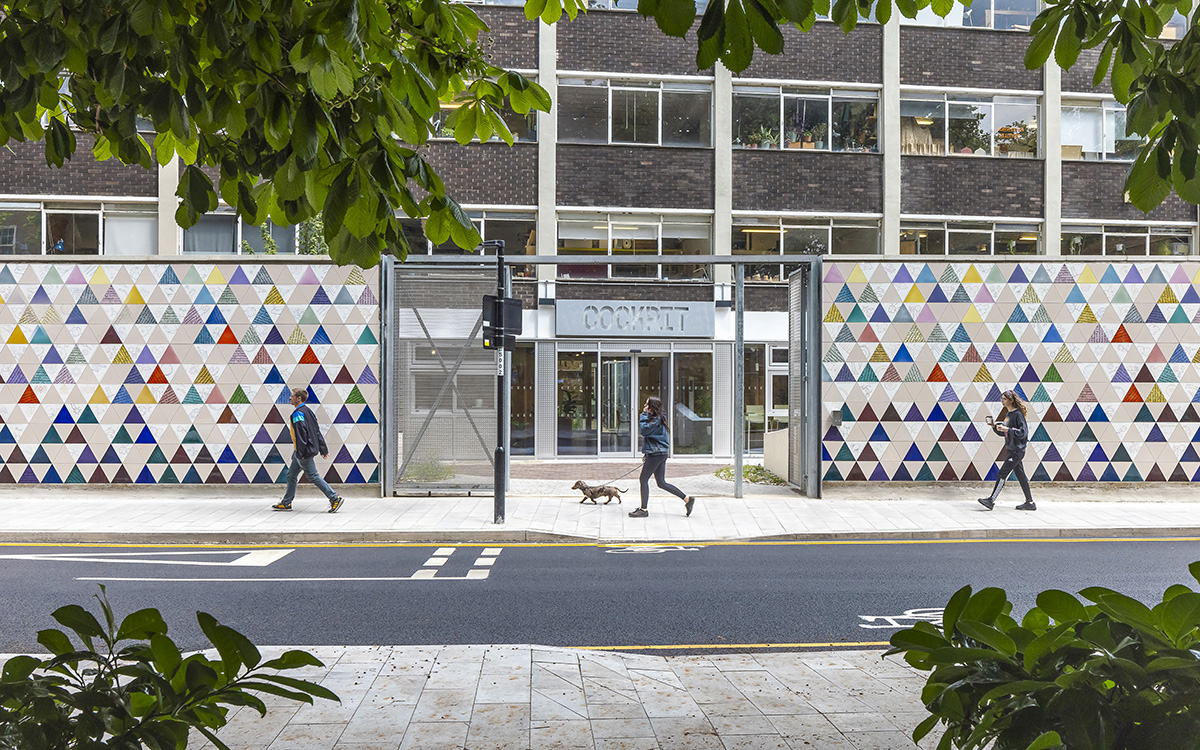
Cockpit Arts Deptford | Cooke Fawcett Architects / Peter Landers Photography
The Stirling horizon: international stars in waiting?
This year’s regional winners include two global heavyweights: OMA and Herzog & de Meuron – architects of international renown whose rare entries into RIBA’s regional arena are already stirring speculation about the 2025 Stirling Prize shortlist. Their UK-based projects have now cleared the first hurdle, and given RIBA’s evolving openness to global perspectives on British soil, these selections may be strategic markers for higher honours to come. OMA’s Aviva Studios in Manchester is that rare thing in the UK – a major new cultural building that packs a punch, the result of an international design competition that was first launched in 2015. Likewise, Herzog & de Meuron’s Discovery Centre for Astrazenica in Cambridge – delivered with BDP as executive architect – is a showpiece scientific research building of the kind that has won the Stirling in the past.
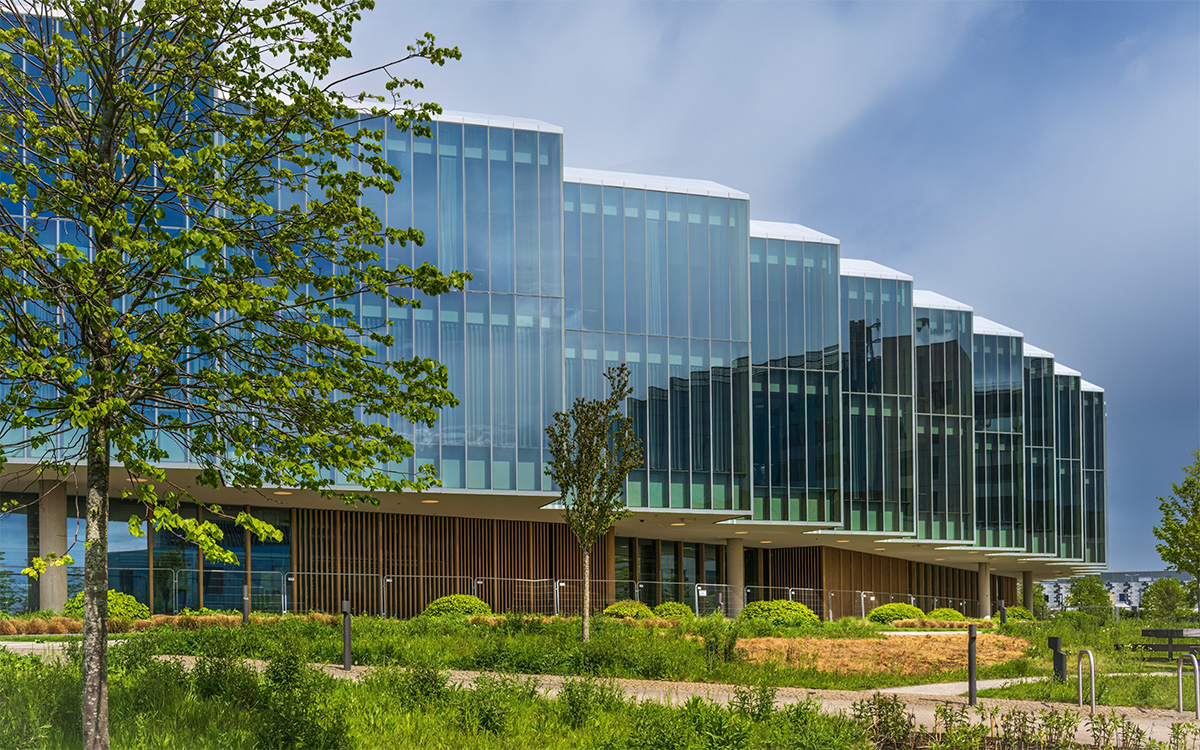
AstraZeneca’s Discovery Centre (DISC) | Herzog & de Meuron / Photography Gordon Bell, Shutterstock
As we move into our second year since launching Beedier, we now have a solid two-year data set on RIBA Awards shortlisted and Regional Award-winning projects – so let’s dive into what the numbers reveal.
Context and place: a Consistent picture
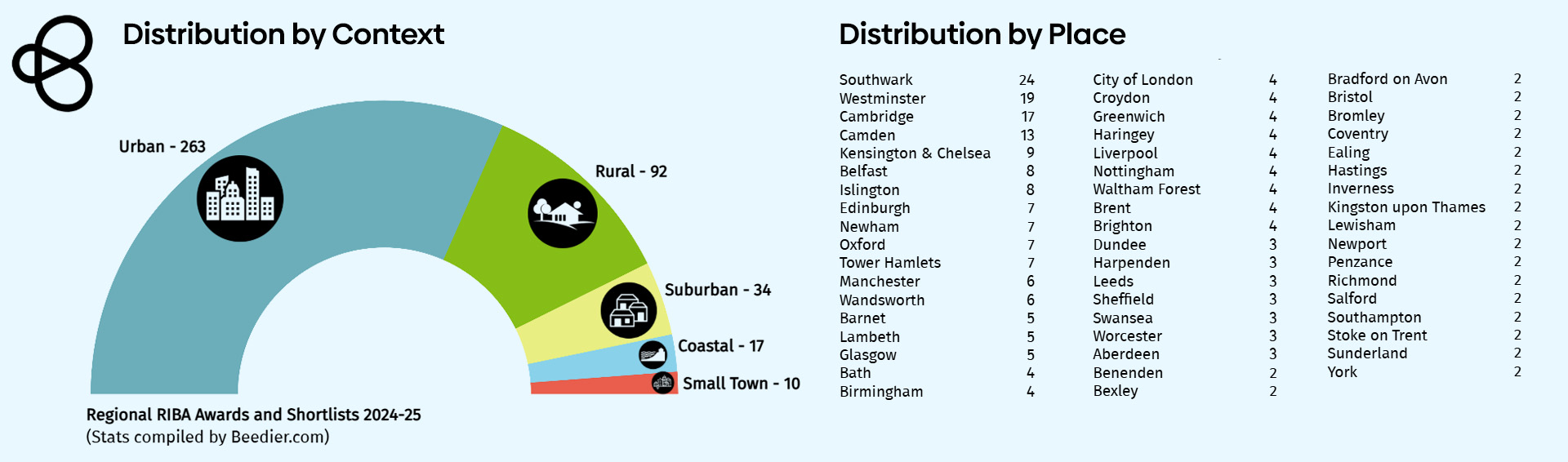
Urban settings continue to dominate the shortlist, accounting for 64% of projects this year – almost identical to last year’s 63%. Rural projects also held steady at 22%, down just a single point from 23% the year before. Suburban and coastal projects have seen minimal change too, fluctuating by less than 2%.
But there is one notable shift: inland small towns – defined as places with populations under 25,000 – have seen a marked drop in representation. This year, only two projects were shortlisted in such areas: one in Swanley, the other in Billingshurst, and neither picked up awards.
Considering that around 15% of the UK population lives in small towns such as these, this raises an important question: why is high-quality architecture so rarely commissioned in these communities?
Location hotspots: London still dominates
Of the top five locations for shortlisted buildings over the past two years, four are central London boroughs. The only non-London contender to break into the top tier is Cambridge, buoyed by its wealth of university, research, and housing-led projects.
Typology and scale: a subtle shift, with one notable absence
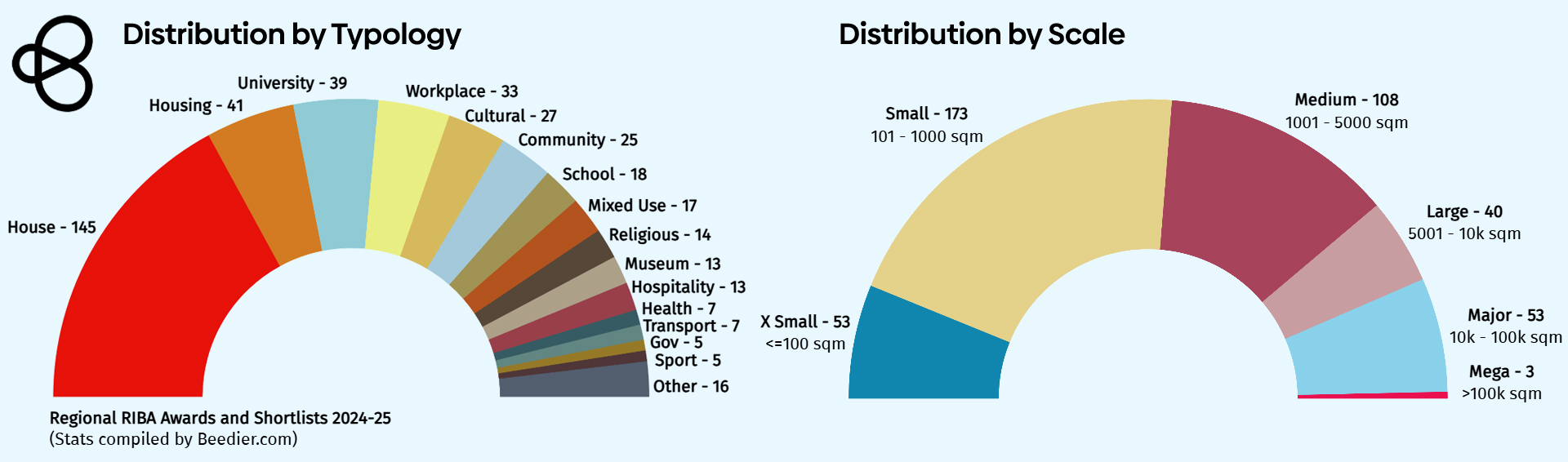
In terms of building typologies, the landscape hasn’t changed dramatically since last year – except in one area that stands out. Housing, once the second most-represented category after the individual house, has seen a significant drop in visibility.
Last year, multi-unit residential projects made a very strong showing on the shortlist. This year, just 16 housing projects made the cut, and only eleven went on to win Regional RIBA Awards including two in Cambridge and six in London.
While a handful of larger mixed-use schemes with residential components were recognised, the sharp drop in dedicated housing projects is hard to ignore. So, what’s going on?
One possibility is that quality housing design is struggling to break through in procurement models dominated by volume delivery and cost engineering, especially in the face of market pressures, planning delays, and the long tail of post-COVID disruption. Another is that truly design-led residential developments are increasingly tucked inside mixed-use frameworks, making it harder for them to stand alone in award considerations.
Either way, the numbers raise a question: where are the bold, beautiful housing schemes that respond to urgent national need – and why aren’t more of them being recognised?
Summary
Once again, the message couldn’t be clearer: if you’re aiming for a coveted RIBA Regional Award, your best bet is still to submit a small house in a central London borough. It’s a formula that continues to dominate the field: beautifully crafted, often highly bespoke domestic projects tucked into the historic or leafy fabric of Southwark, Camden, Islington, and beyond.
And while these projects are often outstanding in design and detail, we can’t help but wonder if this is truly a full reflection of the architectural energy across the UK?
There are promising signs of change. This year’s shortlist included some inspiring community-led initiatives, and intriguingly, a handful of industrial buildings – most of them distilleries, suggesting we might be entering a new golden age of beautifully designed booze production.
But there are also some glaring omissions. Over two years, just one scientific research building has made the shortlist, a surprising absence given the sector’s growing national importance in driving innovation, investment, and long-term economic resilience. As the UK looks to science and tech to power its future, we hope the architecture that houses this ambition receives the attention, and recognition, it deserves.
So here’s to a future where bold housing, science, and rural architecture stand shoulder-to-shoulder with the London townhouse, and where excellence isn’t just concentrated, but shared.
Look out for Beedier’s predictions for this year’s Stirling shortlist in a future article. Which will be the strong projects likely to make the cut for the most prestigious of architecture prizes this year?