


por Robert 2 Park
From monuments to memes in Brazil’s battle for power
Niemeyer’s Brasília gave government an enduring architectural identity. As Brazil votes, Beedier's editor Robert Woodburn Park considers how social platforms have become a contested medium for political image-making - with consequences for democracy, sovereignty and everyday lives
An architect’s studio once provided many prospective clients with their first impression of a practice. The building, interior and working environment communicated its priorities. Increasingly, that encounter moved to the website and then the social feed. Each medium shapes expectations before a conversation begins.
Political authority has undergone a related expansion of its communications. Government buildings establish an institutional identity. Photographs, television and social platforms distribute it. A presidential appearance becomes a broadcast, a campaign clip, a meme. The setting lends authority to the politician; the accompanying message can reinforce or challenge what the institution represents.

Ministries Esplanade
In Brasília, that relationship is particularly visible. Looking along the Ministries Esplanade towards Congress, the administration of a country becomes an architectural composition. Repeated ministry buildings line an extensive central lawn. Beyond them, Congress’s paired towers and contrasting domes establish a recognisable destination. Lúcio Costa planned the arrangement; Oscar Niemeyer designed the buildings.
I photographed many of these buildings when visiting Brasília a few years ago. Returning to those images before Brazil’s presidential runoff raises a question: who controls the meaning of these national symbols, and how closely does their message correspond with the power exercised inside?
On 25 October, Brazilians choose between President Luiz Inácio Lula da Silva and Senator Flávio Bolsonaro. Bolsonaro led the first round, but Datafolha’s poll published on 22 October places them level at 50% of valid votes.
A capital designed to communicate
Brasília was inaugurated on 21 April 1960 under elected president Juscelino Kubitschek. His promise of “fifty years in five” connected the capital with accelerated national development. Moving government from Rio de Janeiro to the central plateau would direct investment towards the interior and demonstrate Brazil’s capabilities. Architecture made that ambition visible.

National Congress | Congresso Nacional
Costa produced the winning urban plan in 1957. Niemeyer gave the principal public institutions their architectural identities. Their modernism projected technical invention and cultural confidence. UNESCO’s assessment explicitly connects Brasília with national development and international self-assertion.
The presidential residence, the Palácio da Alvorada, opened in June 1958. The Palácio do Planalto, the president’s workplace, opened on 21 April 1960, when the National Congress and the Supreme Federal Court also began operating in the new capital. The Palácio do Planalto, National Congress and Supreme Federal Court buildings together form the Praça dos Três Poderes – Three Powers Square.
The arrangement can be read as a spatial explanation of constitutional government. Executive, legislative and judicial authority occupy distinct buildings within a shared setting. Each has an individual identity; their relationship is visible.
Congress’s silhouette communicates parliamentary authority from a distance. The Planalto’s ceremonial ramp provides a setting for presidential arrivals and departures. Through repeated appearances, officeholders become associated with an architectural image that precedes them and will survive them.
Democracy, dictatorship and the buildings of government
The buildings preceded the military dictatorship of 1964–85. They belonged to the democratic period following the collapse of Getúlio Vargas’s Estado Novo dictatorship in 1945. Four years after Brasília opened, the military inherited its government precinct and restricted the institutions within it. Following Institutional Act Number Five in December 1968, Congress was closed for almost a year.

Palácio do Planalto | President’s workplace with icon entrance ramp
Washington’s involvement in the coup period is documented. On 31 March 1964, the US State Department authorised preparations to assist anti-government forces, including fuel deliveries, a naval task force and approximately 110 tonnes of ammunition and equipment assembled for possible shipment. The contingency operation was designated Brother Sam.
Niemeyer, a Communist Party member since 1945, opposed the regime and settled in Paris in 1967, although his architecture continued to represent the state. The Itamaraty Palace, headquarters of the foreign ministry, was officially inaugurated in 1970, during military rule. The buildings communicated modernity while serving an authoritarian government.
Civilian government returned in 1985 after 21 years of military rule. Three years later, Brazil’s new democratic constitution was formally adopted in the Congress building, the same parliament the dictatorship had repeatedly closed. Then fast foward to 8 January 2023, supporters of Jair Bolsonaro invaded Congress, the Planalto and the Supreme Court. They damaged buildings, artworks and historic objects. The occupation produced internationally circulated images of an assault on constitutional authority. Architecture became both a physical target and a medium of political communication.
Jair Bolsonaro subsequently received a sentence of 27 years and three months for offences connected with the wider attempted coup, including damage to protected heritage. He is serving his sentence under humanitarian house arrest. His son now seeks an electoral mandate to occupy the presidential workplace attacked by his father’s supporters.
Ballot numbers and viral videos
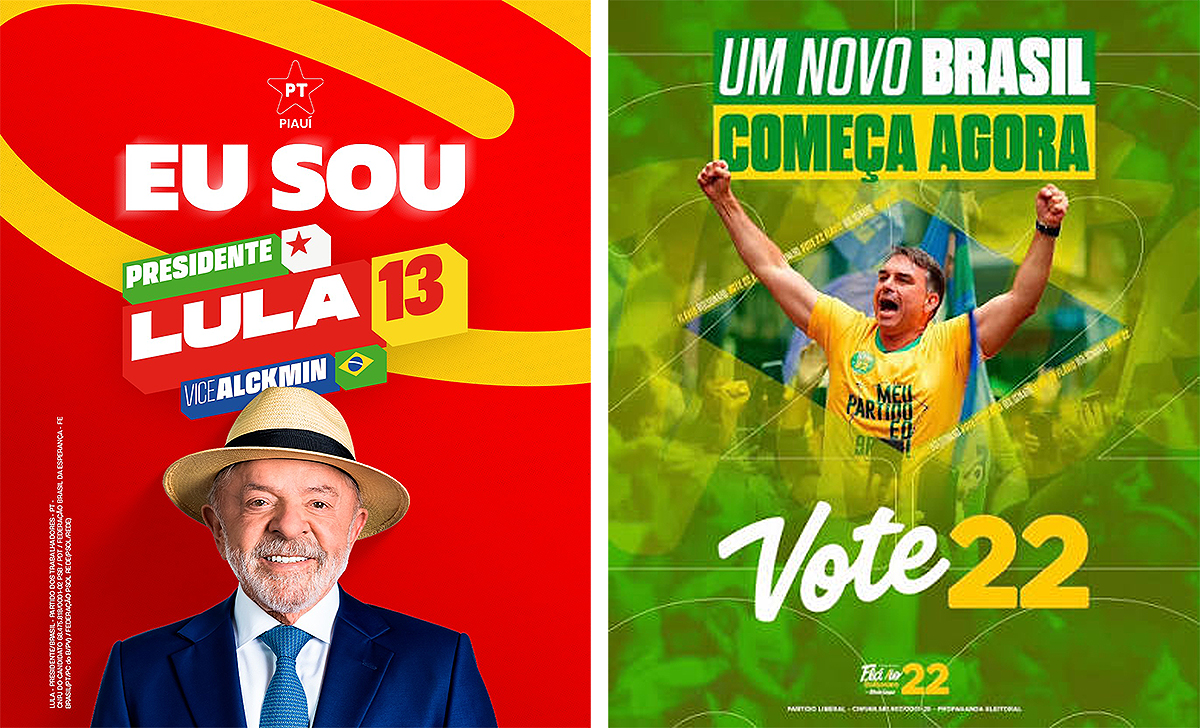 Brazil’s electoral system gives campaigns a ready-made visual identity. Voters select candidates by entering their numbers into an electronic voting machine: 13 for Lula, 22 for Flávio Bolsonaro, corresponding to their parties, PT and PL. Repeated in graphics, hashtags, stickers and videos, those digits identify a political allegiance and tell supporters how to vote.
Like Congress’s silhouette, the numbers work through immediate recognition. In social feeds, they accompany official campaign material, influencer endorsements and jokes. Debate clips isolate awkward phrases, gestures and confrontations; captions and music turn brief exchanges into repeatable political messages.
AI allows supporters and opponents to rewrite the performance altogether. “Lula Maromba Oficial” presents Lula as a gym instructor confronting “Inflávio”, a character with inflatable muscles. Flávio’s campaign launch featured an explicitly labelled AI simulation of Jair Bolsonaro; a subsequent parody made the former president urge people to vote for Lula. Other fabrications are more deceptive: fact-checkers identified synthetic videos falsely showing Flávio promising a R$3,000 minimum wage.
These formats compress political identities into recognisable, shareable content. They also make authenticity harder to establish. Who created a message, whether the candidate actually said it and why it appeared in someone’s feed become essential electoral questions.
Who controls political visibility?
The ballot numbers themselves became part of the dispute with Meta. Tests by fact-checking organisation Comprova found that Meta AI accepted image requests involving “Flávio” and his number while refusing comparable requests involving Lula. Later tests found the inconsistency had been corrected. Meta said it had tightened restrictions covering candidates’ first names and ballot numbers. Lula’s campaign also challenged restrictions affecting its accounts and advertising. The electoral court ordered equal treatment, backed by potential daily penalties reaching R$1 million for noncompliance. Meta denies favouritism and attributes the problems to technical failures.
The complaints extend beyond candidates. On 21 October, federal prosecutors recommended changes to Meta’s moderation following restrictions affecting student organisations, cultural groups, journalists and commentators. They called for clearer explanations and human review informed by Brazilian language and context.
Washington has made platform regulation a diplomatic issue too. Trump’s July 2025 executive order explicitly connected economic pressure on Brazil with Bolsonaro’s prosecution and judicial demands affecting American technology companies. Separate tariffs announced in July 2026 cited additional grounds, including digital trade, payments and market access.
Lula has challenged that pressure publicly. Responding to Trump’s tariff threats at the July 2025 BRICS summit, he said: “The world has changed. We don’t want an emperor.” The confrontation combines competing claims about sovereignty, free expression and commercial interests. It does not establish that Washington directed Meta’s treatment of the campaigns.
Brasília gives Brazilian institutions a recognisable public identity. Platforms influence how their actions are presented: a court order becomes electoral protection in one feed and censorship in another. In a polarised electorate, the struggle concerns both the exercise of power and the messages through which power and influence is communucated to its citizens.
Who benefits, and who bears the cost?
For Beedier, these questions have a personal dimension. Brazilian colleagues work alongside our UK team on research and editorial. Our integrated, diverse team includes LGBTQ+ Brazilians. There is genuine fear about rights, security and political retaliation under another Bolsonaro administration.

Supreme Federal Court | Supremo Tribunal Federal
The Supreme Court has supplied important protections, recognising same-sex stable unions in 2011 and applying anti-racism legislation to homophobic and transphobic conduct in 2019. Bolsonaro’s allies in the strengthened congressional right seek changes to the court, including the impeachment of Justice Alexandre de Moraes. Those objectives face constitutional procedures and voting requirements, but they give institutional independence an immediate human significance.
Environmental decisions are similarly concrete. Flávio’s reported programme proposes revising environmental agencies’ functions and allowing automatic authorisation where licensing officials fail to respond within a specified period. His opposition to new Indigenous land demarcations could stall 286 ongoing territorial processes, according to Folha.
INPE records 11,594 km² of deforestation in the Legal Amazon in 2022, compared with an estimated 3,335 km² for the monitoring year ending July 2026. Lula’s environmental record also contains contradictions, including support for further oil exploration. Both candidates’ development choices require scrutiny.
After the election, familiar images will return: a president on the Planalto ramp, Congress beneath its towers, judges inside the Supreme Court. These buildings have served democracy and dictatorship; their appearance tells us little about how power is exercised within them. As Brazil votes, the questions are whose interests its institutions serve and whether citizens can challenge their decisions. For our Brazilian colleagues, and many others, the answers affect their ability to live openly, work securely and trust that their rights will survive a change of government.
Robert Woodburn Park is Beedier’s founder and editor-at-large. He divides his time between São Paulo and London. Beedier’s British and Brazilian team includes researchers, writers and content creators.
 English
 Spanish
 Portuguese
 French
 German
 Italian
 Japanese
 Arabic
 Chinese