


Northern Metropolis: Hong Kong’s next decade of opportunity for architects
Arup and AtkinsRéalis have secured a major Northern Metropolis infrastructure commission, as Hong Kong advances a development programme spanning housing, technology, education and civic investment
Arup and AtkinsRéalis have been appointed by Hong Kong’s Civil Engineering and Development Department to design and deliver the remaining phase of Hung Shui Kiu/Ha Tsuen and the first phase of Lau Fau Shan, two of the more advanced districts within the Northern Metropolis.
The joint venture was already the incumbent consultant for both areas, but the new commission substantially extends its involvement. Its scope includes site formation and enabling works, transport infrastructure and public transport interchanges, pedestrian and cycling networks, utilities and provision for the planned Smart and Green Mass Transit System. It also covers the revitalisation of the Tin Shui Wai River, combining flood resilience and ecological improvements with new public realm.
The emphasis on infrastructure reflects the current stage of Northern Metropolis. Hong Kong is forming land, establishing transport connections and servicing development areas before much of the architecture that will eventually occupy them has been commissioned. Other major consultancies are already engaged elsewhere in the programme, particularly around San Tin Technopole.
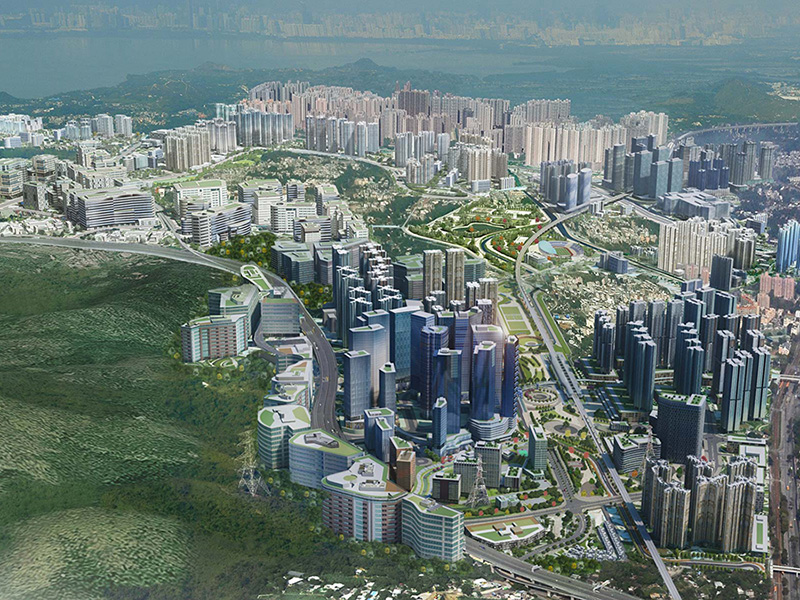
https://www.nm.gov.hk/
Why Hong Kong is looking north
Northern Metropolis was announced in 2021 as a response to several related challenges: Hong Kong’s shortage of land and housing, the need to broaden its economic base, and its evolving relationship with Shenzhen and mainland China.
The programme covers around 30,000 hectares across Yuen Long and the North District, which the government describes as around a third of Hong Kong by land area and planned population intake. This is not, however, a new city on an empty site. Around 980,000 people already live there, in established settlements including Yuen Long, Tin Shui Wai, Fanling and Sheung Shui, alongside rural communities and New Development Areas at different stages of implementation. Under current plans, the population could eventually reach 2.5 million, with more than 500,000 new homes and around 500,000 additional jobs.
Geography is central to the economic proposition. While Hong Kong’s traditional commercial centre developed around Victoria Harbour, Northern Metropolis faces Shenzhen, placing its future population and businesses alongside one of China’s principal technology economies.
The government describes a “South-North dual engine”, with finance and professional services in the south complemented by innovation, technology and advanced industry in the north.
The 2023 Action Agenda divides the territory into four zones covering Innovation and Technology; High-end Professional Services and Logistics; Boundary Commerce and Industry; and Blue and Green Recreation, Tourism and Conservation. The ambition is therefore broader than creating housing around a technology cluster. Universities, healthcare, government facilities, international schools, museums, performance venues, sports facilities and substantial new landscapes are also envisaged, providing the social and cultural infrastructure of a more complete metropolitan region.
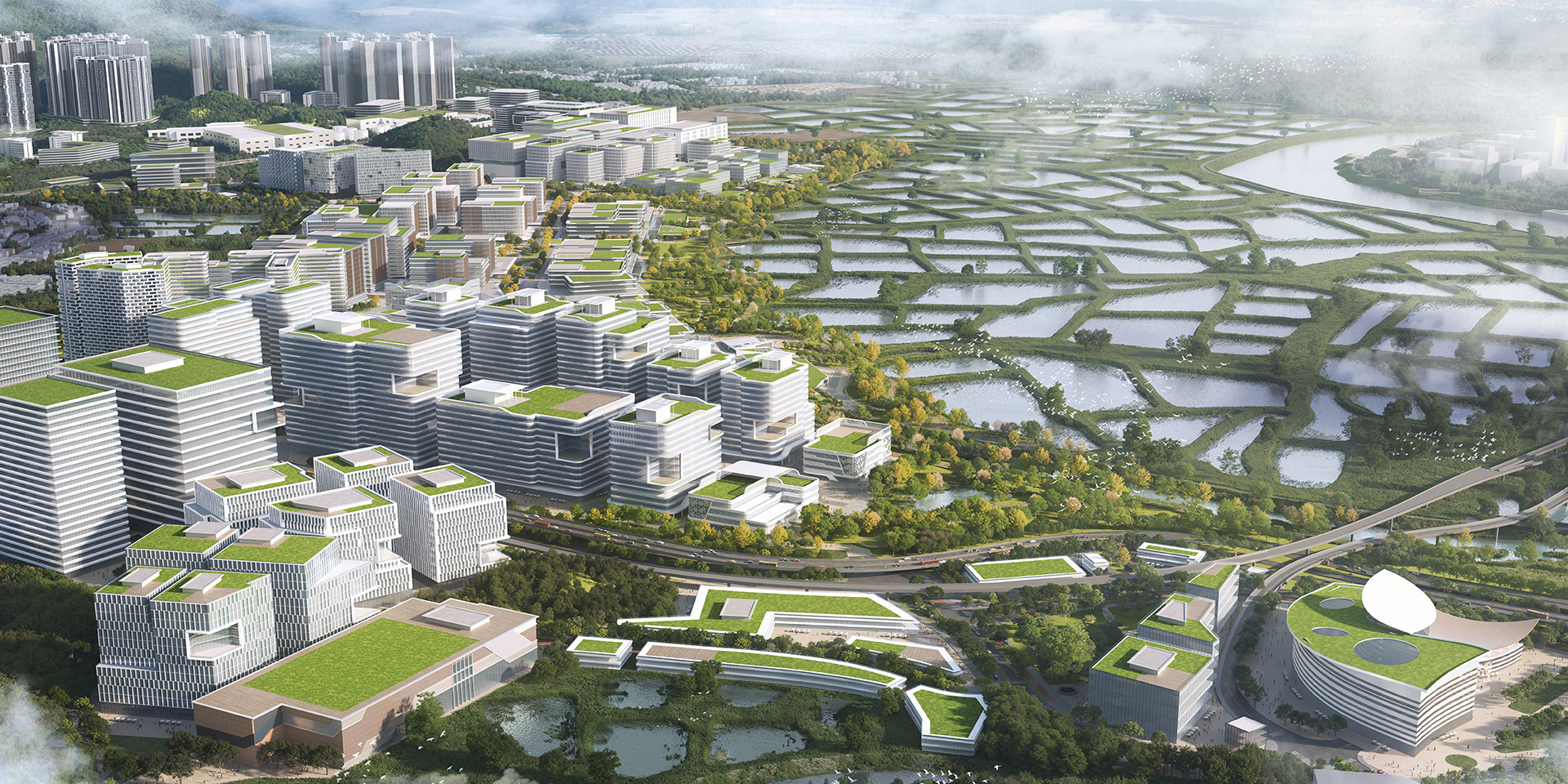
https://www.nm.gov.hk/
Turning policy into development
Delivering that programme has proved more difficult than defining it. Chief Executive John Lee acknowledged concerns over the pace and cost of Northern Metropolis in his 2025 Policy Address, and the government has subsequently addressed both financing and the statutory processes governing development.
Around HK$105 billion was raised through the Infrastructure Bond Programme in March 2025, allocated or earmarked for ten Northern Metropolis projects, while capital works expenditure is planned to increase over the coming years. The Northern Metropolis Development Bill, meanwhile, received its first Legislative Council reading in July 2026. Its provisions are intended to accelerate building-plan approvals, changes to permitted uses and development parameters, land resumption and the establishment of industry parks.
The government is also testing greater private-sector participation. Its first Large-Scale Land Disposal at Hung Shui Kiu bundled residential and Enterprise and Technology Park sites into an approximately 11-hectare development package.
The tender weighted the development and industry proposal at 70% and the land premium at 30%, reflecting an attempt to select a long-term development partner rather than simply sell land to the highest bidder.
It attracted two bids. Henderson Land tendered alone, while Sino Land joined a six-party consortium including China Overseas Land & Investment and JD.com. CK Asset, New World Development and Sun Hung Kai Properties did not participate. CBRE attributed the limited response partly to the allocation of risk, highlighting a 50-year service deed and premium liabilities held jointly and severally across the sites. Fanling North is expected to provide the next test of the model, with further large-scale disposal sites to follow.
When will the architectural work emerge?
The Action Agenda provides a broad timetable, targeting land resumption for all major development projects by 2027, and the formation of 40% of new development land and completion of 40% of new flats by 2032. More specific programmes indicate where architectural opportunities may emerge as the enabling infrastructure progresses.
During 2026-28, attention is likely to focus increasingly on the proposed Northern Metropolis University Town, distributed between Hung Shui Kiu, Ngau Tam Mei and New Territories North, with sites expected to become available progressively from 2026 onwards.
Its guiding Development Conceptual Framework was promised for the first half of 2026 but had not appeared by June, with the Education Bureau describing the planning process as highly dynamic. The delay is a reminder that one of the largest institutional programmes in prospect also remains among the least settled.
From 2027 onwards, San Tin Technopole should become another significant source of work as its research, technology and advanced-industry clusters develop. Housing and commercial development will progress in parallel, supported by major transport investment. Kwu Tung station is targeted for completion in 2027, while the 10.7km Northern Link Main Line, connecting Kam Sheung Road to Kwu Tung via new stations at Au Tau, Ngau Tam Mei and San Tin, is scheduled for commissioning by 2034.
The architectural pipeline is consequently unlikely to appear as a single Northern Metropolis procurement programme. Commissions will instead be distributed between government departments, infrastructure bodies, universities, developers, technology occupiers and individual development areas.

https://www.nm.gov.hk/
How international practices can engage
Overseas architects face an established Hong Kong procurement and regulatory system. Public commissions run through the Architectural Services Department’s consultant list, where Band 1 firms may bid for consultancies above HK$400 million and Band 2 firms below it, but Band 1 requires five continuous years of practice in Hong Kong, and Band 2 requires two. Private projects separately require an Authorized Person to coordinate statutory submissions.
International practices are therefore more likely to enter through partnerships with Hong Kong architects, multidisciplinary consultant teams, developers, universities and technology organisations than by pursuing major public commissions independently.
Practices considering the market should monitor CEDD, the Architectural Services Department, MTR, the Education Bureau, universities and the emerging developer-operator consortia. The government’s Northern Metropolis Tender & Contracts portal provides a useful starting point, linking to Hong Kong’s e-Tendering system and relevant CEDD procurement: Northern Metropolis — Tender & Contracts
Northern Metropolis remains a programme whose timing and delivery models will continue to respond to economic and market conditions. The Arup and AtkinsRéalis appointment nevertheless provides further evidence that its enabling infrastructure is moving into sustained delivery. The building commissions will follow, but for most international practices the route into them is likely to be through a Hong Kong partner rather than an open competition.
Sources and further reading:
Northern Metropolis, Development Bureau – the official programme site: Action Agenda, development areas, transport infrastructure, and the Tender & Contracts page linking to Hong Kong’s e-Tendering system.
AtkinsRéalis – announcement of the Arup–AtkinsRéalis appointment for Hung Shui Kiu/Ha Tsuen and Lau Fau Shan, 17 August 2026.
Legislative Council Secretariat, Northern Metropolis: accelerating development through industry-driven momentum, March 2026 – a short, neutral survey of the dedicated legislation, University Town, San Tin Technopole and conservation provisions.
CBRE – assessment of the first Large-Scale Land Disposal tender at Hung Shui Kiu, including its risk allocation and implications for future sites.
Architectural Services Department, List of Consultants of AACSB – bands, value thresholds and eligibility requirements for public architectural consultancies in Hong Kong.