


Marking 115 years of Scott Brownrigg
Claire Donald discusses how Scott Brownrigg marked 115 years with a new book and Building Centre exhibition, reflecting on heritage, innovation, and future-facing practice evolution
 To mark its 115th anniversary, Scott Brownrigg chose to look both backward and forward, launching a new monograph alongside an exhibition at the Building Centre last November. In this interview, Claire Donald, the practice’s Head of Marketing and Communications, explains the thinking behind Scott Brownrigg: Architecture and Progression, how the book captures more than a century of architectural, commercial and cultural change, and why the milestone offered a powerful opportunity to reinforce the practice’s multi-sector expertise, international outlook and entrepreneurial spirit.
Beedier: What prompted the idea for the book and the exhibition?
Claire Donald: We realised that we were one of the few in the AJ100 top 20 that didn’t have any sort of book. Our 100th year anniversary was just after the recession when times were quite tough, and it didn’t feel right to do a book then. The last financial year has been one of our most successful to date, and it feels like there are developments happening within the practice which are going to be part of our future.
At the same time, we were very keen to document our past, so to celebrate our 115th year we thought we needed to celebrate this milestone by publishing our own book – Scott Brownrigg: Architecture and Progression.
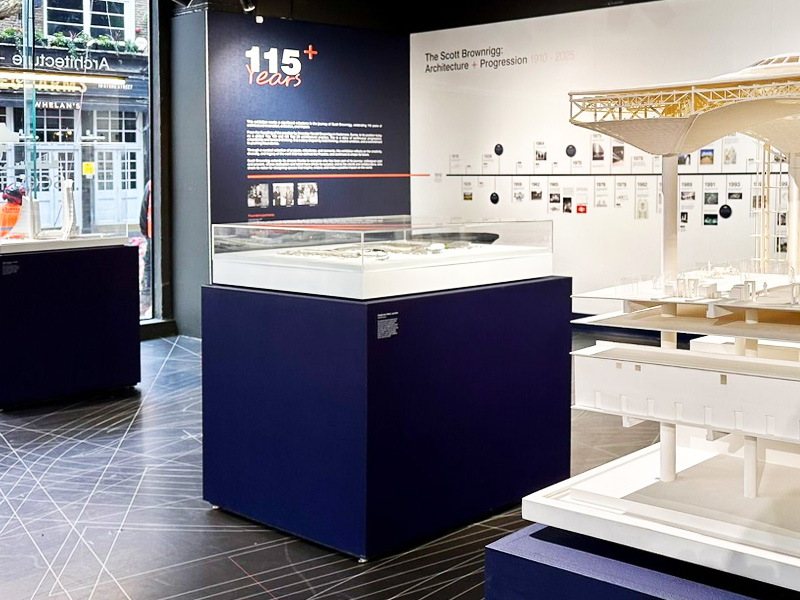 I was keen to elevate the anniversary and book launch as much as possible. When looking at suitable venues for the book launch the Building Centre, seemed perfect and gave us the opportunity to put on an accompanying exhibition – a timeline, telling the story of our history and showcasing just some of our significant milestones, initiatives and projects. We were also able to display a number of architectural models of projects from throughout the years going back to the late 1980’s.
Beedier: Who is the book aimed at, and what do you hope readers will gain from it?
Claire: We want clients and prospective clients to have a look at it so that they can fully understand our ethos and our history, and also consultants and wider industry collaborators including academia and of course students. We’re one of nine RIBA Practice role models, defined by the RIBA as ‘organisations that exercise a positive impact – on their people, their clients, the profession and wider society,’ and we’re really happy for our peers to gain some insight into how a big practice has managed to remain relevant and entrepreneurial for over a century.
Beedier: What approach did you take, and why?
Claire: We didn’t want it to be an architectural practice monologue. We wanted it to have a business element.
We’re one of the oldest practices in the UK with a lineage going back to 1910, and we really wanted to document our story before it was lost. We wanted to talk about the practice’s development, and how it’s remained relevant through innovation and forward thinking.
It was important to show that history, and to identify some of the key milestones and initiatives as we’ve innovated and remained progressive.
Beedier: How is the book organised?
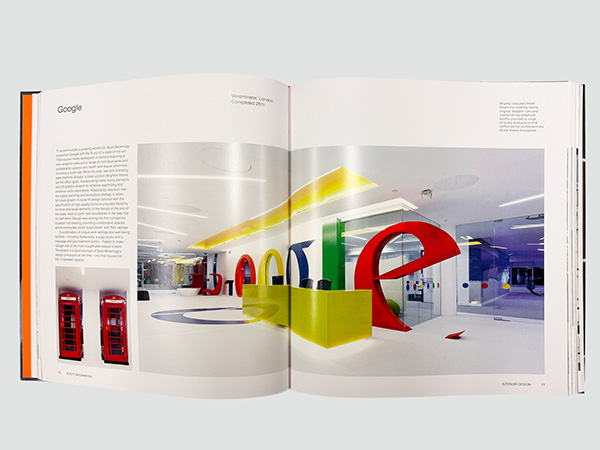
Claire: We’re a multi-sector business, which has really helped to navigate the economic challenges. We wanted to show the different sectors that have been part of our history and helped to form the practice into the business it is today. These include aviation, which has been a massive part of our history – when we worked on Heathrow Terminal 4 in the 1980s, we had about 400 staff and were the second largest practice in the UK.
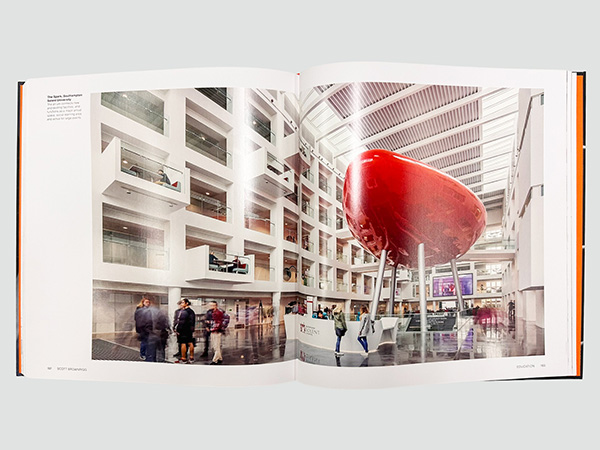
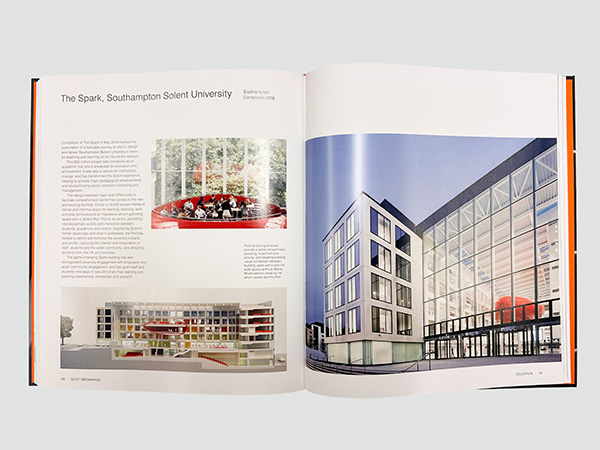
We also have chapters on offices, business and science parks, education, residential and mixed use, rail, defence, and interior design. The idea was to talk about some of the history and evolution of each sector and show the challenges and design ethos running through the projects, as well as showcasing some future thinking. We explicitly left out a few sectors that weren’t part of our history but will be a big part of our future including Advanced Technologies and Culture, Media and Sport.
The book has given us the opportunity to showcase the breadth of our work and our expertise in those sectors, as I still think there are some clients that aren’t fully aware of some of the sectors we work within.
Beedier: How does this fit into your overall practice positioning?
Claire: As well as celebrating our lineage as one of the oldest practices, we wanted to reinforce that we are multi-sector, and to highlight our expertise. We’ve done a lot of vertical and horizontal diversification, adding in complementary services that we can offer our clients.
We’ve got a design strategy unit, which is very intrinsic to our interior design offering. We offer design management as a service on our own projects or as a standalone service to clients. And we have a safety design unit, which we’re actively marketing. Then there’s Design Delivery Unit, our executive architecture brand.
The book also enables us to reinforce our approach to international work. Our objective is that 50% of our turnover will come from international projects. We’re currently at about 40% and creeping up quite quickly. However, International projects aren’t new for our business – we worked in Pakistan in the late 1960s, and were doing a lot of projects in the Middle East in the 1970s.
 Beedier: How have you used the book launch and exhibition to reach out to clients and prospective clients?
Claire: We had around 200 clients at the book launch at the Building Centre, and were lucky to have Surinder Arora from the Arora Group – our client for Heathrow West – to speak at it. We invited those that couldn’t make it to come to the exhibition another time when we could show them round it and give them a book. It’s been quite a good hook for getting clients and prospects interested in finding out more about Scott Brownrigg. We’ve also put together a video including interviews with longstanding friends across the industry to get their thoughts on why we’ve remained successful and relevant. Many mentioned our integrity, resilience and entrepreneurial spirit. It was also great to hear that we are viewed like a family as this is an internal culture we promote.
Beedier: How long did the book take to put together, and what were its most challenging aspects?
Claire: It was surprisingly quick – about a year from meeting with the publishers Merrell to sending it off to be printed. We started having conversations with Merrell, in Spring 2024, but we didn’t actually get physically working on the book until the August. It took us about three months to write and gather images, and we then had to allow time for the editing. The schedule was really tight because we wanted it published and back here by our official anniversary in October.
The most challenging aspects were piecing together our history. I was quite lucky, that some years ago a former director had spent some time working on the historic moments and key projects, which was really helpful I also spent a huge amount of time reading and scanning internal archived newsletters and press cuttings, which was a massive help for understanding key projects in each sector.
Another challenge was that the sector heads had to dedicate quite a bit of time to writing their chapters as well as carrying out their day-to-day jobs on projects. We also spent a lot of time reproducing the drawings to ensure that there was a consistent style. Image selection was a lengthy process, and trying to identify who took the older photos.
Beedier: How many copies have you published?
Claire: We have 1,000 for ourselves, and then Merrell’s in charge of distribution – it’s in Waterstones and is on Amazon as well as a number of outlets globally.
We’re going to give all our staff a book just before Christmas and will send some to select clients, consultants and prospects over the next year. It’s a good sales tool and hook to start conversations about with future prospects.
Beedier: What particular issues does having such a long heritage present when you’re marketing the practice?
Claire: There are pros and cons with such a long history. In perception surveys, we’ve always been considered a safe pair of hands because of our heritage, providing credibility and authenticity which is great.
But I think there can be questions raised about whether old practices can be innovative and entrepreneurial and of course we are – remaining resilient and relevant very much comes hand-in-hand with innovation and pushing the boundaries, and I hope we’ve effectively illustrated this within the book.
Some of our clients in the Middle East don’t know about our history, but are commissioning us for who we are now – a practice with an entrepreneurial spirit that pushes boundaries. We do have to balance perceptions, but it’s a strong position to be in and our heritage can only be a good thing.
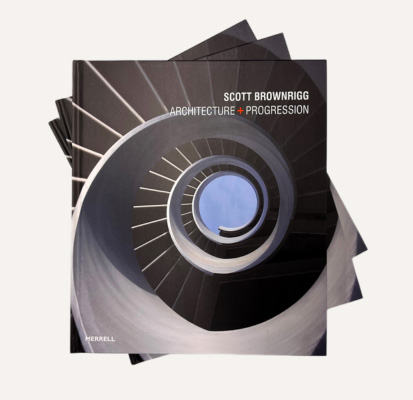 Architectural monographs offer far more than a retrospective record of projects; they provide a rare moment for practices to pause, reflect and take stock. In collating drawings, photographs, stories and milestones, studios are able to re-evaluate their identity, clarify what has defined their success and recalibrate how they communicate their value to clients, collaborators and the wider industry.
As Scott Brownrigg’s book and exhibition demonstrate, this process not only preserves valuable material that might otherwise be lost, but also strengthens future-facing narratives – aligning heritage, expertise and ambition into a clear and confident message about where a practice has come from and where it is going next.
Claire Donald is Head of Marketing and Communications at Scott Brownrigg and a member of the practice’s Management Group. She leads marketing, communications and business development, working with Group Directors to deliver strategic plans, oversee visual communications and support the practice’s growth.