


Making cities human again: Heatherwick’s Seoul Architecture Biennale 2025
Matt Bell of Heatherwick Studio discusses how the Seoul Architecture Biennale 2025 challenges the world to rethink what makes buildings human, joyful, and emotionally resonant
Thomas Heatherwick | Photogaphy by Yongjoon Choi
The Seoul Architecture Biennale 2025 enters the global conversation with a provocative question about what makes our cities truly human. Curated by Thomas Heatherwick, it sets out not to celebrate professional innovation but to ignite public imagination. Under the theme of “How to Make Cities Radically More Human,” the Biennale explores how emotional resonance, visual richness, and civic identity can counter decades of dull urban growth.
In this interview, Matt Bell, Strategic Communications Director at Heatherwick Studio, discusses why Seoul is the ideal host city, the making of the monumental Humanise Wall, and how the Biennale aims to transform architecture from an elite pursuit into a shared public conversation.
Beedier: How did Thomas Heatherwick’s curatorship of the Seoul Biennale come about?
Matt: The organisers came to us a year and a half ago and we pitched them the idea that the theme should be how to make buildings and cities radically more human. We think the reality is that most new development in most cities over the last half century has been boring and soulless – not all, but most – and this is bad for our health and bad for the planet. It’s an extension of the argument we make in the Humanise campaign, and the first expression of this at city-scale.
Beedier: Why is the theme suitable for Seoul?
Matt: Seoul has the confidence to have this conversation in a way that a lot of cities don’t. The Mayor’s team acknowledge that Seoul has suffered from a lot of sterile development. Housing is expensive. There are huge issues with loneliness, a high suicide rate, and a low birth rate. And in this context, there’s a conversation to be had about how to create more emotionally resonant architecture.
The mountains provide an incredible backdrop to the city but as a visitor your first reaction architecturally is pretty shocking. Korea went through a period of compressed modernity from the 1950s onwards, which took place at a staggering pace. It delivered economically but the built environment paid a high price and people are now very conscious of the result. Gangnam, for example, is pure glass and steel – much of it’s deeply sterile.
It’s only when you venture off into the side streets that you find the real magic of Seoul – the life, complexity and detail that you’d want in a city.
South Korea is a cultural superpower in so many respects – film, beauty, food, pop – but not yet architecture. This is almost like their last creative frontier. And we hope this Biennale might help unlock a new sense of Korean identity in contemporary architecture.
Beedier: What’s the USP of the biennale?
Matt: The whole point of it is to start a public conversation – unlike most other biennales around the world, which are essentially designed for the professionals. This biennale is the only one that’s majority publicly funded – by the Seoul Metropolitan Government – and we wanted it to be by the public, for the public, in the public realm. And free so anyone can go.
The aim is to ignite a conversation about why there’s so much soulless new development. We think that to make the physical environment of cities better, you need to start with the demand side (not policy) and re-set public expectation about what is good enough. This is the societal conversation that never seems to happen.
We find in our research that conversations about architecture tend to go through three stages. At first most people find it weird to be asked how a building makes them feel. Then, when they realise you’re serious, there’s a stream of passionate commentary. After which, in different ways, people shrug and retreat, because they feel powerless. It goes from weird to passionate to powerless. The passion is great. What we’re trying to change is the weird and the powerless.
The key thing is that this Biennale isn’t about setting a style agenda – ugly or beautiful, traditional or contemporary. That’s your choice. But buildings must engage us. They should be interesting. And human.
The reality is that politicians only act when they feel like they have a public mandate. And we’re trying to establish a mandate for interesting and human buildings – which is surely what every architect wants.
Beedier: How are you doing this?
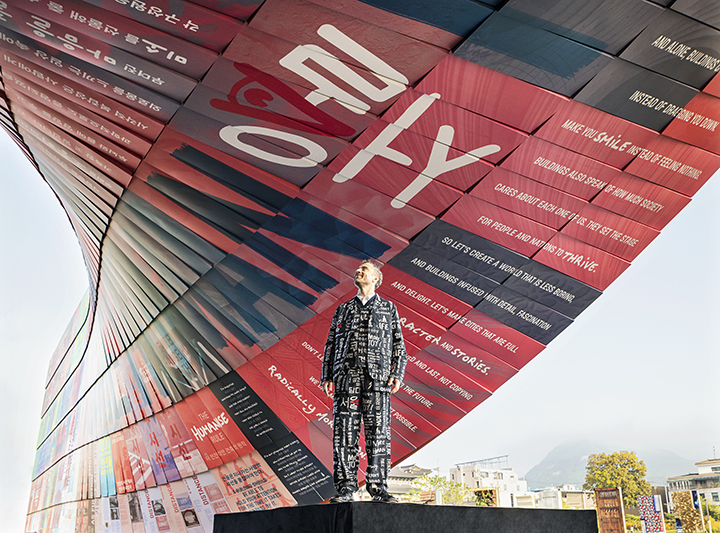
Matt: We’ve created the Humanise Wall, a dramatic installation in a public park in the city centre. It’s 90m long, four storeys high with a parabolic twist in the middle and covered in 1482 steel panels printed with text in English and Korean.
It’s designed as a provocation to start a conversation with the public about how they can help make their city radically more human. It aims to grab people by the shoulders and engage them in a conversation about buildings, in a way that never happens.
What I love is that most people who come to this Biennale will encounter it by accident. Walking from one place to another through the city. They won’t be architecture fans purchasing a ticket to an expo. The idea was to create something like a 3D magazine that people can read and explore, and begin to understand why buildings are boring, what joyful looks like, and what their role could be in it creating more of it.
On the left of each side, the wall explores what we call ‘the anatomy of boring’: what we mean by ‘soulless’. And why it matters if the outsides of a building are monotonous and story-less. shiny, lacking ornament or identity? On the other side, the content explores what you might think of as ‘the anatomy of joyful’ and how buildings can offer us detail, humour, belonging and necessary visual complexity
There are 400 images of interesting buildings by 110 designers from around the world, alongside images and ideas from nine community projects from Seoul itself. These were chosen from an open call that generated 83 applications. The successful teams were given a grant to explore and communicate how the buildings in their city make them feel and how they would like them to evolve. The responses have been visceral, funny, brave and challenging.
I hope people will walk up and along the Humanise Wall, be curious and enjoy it. Whether they spend five minutes or five hours here, that’s up to them. We just want people to dream more and demand better.

The Humanise Wall | Photogaphy by Yongjoon Choi
Beedier: How are designers from around the world participating?
Matt: As part of the Biennale, we invited 24 creatives from different artistic disciplines to each make a ‘Wall of Public Life’. These are fragments of buildings, 2,4 x 4.8 metres, designed to suggest how good the outsides of buildings can be. The idea is that people first see the Humanise Wall – which acts as a provocation – and then walk in and out of these giant, joyful slices of buildings – which act as an inspiration – and start to imagine how different the buildings in their city could be.
We wanted the designers only to think about the outside of the building – not about the public realm, the structure, the form or the space inside. And we picked a very diverse, eclectic bunch – two thirds are architects including some big names like Francis Kéré and Kengo Kuma, as well as five Korean practices. But we also have a chef (Edward Lee), a tailor (Ozwald Boateng), a fashion designer (Stella McCartney), a sculptor (Yinka Shonibare), a car company (Hyundai), a team of engineers from Arup, and two wonderful traditional building makers from Burkina Faso who are making their wall live on site. What we’re trying to do is bring the sensibilities of other creative disciplines into the world of architecture.

Wall of Public Life Exhibition | Photogaphy by Yongjoon Choi
Beedier: What else can we expect from the Biennale?
Matt: We’re publishing three major pieces of research at the Biennale to deepen the discussion about the campaign and the science it is rooted in. We’re very interested in the emerging field of neuro-aesthetics, which is increasingly beginning to show direct links between the design of the outside of buildings and public health. We now understand much more clearly how building design impacts on your brain, on your heart, and on your behaviour.
This has been launched at a two-day opening conference, Emotional City, free and open to the public, and included presentations from nine creative community projects to an audience of politicians, activists and scientists.
Beedier: Curating a biennale is a huge undertaking. What’s been the biggest challenge?

Matt Hill, Strategic Communications Director, Heatherwick Studio
Matt: Finding a way to communicate simply and effectively has been such a massive challenge – how to talk in clear, expressive English and Korean to people who have no interest in architecture. It’s an enormous challenge to the whole world of architecture.
Beedier: In addition to contributing to the Humanise campaign, what marketing benefits might curating the Biennale have for the practice?
Matt: I’m totally indifferent to that. What will be will be in terms of the profile of the studio. The point of this is to spark a city-wide conversation. It would be great if it begins to reinvent the spirit of biennales, which used to be such super-radical events where you’d get really challenging ideas put out there. I’m not really sure that’s the case today.
Beedier: What’s next for the Humanise campaign?
Matt: Humanise has just had its two-year anniversary. This is a ten-year initiative, and it will easily take that long to achieve a mindset shift that changes the conversation globally about the outside of buildings. Seoul is the first city in the world that’s really embraced the Humanise campaign, and there’s a very long way to go – a whole societal narrative that needs to shift. The exciting thing about the Humanise campaign is that so much is now popping up around the world that we have nothing to do with. Humanise is evolving from a book to a campaign to a movement, and it’s that leap from campaign to movement that’s the critical challenge which you need but can’t control. Social change like this has to self-seed. But I think we’re at a point now where people really want the outsides of buildings to become radically more human.
As the Seoul Biennale opens, Heatherwick Studio’s message is clear: the future of cities depends on empathy, imagination, and emotional connection. By reframing architecture as a civic conversation rather than a technical field, Humanise challenges both professionals and the public to demand more of their built environment. What began as a campaign is evolving into a movement, at least that is the ambition – and in Seoul, one of the world’s most digitally connected city, this conversation becomes tangible, public, and hopeful: a reminder that architecture’s greatest task is not to impress, but to move us. 370,000 people have now visited the Seoul Biennale in its first three weeks, so it is clearly a message that is resonating.
The 5th Seoul Architecture Biennale, curated by Thomas Heatherwick, runs from 26 September to 18 November 2025 across Songhyeon Green Plaza and the Seoul Hall of Urbanism & Architecture. Entry is free, with full details, including programming updates and visiting information, are available on the official website at www.seoulbiennale.org.