


によって ソフィア・アラウイ・シャヒド
Delhi 2047: where will four million new homes come from?
Delhi has formally adopted a new masterplan for 2047, opening the way for higher-density development, redevelopment of existing neighbourhoods and a larger role for private developers as the Indian capital prepares for around four million additional homes
India’s government has notified the Master Plan for Delhi 2047, establishing a new planning framework for a city expected to accommodate around 32 million people by the middle of the century.
Notified on 20 August 2026 after approval by the Delhi Development Authority, the plan replaces Master Plan 2021 and sets the statutory direction for the capital’s development to 2047.
Delhi may need around four million additional homes by 2047, plus major investment in transport, utilities, jobs and social infrastructure. In an already urbanised city, delivery will rely on land pooling, higher density around public transport and redevelopment of existing neighbourhoods.
The plan also gives private developers a larger role, potentially creating a long-term pipeline for architects, planners and multidisciplinary consultants.
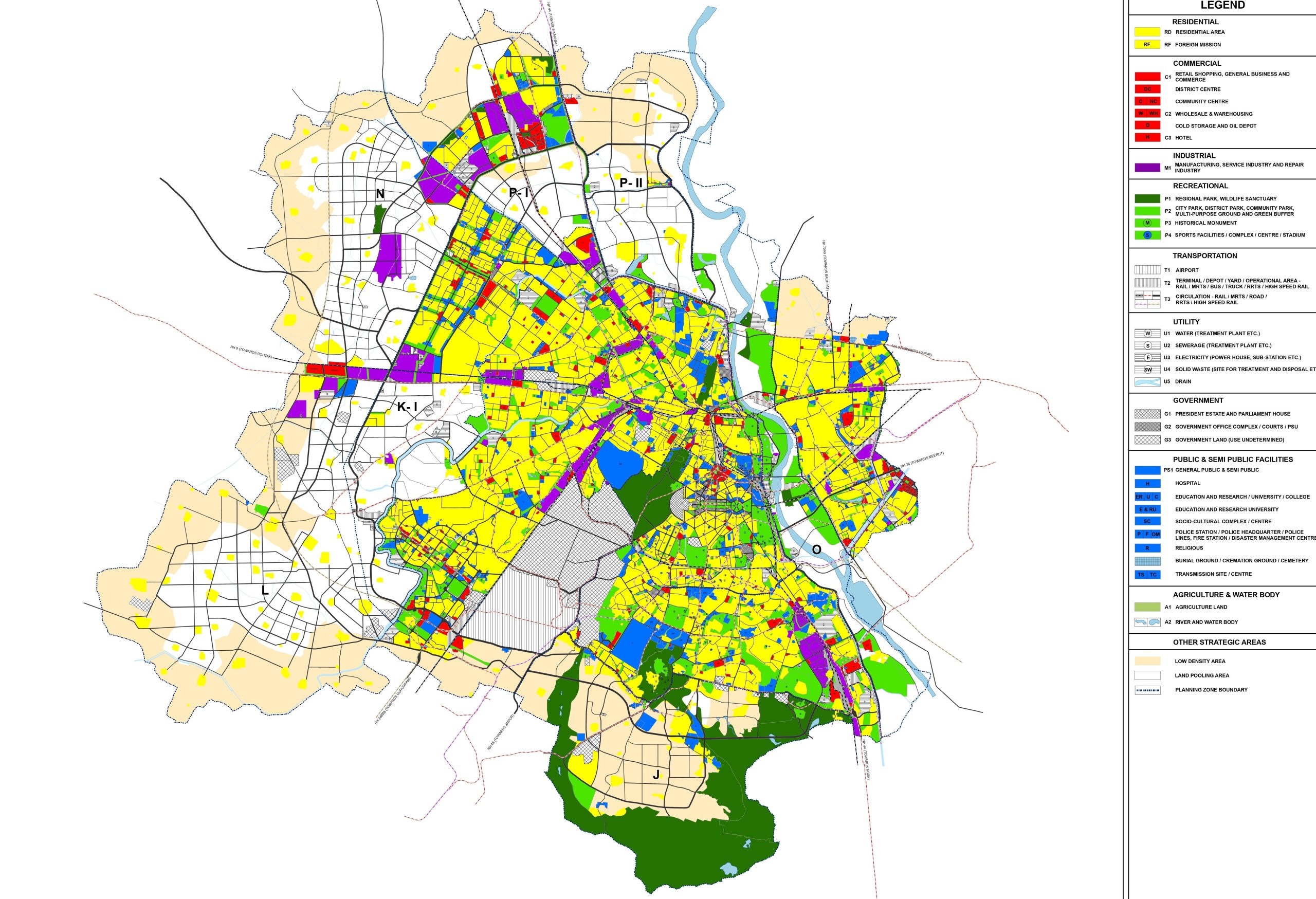
Land Use Plan for Delhi 2047 | DDA
Where will four million homes come from?
Meeting demand will depend on several forms of development rather than one urban extension.
Land pooling could provide around 1.2 million homes across nearly 200 sq km of urban extensions, while transit-oriented development (TOD) zones could supply about 1.8 million affordable homes.
A third source is redevelopment of ageing DDA housing, group schemes and other planned areas, alongside measures addressing unauthorised colonies.
The result is a housing programme that depends as much on rebuilding and intensifying the existing city as constructing new districts at its edge.
For architects, opportunities are likely to come through landowner groups, private developers, housing societies and redevelopment projects as well as public commissions.
Turning private land into development
Land pooling reverses Delhi’s historic model of public acquisition. Instead, private owners assemble land for planned development, retaining a share while the remainder supports roads, utilities, open space and public facilities.
Around 60% of pooled land can remain with the developer entity and 40% is allocated for infrastructure and public uses.
The DDA estimates that land pooling could enable planned development across nearly 200 sq km, providing around 1.2 million homes and approximately 600 km of additional roads.
Housing is intended to be delivered with schools, healthcare, parks and commercial centres. Implementation remains difficult: fragmented ownership has slowed land assembly for more than a decade. MPD-2047 strengthens the DDA’s infrastructure role, but its success will depend on converting theoretical capacity into viable sites.
MPD-2047 also introduces mechanisms intended to overcome stalled land assembly, including town planning schemes that can bring fragmented holdings into planned development. DDA is expected to take a more direct role in strategic infrastructure, allowing roads and utilities to precede rather than follow private development.
Building upwards around transport
MPD-2047 uses Delhi’s extensive Metro network to support denser, mixed-use neighbourhoods around mass-transit corridors, with affordable housing central to the policy.
Because much of Delhi remains relatively low-rise, the plan points towards a more vertical city, concentrating density where transport and infrastructure can support it.
The opportunity extends beyond housing to commercial buildings, schools, healthcare, public realm and pedestrian connections.

Redeveloping the existing city
Some of the earliest work may arise in established neighbourhoods. The plan expands scope to reconstruct ageing housing and commercial areas, including old DDA developments.
For some comprehensive schemes, the minimum site has fallen to about 3,000 sq m, increasing the number of potentially viable projects.
A separate policy covers old two-storey DDA units on low-density sites. Commercial redevelopment and mixed use along major roads are also encouraged.
A broader programme of development
Beyond housing, MPD-2047 opens opportunities in employment, education, industry and civic infrastructure, with mixed use permitted more widely.
Narela is earmarked for universities and housing, while Dwarka is positioned as an international gateway and employment centre for technology, data centres and start-ups.
The plan also supports adaptive reuse of heritage buildings, regeneration of historic areas and restoration of the Yamuna floodplain and green spaces.
When will the architectural work emerge?
MPD-2047 creates capacity rather than a fixed construction programme, with redevelopment likely to advance fastest where ownership is consolidated and infrastructure exists, while TOD depends on sites and transport investment and urban extensions require land pooling, sector planning and infrastructure first.
The DDA has appointed consultants for infrastructure designs across 109 land-pooling sectors and published mapping for 101, with DDA’s current land-pooling status confirming both steps. Roads, water, sewerage, drainage, power and social infrastructure must follow before construction reaches scale.
The architectural pipeline is therefore unlikely to appear as a single MPD-2047 procurement programme. It will emerge at different speeds as redevelopment sites, transit corridors and new urban-extension sectors move from planning into delivery.
Early work is therefore likely to sit upstream in masterplanning, transport, infrastructure, landscape and urban design, followed by building commissions as areas mature.
DDA land-pooling notices, sector plans and reference maps can show progress before commissions are advertised, while public work may appear through DDA tenders and India’s Central Public Procurement Portal; and private developers and landowner consortiums will matter increasingly.
Aerial View of Dwarka | Sumita Roy Dutta, CC BY-SA 4.0 via Wikimedia Commons
For international practices, early routes into the programme are therefore more likely to involve partnerships with Indian architects, developers and infrastructure consultants than standalone building commissions.

What MPD-2047 means for Delhi
MPD-2047 combines redevelopment and intensification within the existing city with infrastructure-led expansion at its edge. Rather than a single housing programme, it establishes a framework through which different parts of Delhi can develop at different speeds.
Delivery is not guaranteed. Fragmented ownership has already slowed land pooling, while greater density will increase pressure on transport, water, drainage, power and social infrastructure. The detailed design now under way for land-pooling sectors illustrates how much enabling work remains.
For the built environment industry, that means the opportunity extends beyond housing to infrastructure, education, employment districts, public realm, landscape and neighbourhood renewal. Much of the earliest work may therefore precede individual building commissions.
With the statutory framework now in place, the question is shifting from where Delhi can accommodate another four million homes to how that development will be delivered. The answer will shape the physical form of one of the world’s largest metropolitan areas over the next two decades.
 English
  Spanish
  Portuguese
  French
  German
  Italian
  Japanese
  Arabic
  Chinese