


によって
New York prepares to rebuild Coney Island’s historic boardwalk
New York has opened procurement for the US$1+ billion reconstruction of Coney Island’s 2.4-mile boardwalk, creating a major opportunity spanning landscape, public space, coastal resilience and architecture.
New York City is looking for a team to lead the reconstruction of Coney Island’s historic Riegelmann Boardwalk, beginning a multi-year project expected to cost more than US$1 billion.
The New York City Economic Development Corporation (NYCEDC) and NYC Parks issued a Request for Qualifications on 30 September for a progressive design-build team to reconstruct the entire 2.4-mile waterfront structure. Responses are due on 4 November, with shortlisted teams expected to move to the Request for Proposals stage over the winter and selection planned for spring 2027.
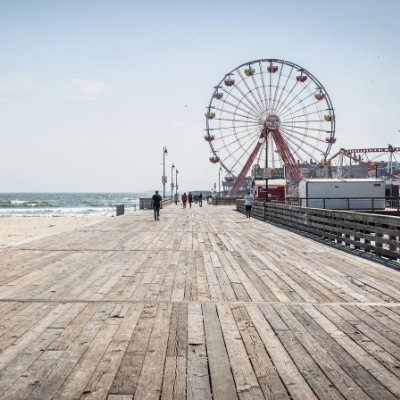
Coney Island Boardwalk, via newyork-trip.com
The scale of the project extends well beyond replacing the boardwalk itself. Alongside new piles, pile caps and decking, the programme includes access points and street-end plazas, lighting and furnishings, drainage, water and electrical infrastructure, nine restroom buildings, six lifeguard stations, four shade pavilions and improvements to public space at the eastern end of the boardwalk. A new NYC Parks garage with a public restroom is also planned.
Climate resilience will shape much of that work. Portions of the boardwalk are expected to be raised to improve protection from storms and coastal flooding, with protective barriers incorporated below ground.
What appears at first to be an infrastructure project is also a substantial commission for the redesign of one of New York’s most recognisable pieces of public realm.
The procurement model is significant. Rather than commissioning design and construction separately, New York is using progressive design-build, selecting one team to develop both together. Cost, programme and design will be refined progressively with the city, while formal community engagement will begin after the team is appointed.
The approach remains relatively new at this scale in New York City. Procurement documents for the project acknowledge that progressive design-build experience within the city remains limited and allow relevant experience gained elsewhere in the United States to count towards team requirements.
That potentially widens the opportunity beyond firms already embedded in New York’s municipal procurement system. It also places collaboration at the centre of the commission: architecture, landscape, engineering, coastal resilience, accessibility, public space and construction will need to develop within the same delivery structure.
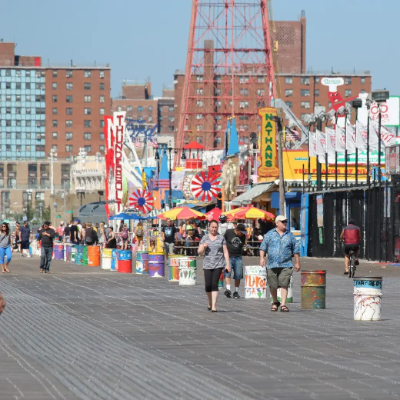
Coney Island Boardwallk. Shinya Suzuki, via 6sqft.com
The city has authorised up to approximately US$1.15 billion across the wider reconstruction programme. Most of that is expected to go towards the progressive design-build contract, alongside separate contracts for the owner’s representative and special inspections. Arup has already been appointed as owner’s representative.
The boardwalk is also part of a broader period of investment in Coney Island. Plans announced for the area include new housing, streets and sewers, public-realm improvements and the renovation of the Abe Stark Sports Center, placing the reconstruction within a wider programme of neighbourhood development.
For architectural practices, the opportunity lies not only in the project’s scale but in how infrastructure, landscape and public architecture are being brought into a single brief.
Coney Island therefore offers a useful example of how climate adaptation can become a catalyst for much broader design work. Rebuilding the boardwalk means reconsidering how people arrive, move along the waterfront, access the beach, find shade and public facilities, and experience one of New York’s most heavily used coastal spaces.
For practices working across landscape, public realm and resilient infrastructure, the project is also a significant live opportunity. The first procurement stage remains open until 2026年11月4日, making Coney Island not simply a major project to watch, but one in which design teams can still participate.
Further Information
NYCEDC – Request for Qualifications announcement and project scope
 English
  Spanish
  Portuguese
  French
  German
  Italian
  Japanese
  Arabic
  Chinese