


per
Bradford Interchange to Anchor Southern Gateway Renewal
A new railway station planned for Bradford in the 2030s could reshape the city's southern gateway, creating opportunities for housing, employment and public-space improvements while strengthening transport connections and supporting wider urban regeneration
Bradford’s proposed new railway station will be built at the existing Bradford Interchange site, a location decision that could shape one of the city’s most significant regeneration areas for decades.
Confirmed by the UK government on 20 October 2026, the decision forms part of Northern Powerhouse Rail (NPR), a programme intended to improve connections between major cities across northern England. The new station will replace the existing 1970s facility, providing faster and more frequent services to Leeds, Manchester and York.
Beyond transport improvements, the announcement establishes Bradford Interchange as a potential anchor for regenerating the city’s Southern Gateway. Its location is expected to influence future development sites, pedestrian connections, public spaces and the relationship between the city centre and surrounding neighbourhoods.
The location of Bradford’s new station could determine the shape of future housing, commercial development and public space long before construction begins.
The government’s plans also anticipate connections with the proposed West Yorkshire Mass Transit network, bringing regional rail and local transport investment into a wider urban development strategy.
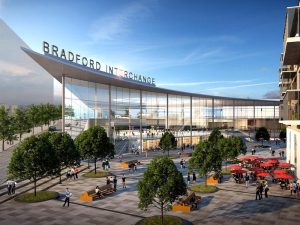
Credit: Stephen Armstrong / Geograph, Creative Commons licence
Bradford Council estimates that the combined infrastructure investment could support thousands of new homes and jobs, generating up to £1 billion in economic benefits. This remains a projection dependent on the delivery of the transport programmes and associated development, rather than a guaranteed outcome.
The decision was reached through discussions involving the Department for Transport and West Yorkshire Mayor Tracy Brabin, reflecting the role of regional authorities in coordinating transport and economic development. The proposed station will form part of Great British Railways, the government’s publicly owned railway organisation.
Delivery is planned for the 2030s, although the announcement does not establish a detailed architectural appointment or construction timetable. It confirms the station’s location rather than the design or procurement arrangements for individual regeneration projects.
For architectural practices, the opportunities created by major transport investment may extend well beyond the station itself, into the surrounding urban fabric.
The implications for Bradford extend across masterplanning, housing, commercial development, landscape architecture and public realm. Future commissions will depend on how the Southern Gateway regeneration programme progresses, which development sites become viable and how public and private investment is coordinated.
For practices tracking opportunities across northern England, Bradford illustrates how infrastructure decisions can establish the conditions for a wider architectural market. The next developments to follow are not only the station’s design and delivery, but the regeneration partnerships and projects that emerge around it.
Ulteriori informazioni
 English
 Spanish
 Portuguese
 French
 German
 Italian
 Japanese
 Arabic
 Chinese