


Does architecture need a new movement?
With the departure of Gehry and Stern - the emblematic voices of American Deconstructivism and Postmodernism - architecture loses two of its clearest ideological anchors. Their absence raises a pressing question: does the field now require a new movement to advance both emerging and established ideas?
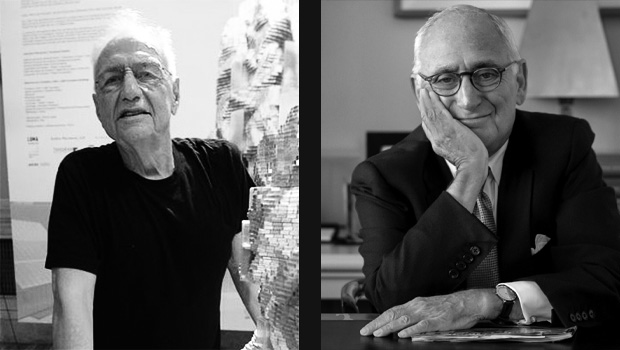 The passing of Frank Gehry and Robert A.M. Stern within the past two weeks marks the symbolic end of an era in American architecture, one shaped by strong personalities, clear ideological frontiers, and the belief that architecture could be both a cultural project and a public conversation. From the parametric contrarianism of Deconstructivism to the pop historicism of Postmodernism, their generation navigated a landscape where movements carried real cultural weight and architectural expression was inseparable from architectural argument.
Gehry, with his explosive forms and unrestrained sculptural ambition, became the face of late-20th-century experimentation: the architect who liberated buildings from the constraints of right angles and conventional materials, and who pushed digital fabrication from niche experiment to mainstream toolset. Stern, in almost perfect counterpoint, championed continuity, memory, and the value of architectural legibility. His work asserted that tradition could be contemporised without irony, that the American vernacular still held untapped civic potential, and that buildings were at their best when they connected people to place.
Between them, Gehry and Stern held open a productive tension within the discipline: one insisted that architecture must continuously reinvent itself; the other insisted that architecture must always remember where it came from. Their passing leaves the profession without two of its clearest ideological reference points. And with that loss comes a deeper question: if these figures represented the last great movements of the 20th century, what guides us now?
Does contemporary architecture need a new movement to orient its future, or has the age of movements itself come to an end?
The state of architecture today: fragmentation, and diversity
In recent years, architecture has drifted away from strong, unified movements because the focus has shifted toward process and impact rather than style. Parametricism briefly seemed poised to become a major new direction in the early 2000s, but it largely remained a tool for academic experiments and high-end projects. Sustainable architecture is now a universal concern, yet it is applied unevenly and often more as a process than a clear movement. Urbanism, once shaped by bold theories, is increasingly driven by planning rules, development pressures, and private investment. As a result, architectural energy today is channelled into solving practical problems rather than forming cohesive, recognisable movements.
If Modernism was a manifesto and Postmodernism a reaction, today’s architecture is something different: a mix of specialisms with no common cultural thread. The field is skilled and sophisticated, but often lacks coherence and a driving narrative.
This fragmentation mirrors the wider societal context. We inhabit a world defined by overlapping crises: climate, affordability, social inequity, digital transformation. In such conditions, architecture often struggles to articulate a unified cultural role – but perhaps this is no bad thing?
The case for a new movement: in an age of crisis, architecture needs defining clarity
Architecture’s current fragmentation, while productive, struggles to address the scale of today’s challenges. The climate crisis demands a response as transformative as the one that produced Modernism, calling for new materials, new approaches, and a cultural shift in how we build.
A movement could give form to ecological values, treating sustainability not as a checklist but as an identity. Ideas such as buildings designed for disassembly, rewilded urban spaces, and visible material cycles could coalesce into a recognisable architectural language with real public meaning.
At the same time, emerging technologies such as AI, robotics, and bio-fabrication are reshaping how architecture is conceived. Without a guiding framework, these tools risk reducing architects to technicians rather than authors of cultural intent.
In this context, a new movement could act as both compass and catalyst, helping articulate what architecture stands for in a time of environmental urgency and rapid technological change.
The case against a new movement: beyond dogma and iconography
Yet there is an equally compelling argument that the discipline does not require a new movement, and may be better off without one. Architectural challenges today are too complex and context-specific for any single ideology to meaningfully address. In this view, the discipline’s diversity of practice is not a weakness but a valuable adaptation.
The climate crisis does not need an aesthetic; it needs diverse, regionally informed responses. Social inequities cannot be resolved by stylistic coherence; they require policy, governance, and long-term engagement. Digital tools do not necessitate a new style; they enable new processes whose outcomes should vary with need.
Movements also depend on charismatic leadership, and the profession is consciously shifting away from the “starchitect” model that shaped the late 20th century. Today’s focus on collaboration, shared authorship, and community engagement sits uneasily with the idea of a singular manifesto guiding all practitioners.
So should we resist the urge to name a new movement and instead embrace an agile, decentralised approach – one capable of adjusting to overlapping crises rather than conforming to a unified stylistic agenda.
Do movements aid architectural communication?
The question of whether architecture needs a new movement is inseparable from a deeper issue: what do movements actually do? Historically, they have been powerful communication tools. They distil complexity into clarity, turning scattered ideas into coherent narratives. A movement gives architects a story to tell – why they design the way they do, not just how.
Movements create narrative coherence. Modernism framed architecture as an expression of industrial society; Postmodernism framed it as a return to symbolism; Brutalism framed it through raw materiality and social purpose; High Tech framed it as a celebration of exposed systems and technological optimism; and Deconstructivism framed it as a critique of stability and logic.
These narratives allowed architects to explain intention, critics to contextualise work, and the public to recognise cultural meaning in buildings. Without such frameworks, architecture risks becoming technically impressive but culturally unreadable.
They also coalesce thought, giving the discipline shared reference points and philosophical anchors. Movements are gathering devices: they bring theorists, practitioners, and educators into conversation, creating momentum out of intellectual drift. In their absence, architectural discourse becomes atomised, with relevant ideas disappearing among the noise.
And movements make architecture legible. To the non-specialist, architectural intentions are often invisible. Movements provide the cultural shorthand that turns buildings into stories. Without shared movements, architecture risks communicative silence – visible, but not understandable.
Yet this power is double-edged. Movements clarify but reduce; they unite but constrain; they inspire but can calcify into dogma. A movement helps architecture speak clearly, but sometimes at the cost of its nuance.
If a new Movement emerges, what might it look like?
Even if architecture does not need a new coalesced movement, it is fun to imagine what form one might take. Several possibilities hover at the edges of current practice, and we have playfully suggested some headings…
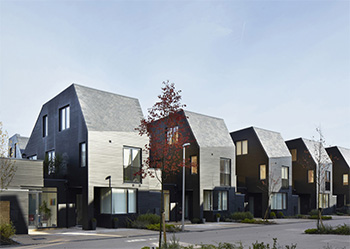
Newhall-Be by Alison Brooks Architects (photograph: Paul Riddle)
Domodernism: a blend of vernacular warmth and modernist restraint, an aesthetic approach that uses familiar domestic proportions expressed through simple geometry and contemporary materials. It has quietly shaped everyday architecture for two decades without ever being formally recognised, sometimes dismissed as “Polite Modernism,” yet remains a defining architectural language, with variations across different cultures.
Examples: Agar Grove Estate. London (Mæ); Newhall-Be (Alison Brooks Architects); Ash Court, Girton College (Allies and Morrison)
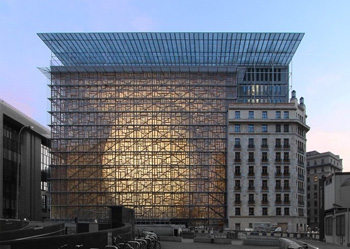
Europa Building by Samy and Partners (Photograph: Samynandpartners / Wikimedia Commons)
Circularism: embraces reuse, repair, and material hybridity, treating buildings as evolving compositions rather than fixed, pristine objects. Salvaged components, visible joints, and layered histories are celebrated as architectural expression, recasting wear and adaptation as markers of value. Beauty emerges through continuity, resourcefulness, and the unfolding life of materials.
Examples: Europa Building (“The Lantern”), Brussels (Samyn and Partners); Grand Parc Renovation, Bordeaux (Lacaton & Vassal); Museum-Kaap-Skil, Texel (Mecanoo)
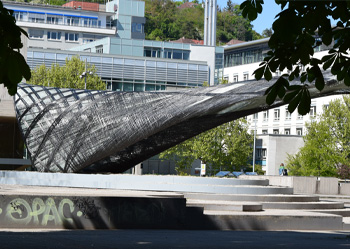
ICD/ITKE Research Pavilion 2016-17, Universität Stuttgart (Photograph: MSeses / Wikimedia Commons)
Datanature: harnessing the use of AI and computational tools to generate forms shaped by climate, culture, and local material constraints, producing architecture that differs from place to place rather than conforming to a global digital aesthetic. Here, computation becomes a means of deepening regional specificity- turning data into a new kind of vernacular language.
Examples: ICD/ITKE Research Pavilion 2016–17 (University of Stuttgart); DFAB House, Zurich (Gramazio Kohler Research); The Living’s Hy-Fi Tower, MoMA PS1, New York, (The Living)
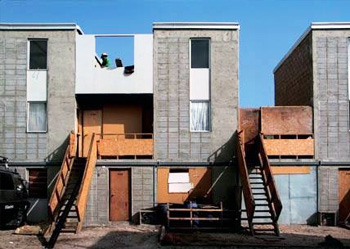
Quinta Monroy ‘Half a House’ by Elemental
Low-Tech: architecture that prioritises passive performance, local materials, and craft-based construction, achieving comfort and resilience through modest means rather than technological excess. It values durability, repairability, and clarity, resisting disposable building culture and proposing a quieter, more grounded form of modernity – one where simplicity becomes both ethical stance and aesthetic choice..
Examples: Makoko Floating School, Lagos (NLÉ); Quinta Monroy ‘Half a House’, Iquique (Elemental); The Enterprise Centre, University of East Anglia (Achitype)
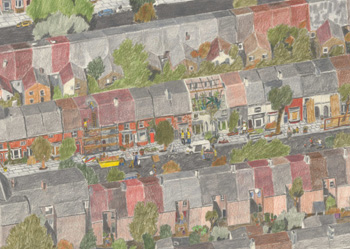
Granby Four Streets by Assemble
Collectivism: design conceived as a shared social process shaped by community participation, co-authorship, and open-source tools. Architectural form emerges through negotiation rather than individual artistic control, embedding social values directly into spatial outcomes and aesthetics. It reframes architecture as collaboration: an evolving, collective act rather than a singular vision.
Examples: Granby Four Streets, Liverpool (Assemble); Floating University, Berlin (Berlin); St Clements Hospital Housing, London (JTP)
None of these are movements in the formal sense, but each expresses a growing sensibility that could crystallise into a shared ethos – either retrospectively, or through continued cultural attention.
The deaths of Gehry and Stern invite reflection not only because they were great architects, but because they embodied belief systems larger than themselves. They stood for movements, and movements offered architecture a story to tell, often despite the architects’ own resistance to labels.
Whether architecture today needs a new movement is uncertain, but it does need a renewed sense of purpose: a shared commitment to addressing environmental limits, social inequalities, and technological change with imagination equal to the moment. If a movement does emerge, it will not mimic those of the past; it will be less about style and more about intention, ethics, and responsibility.
 English
  Spanish
  Portuguese
  French
  German
  Italian
  Japanese
  Arabic
  Chinese