


Designing moments not monuments
Architectural pavilions offer studios a rare chance to test ideas, explore new materials and connect with audiences. We speak to leading architects and highlight the festivals, strategies and opportunities shaping pavilion design in 2026
Architectural pavilions occupy a unique place in the culture of design. Freed from the constraints of long-term budgets, regulations, and client expectations, they allow architects to test ideas quickly, publicly, and often playfully. For many studios, these ephemeral works offer a rare chance to explore new materials, craft narratives, and express design intelligence in its purest, most experimental form.
Yet pavilions do more than test a concept: they create memorable moments – where architecture reshapes how people gather, look, touch, and participate. Whether built for a design week, a biennale, or a flower show, these structures act as open invitations to engage with architecture up close. And for studios, they can become platforms for visibility – a way to show new audiences what you stand for, and to demonstrate values that standard commissions may not always reveal.
This year, two UK practices, Hawkins\Brown and Hollaway Studio, contributed to cultural festivals with pavilion projects that were not only materially ambitious, but socially charged. Their reflections offer insight into what pavilions can achieve, and how architects might navigate the world of temporary installations. We speak to their creators.
Hawkins\Brown on reviving stone
For Hawkins\Brown, 2025 was a year of experimenting with stone, structure and public interaction. Brick from a Stone: Arch Revival, was created for Clerkenwell Design Week – a festival right on the studio’s doorstep.
“Now that we’ve moved to our offices in Clerkenwell, we’ve got a lot more presence in the street,” explains co-founder Roger Hawkins. “Clerkenwell Design Week was a good opportunity to be neighbourly and reach more people.”
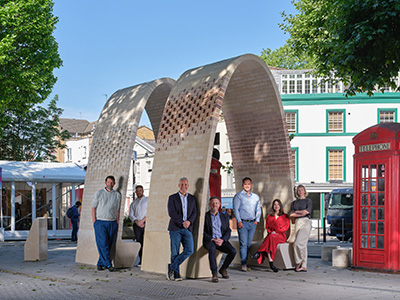
The project emerged from a collaboration with Albion Stone and Hutton Stone, who had recently developed an innovative low-carbon stone brick. Before committing to the idea, Hawkins\Brown visited the Portland quarry. “We didn’t jump at it straightaway. First, we had a great day going round Albion’s quarry… and saw how they’d invested in a machine to make bricks using a fraction of the carbon of a fired brick.”
Working with Webb Yates Engineers, the team used the pavilion as a testing ground for the material’s structural potential. The piece became both demonstrator and experiment – a public prototype revealing how stone, one of the oldest architectural materials, could be reimagined for a low-carbon future.
Although the pavilion was temporary, its impact may not be. “It’s still early days, but we are looking at using that material in the future. It’s a great product and we’d like to be able to demonstrate its use in a project.”
Hollaway Studio: a pavilion with two lives
At the Chelsea Flower Show, Hollaway Studio collaborated with garden designer Jo Thompson and The Glasshouse, a charity supporting women through horticultural training. The resulting pavilion, The Glasshouse Garden, embodied both craft and purpose.
“When The Glasshouse approached us, we knew it was a project we wanted to be a part of,” says managing partner Alex Richards. “It felt meaningful and gave us the chance to contribute something creative and lasting, rather than simply donating money.”
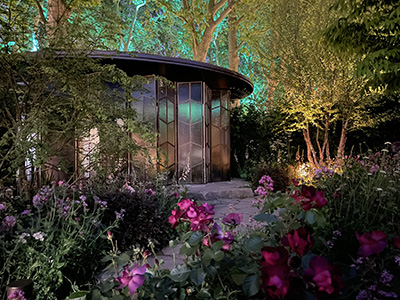 Chelsea is famous for its spectacle, but this project held a unique brief: the pavilion needed a second life. After the festival, it was relocated to HMP Downview, transforming a once bleak concrete exercise yard into a place of calm and sanctuary.
Richards describes the dual challenges: “Designing a building for the Chelsea Flower Show that later became a place of solace at HMP Downview was incredibly rewarding. It’s rare for a single project to have two such different lives, and for both to feel equally worthwhile.”
The materiality reflects robust sensitivity. “The pavilion needed to be robust… acrylic rather than glass windows, no thresholds, handles or locks. It feels open, private yet connected.”
The project was delivered pro bono, supported by Project Giving Back. But the value to the studio was more than reputational. Richards himself fabricated elements on site: “I even built the pavilion at Chelsea myself… everyone in the studio loved working on it.”
Still, the pavilion amplified Hollaway’s voice. “Although its first purpose is charitable, this has definitely helped to build our brand and awareness, which is nice.” The press evening also provided a rare moment to celebrate with clients and collaborators.
Where to build: major festivals featuring architectural installations
With most design festivals taking place across late spring and summer, now is the ideal moment for architects and designers to start shaping ideas, sketching proposals and initiating conversations with festival organisers. Many events open their calls for entries months in advance, and the most successful pavilions often emerge from early collaborations—whether with manufacturers, charities, engineers or cultural partners. Temporary structures require fast, agile development, so forward planning is essential. Below is a list of UK and international events that regularly feature architectural installations and pavilion commissions, offering rich opportunities for experimentation, visibility and public engagement.
Brighton Festival | 2-25 May 2026
A leading UK multi-arts festival known for ambitious outdoor works and occasional spatial installations that animate Brighton’s public realm.
https://brightonfestival.org/about-the-festival/
Chelsea Flower Show | 19-23 May 2026
The world-renowned horticultural showcase where architects increasingly collaborate with garden designers and charities to create refined pavilion structures that often enjoy a meaningful second life after the festival. The deadline for the 2026 show has passed, but you can apply for the 2027 programme, with a deadline in June 2026.
https://www.rhs.org.uk/shows-events/exhibit-at-a-show/garden-applications
Clerkenwell Design Festival | 19-21 May 2026
An influential design showcase where architects frequently collaborate with manufacturers to create bold material-driven pavilions in the streets of Clerkenwell.
https://www.clerkenwelldesignweek.com/exhibiting-information
London Festival of Architecture | 1-3- June 2026
The UK’s largest architecture festival, offering open calls for inventive public installations and small pavilions across London’s neighbourhoods. The LFA2026 Call for Events will open in January 2026.
https://www.londonfestivalofarchitecture.org/2026-festival/
Freedom Festival Hull | August 2026
Hull’s annual festival of performance and public art, often commissioning playful or socially engaged outdoor structures.
https://www.freedomfestival.co.uk/
London Design Festival | 12–20 September 2026
A citywide celebration of creativity featuring landmark architectural installations and high-profile design interventions in major cultural venues.
https://londondesignfestival.com/
Haringey – London Borough of Culture | April 2025-March 2026
A year-long cultural programme transforming public spaces with commissions that may include temporary structures, installations and community-led design projects.
https://haringey.gov.uk/leisure-parks-culture/culture/london-borough-culture-2027
Dutch Design Week | 17-25 Oct 2026
Europe’s largest design festival, renowned for experimental installations and cross-disciplinary spatial works spread throughout Eindhoven. Submit project ideas from April 2026.
https://ddw.nl/
Tallinn Architecture Biennale | 9 Sept-30 Nov 2026
A major international biennale exploring future architectural ideas, often featuring innovative built installations and competition-led pavilion projects.
https://estonianarchitecture.com/service/tallinn-architecture-biennale/
Hong Kong–Shenzhen Bi-City Biennale of Urbanism/Architecture | Dec 2026- Jan 2027
A cross-border architecture and urbanism biennale that showcases large-scale installations and experimental pavilions responding to fast-changing city environments. Open calls in June 2026.
https://www.uabb-sz.com/en
Tips for preparing successful pavilion proposals
Design festivals receive an increasingly high volume of submissions, and the strongest proposals tend to combine clarity of concept with a grounded understanding of how a temporary structure will be delivered. The following principles can help shape a persuasive and buildable pavilion idea.
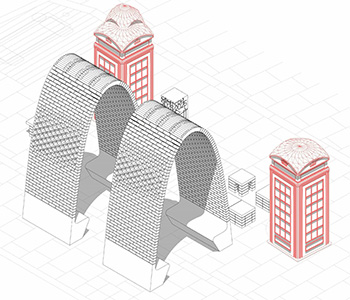
Clearly articulated concept proposals for Brick from a Stone: Arch Revival
1. Lead with a clear design idea
A compelling pavilion begins with a sharply defined concept—something that can be explained in a sentence and understood intuitively by the public. Proposals should convey why the structure exists, what experience it offers, and how it responds to the festival’s theme or site. Focus on atmosphere, interaction and material presence as much as form, and avoid over-complication: the best pavilions are often simple ideas expressed with confidence.
2. Articulate an ethos, not just a form
Festivals increasingly look for projects with purpose. Whether your ethos centres on sustainability, social value, material innovation or cultural storytelling, make it explicit. Explain how the pavilion contributes to broader conversations—about carbon reduction, public space, craft, or community identity—and how its afterlife may extend its value beyond the festival itself.
3. Build strong collaborations from the start
Temporary projects benefit enormously from early partnership building. Collaborate with structural engineers to test feasibility and demonstrate safety and buildability. Consider teaming with fabricators or material manufacturers, who may both enrich the design and offset costs. Working with charities, educators or community groups can also give a pavilion deeper meaning and help address festival priorities related to social engagement and accessibility.
4. Engage local communities where relevant
Many festivals favour installations that speak to their neighbourhoods or audience groups. Explore ways for local residents, schools or community organisations to participate—through co-design workshops, programming, or direct use of the structure. These connections can strengthen the narrative and improve the proposal’s chance of selection.
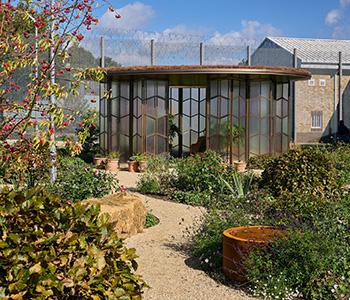
The Glasshouse Pavilion at it’s new location at HMP Downview
5. Plan for sustainability and reuse
Temporary architecture is under increasing scrutiny for its environmental impact. Highlight low-carbon materials, modular construction, and designs that minimise waste. If your pavilion can be relocated, repurposed or gifted—such as Hollaway Studio’s pavilion moving from Chelsea to HMP Downview – make this part of the proposal.
6. Make budgeting and logistics look easy (even if they aren’t)
Festival teams want reassurance that you can deliver on time. Provide a simple, credible outline of programme, fabrication strategy, assembly sequence and risk considerations. Show that you understand transport, permissions, site constraints and deinstallation. Clarity here makes your design feel achievable.
7. Secure sponsorship early
Most pavilions rely on a blend of in-kind and financial sponsorship. Approach material suppliers, technology partners or cultural funders with a clear offer: visibility, storytelling opportunities, thought-leadership, or research value. Sponsorship letters or confirmed partners can significantly strengthen a submission.
8. Celebrate the temporary nature of the project
A pavilion is a chance to test ideas you wouldn’t risk on a permanent building. Embrace this freedom—use the proposal to demonstrate curiosity, experimentation and design intelligence. Festivals are drawn to projects that feel alive, responsive and generous to the public.