


Could this be the project that revives the big competition?
The National Gallery’s competition for a £400 million New Wing brings international talent, bold urban ambition and cultural renewal, raising the question of whether this moment might rekindle Britain’s appetite for open, design-led public architecture
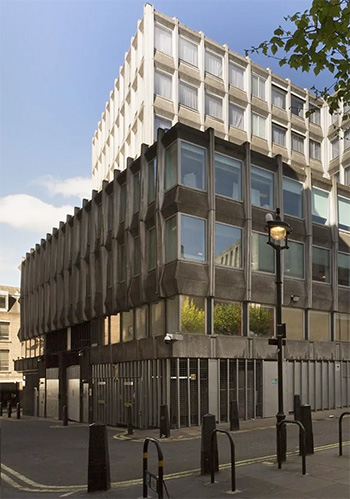
St Vincent House
The National Gallery’s unveiling of its shortlist to design a New Wing is causing considerable excitement both within the architectural world and across the cultural sector. This moment marks a major milestone in the Gallery’s £750m “Project Domani” campaign, an ambitious transformation that aims to extend the national collection into the 20th and 21st centuries while strengthening the institution’s long-term resilience. For a gallery that has just celebrated its bicentenary, the decision to invest at this scale signals a renewed confidence in the civic and cultural role of architecture – and a recognition that the built environment is central to how the Gallery will tell the story of European art in the century ahead. And from the National Gallery’s perspective, an opportunity to offer space to expand it’s collection into modernism and contemporary art, and compete with the showstopper exhibitions currently staged by other major London art galleries.
At the heart of this endeavour is the underperforming St Vincent House site: an overlooked island block tucked between Trafalgar Square and Leicester Square, long treated as a back-of-house zone despite its extraordinary location. Now it is poised to become the focal point of a project that could reshape not only the National Gallery’s campus but a key corner of the West End. With its blend of heritage sensitivity, urban ambition and international design talent, the competition has the potential to become one of the defining architectural commissions of the decade—and to reassert the value of public architecture in the UK at a moment when such opportunities have become increasingly rare.
The six teams moving forward
From 65 global submissions, six teams have been invited into Stage 2 of the design competition:
– Farshid Moussavi Architecture with Piercy & Company (UK)
– Foster + Partners (UK)
– Kengo Kuma and Associates (Japan) with BDP (UK)
– Renzo Piano Building Workshop (Italy) with Adamson Associates (UK)
– Selldorf Architects (USA) with Purcell (UK)
– Studio Seilern Architects (UK)
It is, unsurprisingly, a heavyweight shortlist: Foster + Partners, authors of the British Museum’s Great Court among many other public projects in London; Renzo Piano, synonymous with the Shard in London, theBeaubourg and a generation of cultural architecture; Kengo Kuma, designer of the V&A Dundee; and Selldorf Architects, responsible for the recent Sainsbury Wing refurbishment. Alongside these global names, Farshid Moussavi and Studio Seilern bring a more conceptually driven London-based perspective, both women led studios practised in tackling complex cultural and urban briefs. Overseeing the decision is a jury that brings together trustees, museum leadership, practitioners and cultural figures, including John Booth, Céline Condorelli, Sir Gabriele Finaldi, Patty Hopkins, Sir John Kingman, Dame Diane Lees and David Marks.
We were particularly delighted to see Studio Seilern shortlisted. As long term client of ours, we worked closely with Christina Seilern and her team on their qualifying bid – an intense and ultimately rewarding collaboration. Their excitement at reaching this stage has been unmistakable; this competition offers precisely the type of public-facing platform in which they intend to thrive.
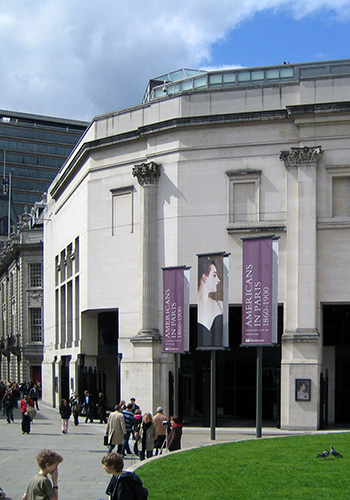
The Sainsbury Wing
Echoes of 1985: The Sainsbury Wing competition
This is not the first time the National Gallery has used an international architectural competition to redefine its identity. In 1985, the competition for what would become the Sainsbury Wing – ultimately won by Venturi Scott Brown – ignited a national conversation about the future of museums, architectural style, and the responsibilities of cultural buildings in the public realm.
The Sainsbury Wing competition arrived at a moment of intense debate: Postmodernism versus Modernism, conservation versus contemporaneity, and the question of how a major public institution could assert its relevance without undermining its heritage.
Venturi Scott Brown’s winning design became a lightning rod: praised, contested, dissected; but crucially, it reenergised public discourse about architecture, culture and urbanism. It showed that a new wing of a museum could become an intellectual and cultural event, not merely a capital project.
Perhaps today’s competition occupies a similar turning point? The National Gallery is again reframing its collection to extend into modern and contemporary art, and once more turning to international architectural talent to articulate what that evolution means.
The question is inevitable: could this competition play a role as catalytic as that of 1985, sparking a renewed national debate about public architecture, civic space, and cultural ambition?
The ingredients are certainly in place.
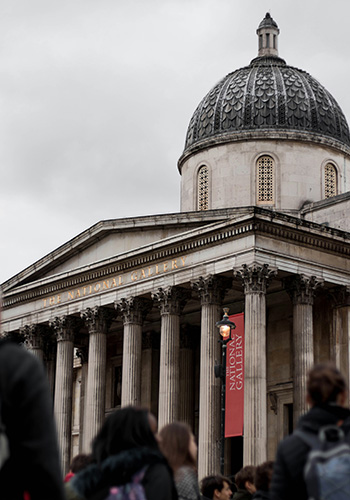
Main entrance portico to Trafalgar Square
A brief with broad cultural horizons
The new wing will add 5,500-7,000 sqm of space, blending seamlessly into the Gallery’s existing rooms while extending the story of European painting into the 20th and 21st centuries. The National Gallery emphasises that this expansion must preserve the “manageable” visitor experience for which it is famous: achieved through careful spatial rhythm, impeccable daylighting and continuity of architectural identity.
City-making at the heart of the project
Unlike the 1985 competition, today’s brief looks outward as much as inward. The transformation of Whitcomb Street, Orange Street and St Martin’s Street is central, turning service routes into a vibrant, green public realm that links Trafalgar Square and Leicester Square. In this respect, the project is not simply an extension to a museum but a major piece of urban repair – an intervention that could reshape a corner of the West End, strengthening the emerging “Arts Quarter” and supporting new forms of public life.
If the Sainsbury Wing clarified architectural ideas within the building itself, the new wing could redefine how the Gallery meets the city.
Sustainability as a cultural and architectural driver
The sustainability agenda reinforces the project’s contemporary urgency. Westminster’s retrofit-first policy and the Gallery’s net-zero ambitions require a serious examination of structural reuse, minimised embodied carbon and a fossil-fuel-free energy strategy. The project must improve biodiversity, reduce potable-water use and achieve BREEAM Excellent. Sustainability is no longer an add-on; it is a conceptual core – one that could shape the architectural expression of the building as profoundly as style shaped the Sainsbury Wing.
Could this be another catalytic moment in UK architecture?
Today’s competition arrives at a time when open, design-led procurement in the UK has become increasingly rare. In that context, the National Gallery’s move feels almost radical: transparent, international, intellectually ambitious and unapologetically public.
If the resulting building succeeds in delivering both architectural excellence and urban transformation, while embedding deep sustainability, it could once again trigger a wider national conversation about what public architecture can be. And if that conversation reignites, it might reshape not only the streets around St Vincent House but the culture of commissioning itself. We live in hope.