


Beedier’s top ten Biennale moments
A visual and critical journey through the standout installations at the Venice Architecture Biennale 2025, capturing the creative essence, spatial ingenuity, fun, and provocative ideas shaping global architectural discourse
In a previous article, The Noise and the Message: Strategies from the Venice Biennale, we explored how the Venice Architecture Biennale serves as a rich, chaotic, and often contradictory space where architecture’s intellectual, political, and aesthetic ambitions clash and converge. This year, the Biennale continues to challenge, and at times, overwhelm us with installations that can be poetic, research driven, speculative, beautiful and provocotative.
While the overarching curatorial strategies remain open to interpretation, what is undeniable is the singular impact of certain works that rise above the noise. These installations do not simply occupy space, they question it, reimagine it, and in some cases, radically deconstruct it.
They linger in memory, not just for their visual drama, but for the questions they pose about the future of cities, climate resilience, colonial legacies, and the very role of the architect in a fractured world.
In this follow-up, we spotlight ten of the most compelling pieces from the exhibition, works that cut through the Biennale’s multitude of voices with clarity, courage, and innovation. Of course, this is a subjective view, but one that is based on the success of the communication strategies at play – images and critical commentary. We were hoping to see beautifully presented installations that present an essential position in ways that are engaging, fulfilling, and clear.
111
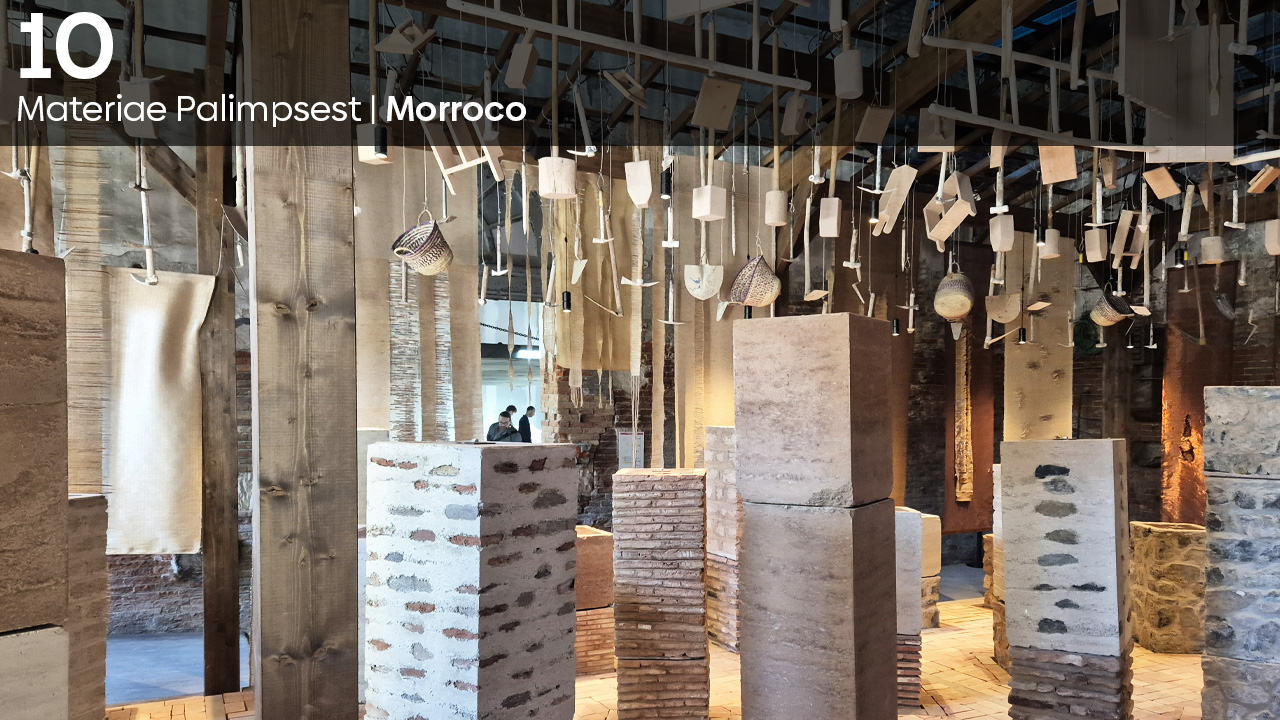
Morocco’s first outing at the Biennale, Materiae Palimpsest showcases the fusion of traditional earth architecture with digital innovation. Curated by Khalil Morad El Ghilali and El Mehdi Belyasmine, founders of Ateliers Be, and Belyas.co respectively, the exhibit invites tactile engagement through brick plinths crafted from various earthen materials, and displays suspended builders’ tools that honor ancestral techniques. Holograms of artisans in motion and textiles by Soumiya Jalal enrich the sensory experience. The pavilion explores circularity, resilience, and local identity, proposing how ancient Moroccan methods can inform sustainable, future-oriented design, and where craftsmanship and technology coalesce to reimagine how we build with the earth. But most importantly, it presents an installation that is fun to navigate, and a clear symbolic visual idea that is bolstered with an impressive digital projection at its spatial heart, that tells the story of local construction practices.
The installation balances conceptual depth with visual clarity, making it accessible to both lay visitors and architectural specialists alike. In a Biennale where complexity often overwhelms, Morocco’s installation offers an elegant demonstration of how cultural specificity and material intelligence can generate a compelling architectural narrative.
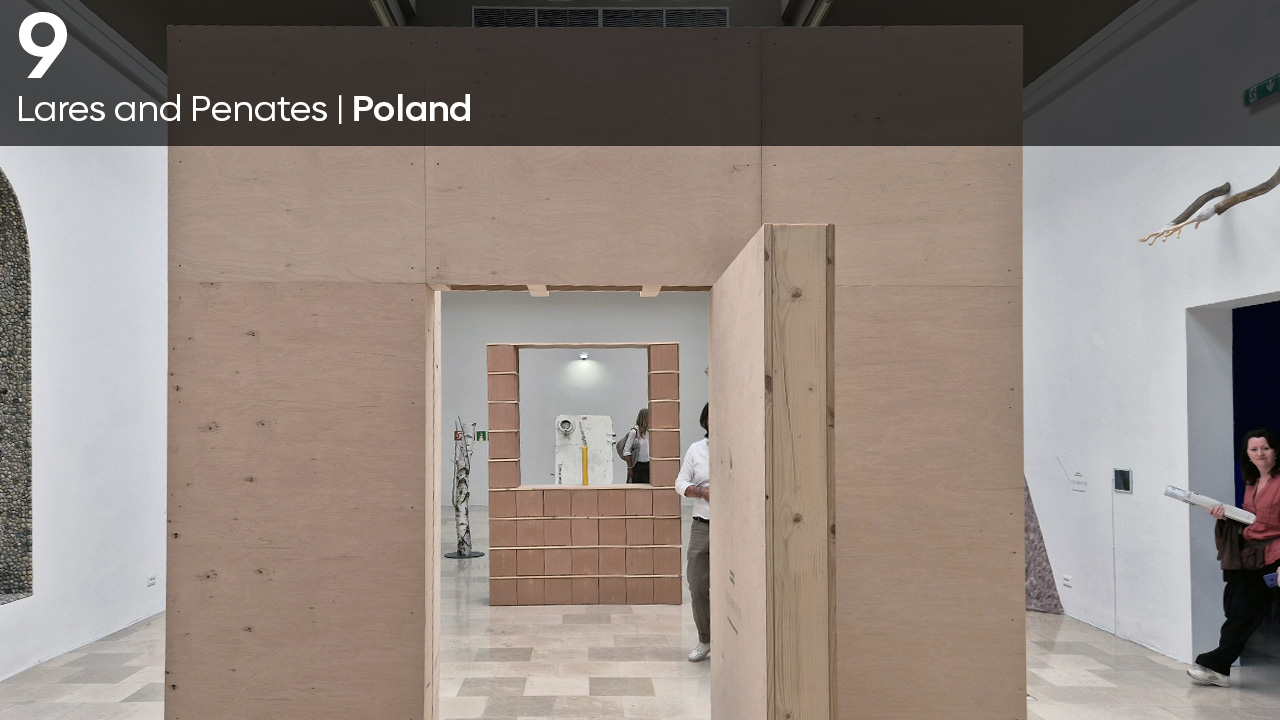
Amidst the density and earnestness that defines much of the Biennale’s architectural introspection, the Polish Pavilion offers a welcome reprieve – thoughtful, yes, but also refreshingly witty and grounded in cultural familiarity. Drawing on everything from municipal regulations to superstition, the Lares and Penates: On Building a Sense of Security in Architecture straddles high seriousness and everyday absurdity. Here, building codes share space with protective folklore: horseshoes above doorways, holy water by the entrance, mirrors deflecting bad energy, eggshells in the foundations. Rather than critiquing these practices, the exhibit embraces them as a kind of grassroots resilience.
Curated by an interdisciplinary team, involving architect Maciej Siuda, writer Aleksandra Kędziorek, and artists Krzysztof Maniak and Katarzyna Przezwańska – their approach offers a playful anthropological lens with visual references from meme culture, religious kitsch, and urban legends, creating a space that feels oddly familiar and gently ironic. In a Biennale heavy with speculative futures and solemn manifestos, Poland’s contribution offers a nuanced reminder: architecture is also about emotion, ritual, and the small, strange things that help us sleep at night.
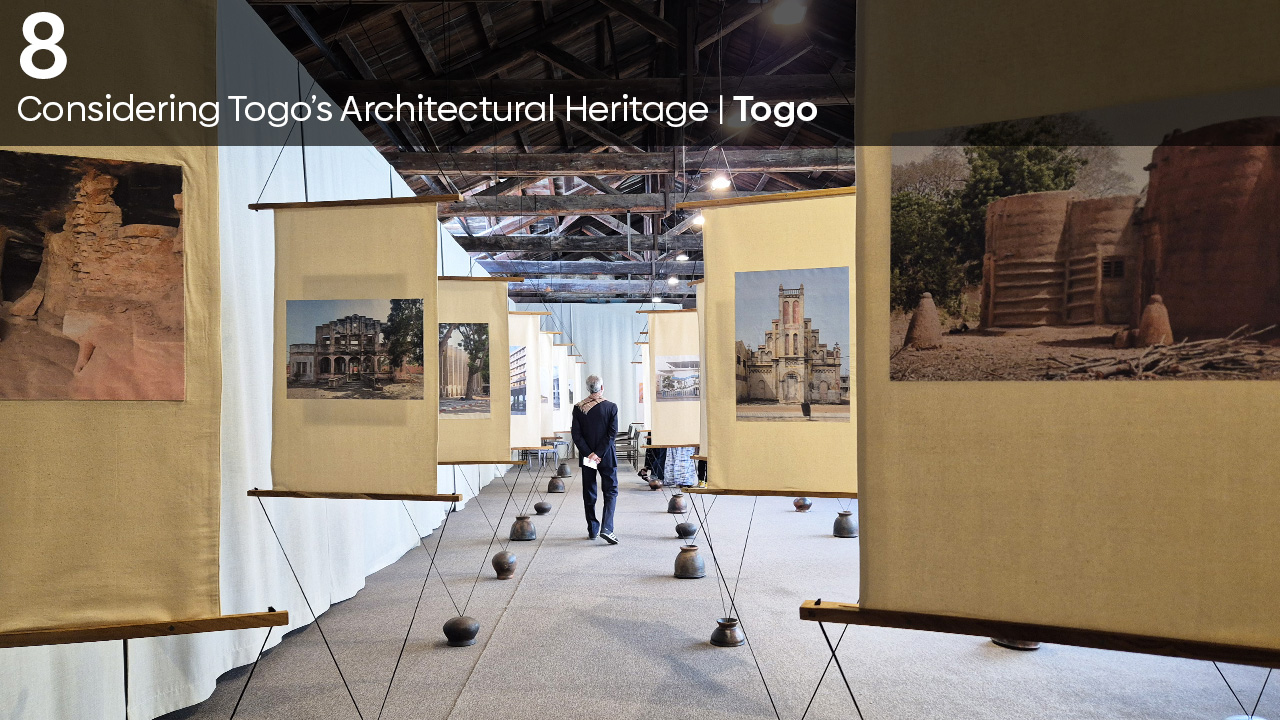
Another debut at the Venice Architecture Biennale, Togo’s inaugural installation is a modest but revelatory presentation that quietly commands attention through its clarity, sincerity, and the strength of its subject matter. Considering Togo’s Architectural Heritage, provides an overdue introduction to a national legacy long overlooked. Curated with both restraint and conviction by female led Studio NEiDA, the exhibition traces a lineage from the ancient Nok Caves and the fortified Tata Tamberma compounds of northern Togo, through the distinctive Afro-Brazilian dwellings built by returnees from the Americas, to the post-independence modernist experiments of Lomé. By intentionally omitting colonial architecture – constructed with disregard for local climate, culture, and materials – the pavilion underscores a more authentic narrative of architectural agency and continuity. What emerges is a portrait of a rich, climate-responsive tradition, built not only of clay, stone, and concrete, but of memory, ingenuity, and resistance.
The presentation is straightforward, avoiding spectacle, but the effect is profound. It invites reflection, not just on Togo’s past, but on how architecture everywhere might reconnect with context, craft, and cultural intelligence. We left not just informed, but inspired, and mentally noting that a visit to Lomé should be on the cards to see some of these gems in person – proof that this pavilion has succeeded not only in showcasing history, but in awakening a sense of architectural interest in the subject matter. In a Biennale of big ideas, Togo reminds us that heritage itself can be a radical proposition.
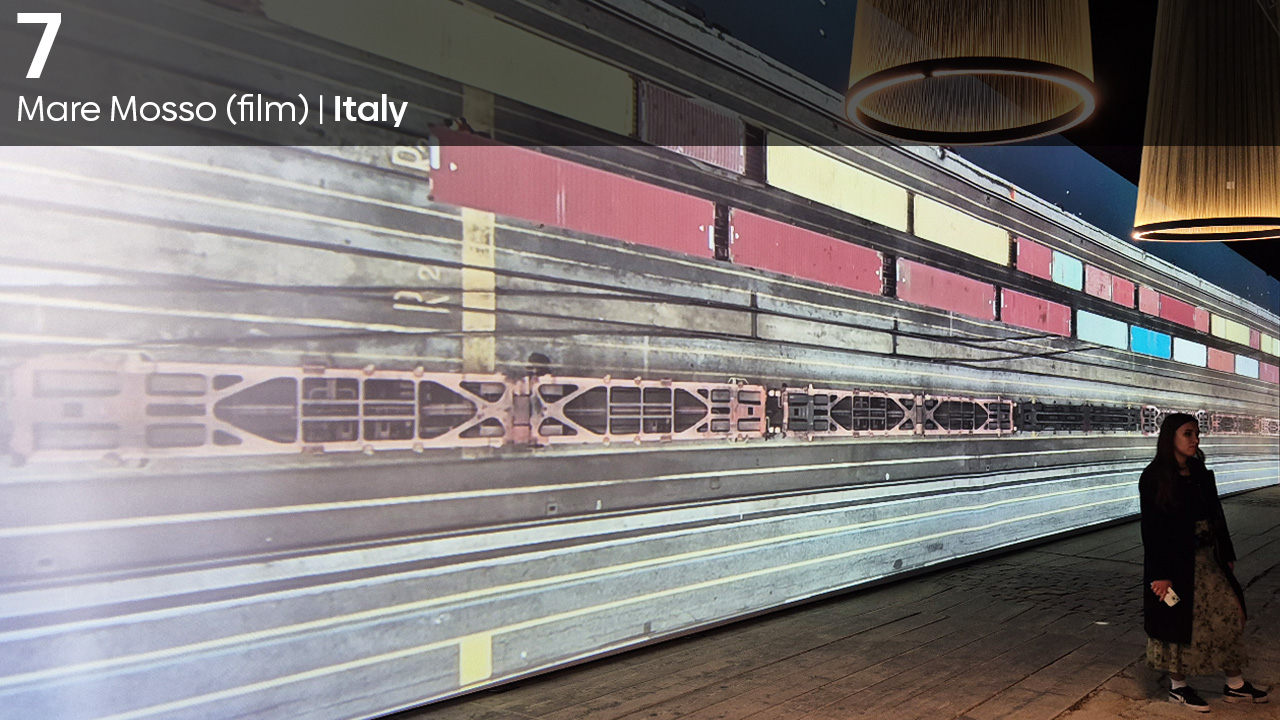
At the heart of the Italian Pavilion’s sweeping, poetic meditation on coastal identity and environmental stewardship – Terrae Aquae: Italy and the Intelligence of the Sea – lies filmmaker Luigi Filetici’s contribution, a monumental film installation that is as visually commanding as it is emotionally resonant. Displayed across an expansive screen, the film doesn’t merely complement the exhibition’s thesis; it embodies it, drawing viewers into a trance-like journey along Italy’s fragile maritime threshold. Mare Mosso (literally “rough sea”) explores the liminal space between land and water, a zone Filetici presents as both a physical edge and a symbolic mirror of transformation. The film oscillates between serene seascapes and frenetic port activity, creating a rhythm that mimics the sea itself – calm and chaos in constant exchange. With an ambient score by David Monacchi, the visuals unfold like a meditative poem: cranes silhouetted against pastel skies, submerged cable production lines, retreating glaciers, and ghostly sequences of container movement. The camera lingers on shorelines, horizons, docklands, and ships, where civilization meets nature and progress contends with collapse.
The film offers not just cinematic grandeur but deep symbolic weight, reminding us that our future may depend on re-learning to read the sea – not just as resource or boundary, but as a profound architectural and existential intelligence. The strength of the piece was in it’s scale, and beauty, offering an impressive and moving moment of pause in the gallop through the exhibits.
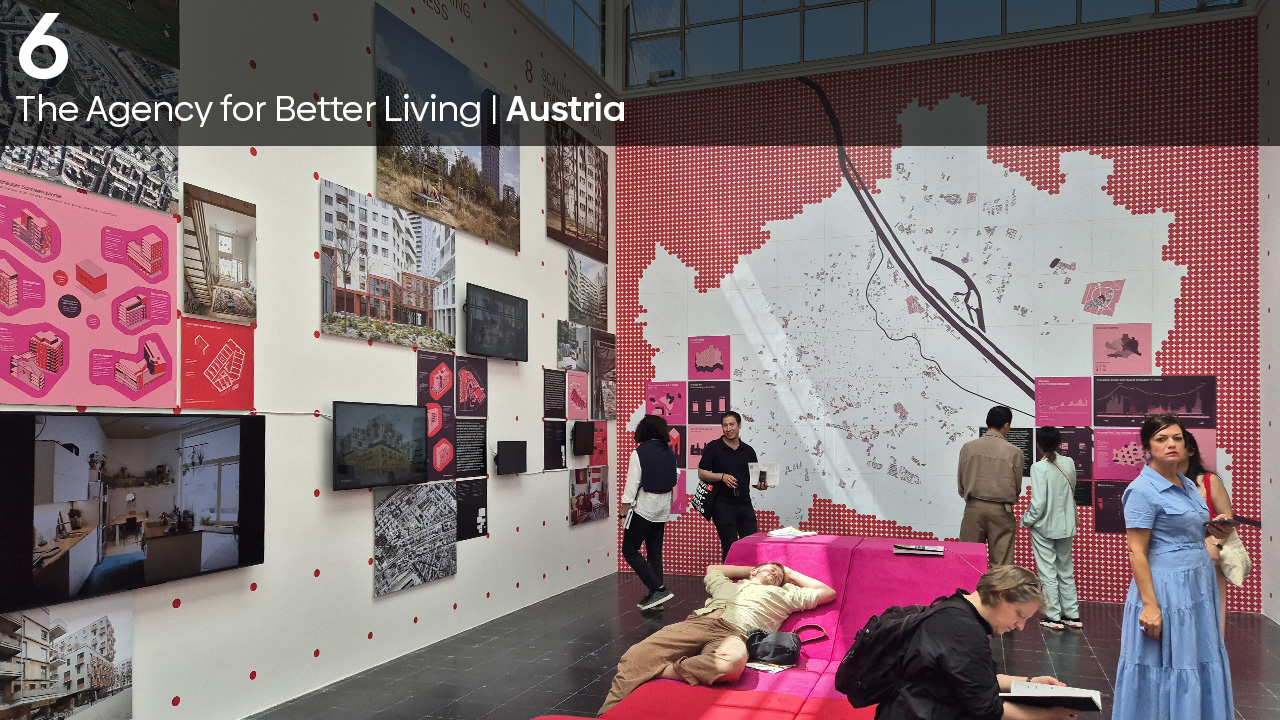
In an era where housing is increasingly treated as a luxury investment rather than a basic right, the Austrian Pavilion stands out as a bold and necessary intervention. The Agency for Better Living is a powerful, clear-sighted response to the escalating urban housing crisis, and one that refuses to romanticise architecture and instead foregrounds its political and social responsibilities. Set within the symmetry of Josef Hoffmann’s national pavilion, the curators – Lorenzo Romito, Sabine Pollak, and Michael Obrist – have staged a compelling comparison between two radically different models of collective housing: Vienna and Rome. On one side, Vienna represents a structured, top-down system of publicly funded housing, rooted in a century-old commitment to affordable living. On the other, Rome showcases informal, bottom-up housing movements – squatted, self-organised, and sustained through grassroots solidarity. By placing these two models in dialogue, the exhibition creates an ideological and spatial conversation: stability versus spontaneity, state policy versus civil disobedience.
The strength of the installation lies in its clarity and urgency. Archival footage, case study models, and resident testimonies ground the message in lived reality, while the central courtyard becomes an open forum for participation – transforming visitors into agents of change. In doing so, the pavilion avoids didacticism and instead fosters curiosity and dialogue. It presents as not just a display of ideas, but a call to action against the commodification of home. It reminds us that better living is not an abstraction, but a right, and one that demands intelligent, collective care. In a Biennale full of speculation, Austria delivers a vital, grounded blueprint for how architecture might reimagine the social contract, with real lived experiences and examples – and this is why it was inspiring.
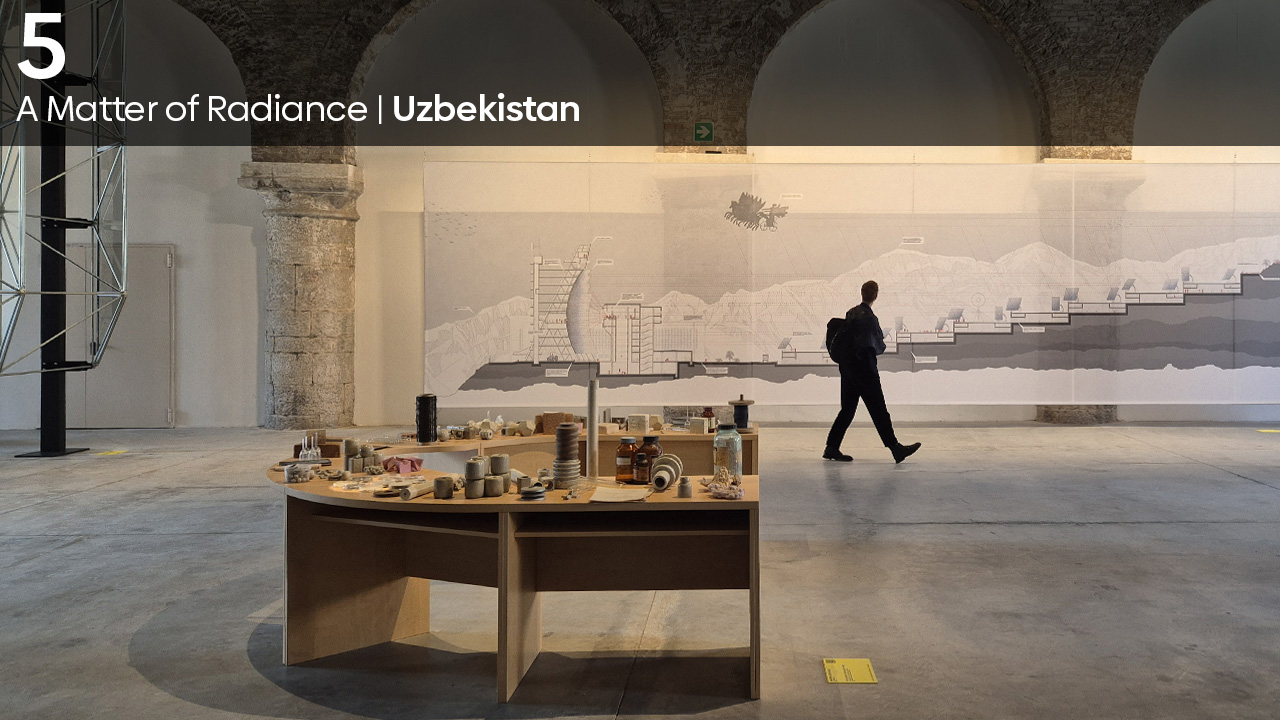
The Uzbekistan Pavilion unveils one of the most unexpectedly fascinating stories of this year’s Biennale. A Matter of Radiance, curated by Ekaterina Golovatyuk and Giacomo Cantoni of GRACE studio, transports visitors into the once-secretive world of Soviet-era scientific ambition, centering on the Sun Heliocomplex – an enormous solar furnace built in 1987 near Tashkent, and one of only two such structures in the world. What unfolds is a story of architectural and scientific vision and political symbolism, through a narrative long hidden to the West, now reanimated with haunting clarity. Originally conceived during the Cold War as a counterpart to France’s Odeillo solar complex, the Uzbek facility was designed to study materials at nearly 3,000°C, pushing the limits of space and military research. Now obsolete in some ways but brimming with untapped potential, the furnace’s monumental form becomes a metaphor for a suspended utopian modernism – mythic, and strangely beautiful
The pavilion’s exhibition is both poetic and forensic. Fragmented elements of the original complex: heliostats; control tables; and screens are displayed within the space like relics of a lost civilisation – while newly commissioned works by artists, filmmakers, and scientists explore the cultural and scientific afterlife of the institute. What might first appear as an esoteric piece of infrastructure becomes, through the curatorial lens, a prism through which to examine the ambitions and contradictions of science, architecture, and ideology. The installation stands out as a rare example of a pavilion that is both specific and speculative, local and global. It doesn’t just reveal a building – it exposes a world, inviting us to see architecture not only as shelter or symbol, but as a vessel of evolving knowledge and forgotten dreams.
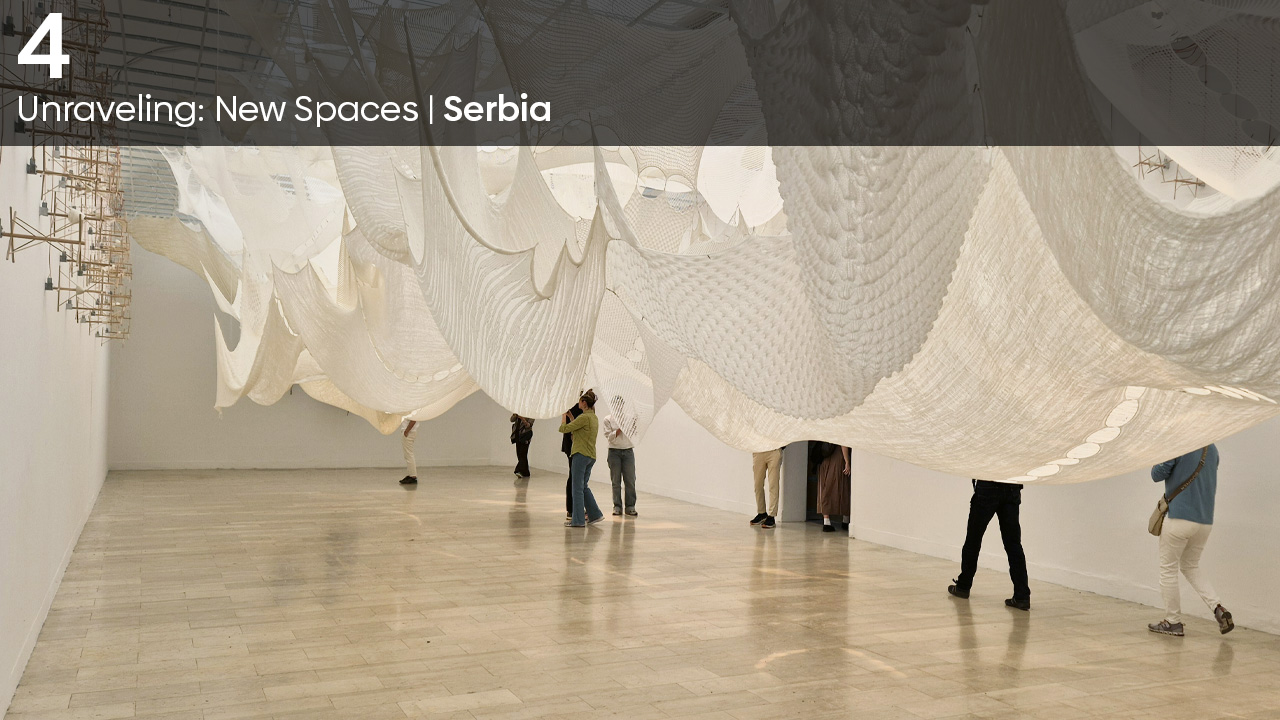
In a Biennale dominated by complexity and spatial density, the Serbian Pavilion takes a radically different approach: slow, tactile, and time-bound. Unraveling: New Spaces unfolds – literally and conceptually – over the full six months of the exhibition, presenting architecture not as fixed form, but as dynamic process. The pavilion’s central metaphor is the act of knitting and unknitting, both a gesture of craft and a structure of thought. An architectural form, assembled from wool fills the space, and then, as the Biennale progresses, it is gradually and visibly unraveled, until only a ball of yarn remains. This cyclical arc transforms the pavilion into a living performance of entropy and regeneration – referencing the consistent pattern of construction and demolition present in contemporary architecture.
The pavilion’s success lies in how gently yet forcefully it reframes the nature of architectural thinking. The changing and temporary nature of the object resists the impulse to comprehend it in one glance. Instead, it demands a slower engagement, figuring out how the unravelling mechanism works, and how the knitted structure was created in the first place. In this regards, the installation is neither monument nor manifesto, but a philosophical meditation. In resisting permanence, it offers something altogether more radical: an architecture of impermanence, vulnerability, and transformation. One that quietly persists in the memory long after the yarn has disappeared. Of all the exhibits, this one perhaps fused the skill of architect, and fine artist most successfully. The project team includes architects Davor Ereš, Jelena Mitrović, and Igor Pantić, as well as Sonja Krstić and Ivana Najdanović (textile structure design), and Petar Laušević, engineer of kinetics and power supply.
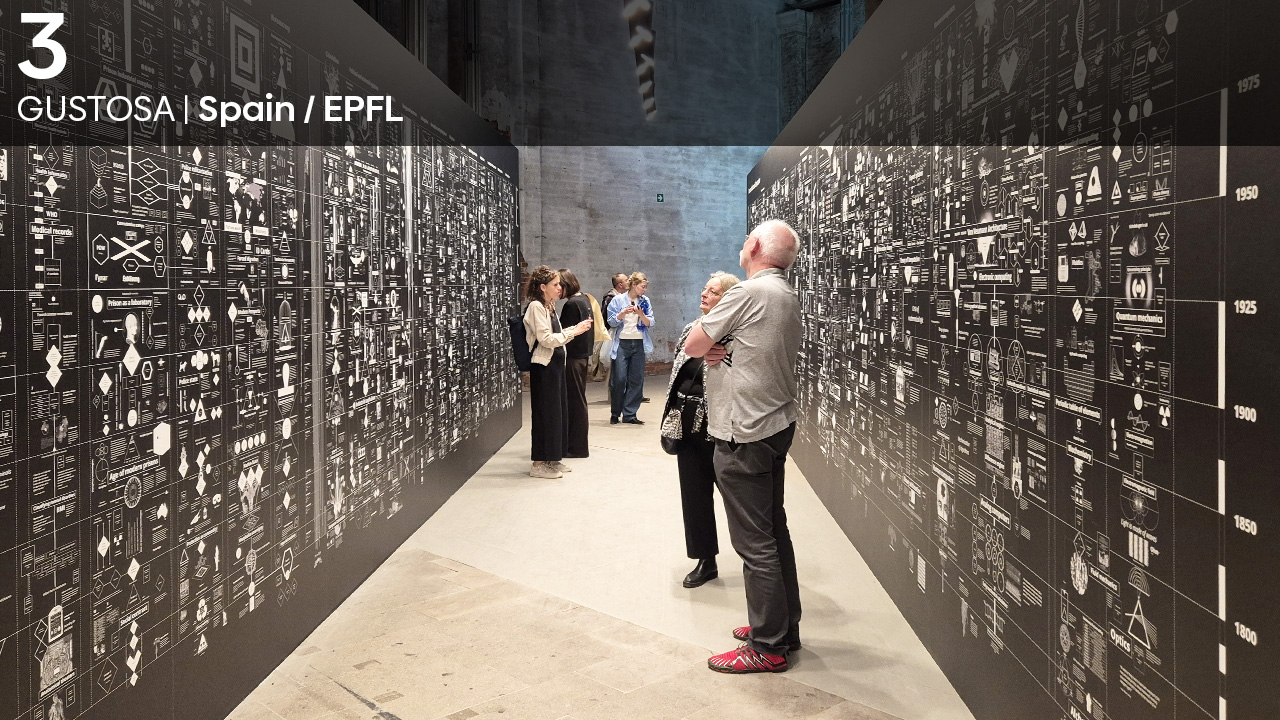
Tucked into the Arsenale, GUSTOSA is one of the most intellectually and graphically ambitious installations of the Biennale. Led by Spanish researchers based at EPFL (École Polytechnique Fédérale de Lausanne) including Aitor Frías and Joaquin Perailes of AFAB Architecture, with Lucía Jalón Oyarzun, Juana María Sánchez Gómez, and Diego Jiménez-López – the project proposes nothing less than a redefinition of how we map, understand, and design for a world of hybrid intelligences. It is a remarkable labour of love, overflowing with visual data, conceptual depth, and speculative potential. GUSTOSA – short for Graphic Umwelt Set Theory of Signs and Affordances – functions as both research protocol and aesthetic artifact. Presented as a massive, immersive graphic panorama, it charts a dizzying network of interactions across human and non-human agents, from the molecular to the planetary scale. Through this framework, it proposes a “technosymbiotic” worldview: one where built environments, ecosystems, and technologies coalesce into multispecies habitats.
The installation is visually intense, an intricate web of symbols, data flows, and relational diagrams that visitors can wander through, get lost in, or study like an atlas of technological consciousness. It doesn’t just visualise systems, it creates a new language for understanding how the perceived possibilities of interaction might operate between humans, machines, animals, and materials. What sets GUSTOSA apart is its synthesis of radical content and exquisite form. The research is rigorous, yet the graphic execution is poetic – a work of systems art as much as architectural theory. The result is an absorbing space that rewards patience and curiosity, making visible the invisible structures that bind together our contemporary existence.
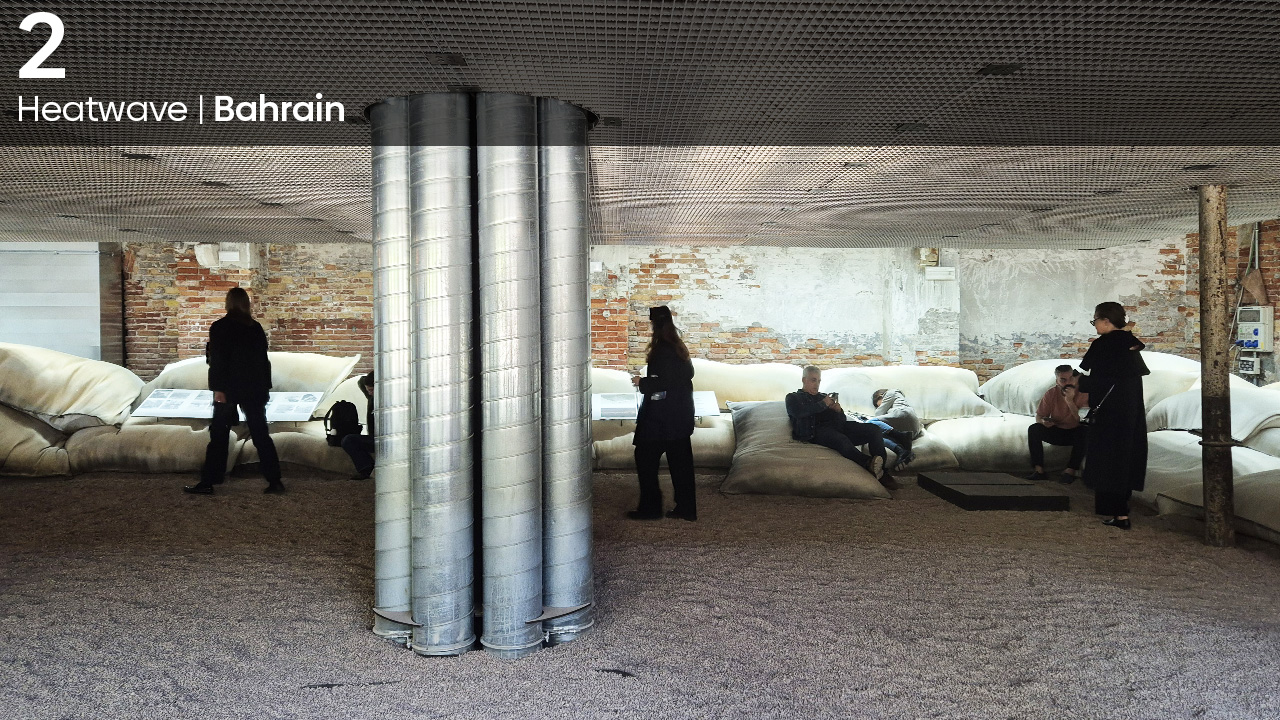
Winner of the 2025 Biennale’s coveted Golden Lion for Best National Participation, the Bahrain Pavilion delivers an understated yet deeply resonant installation that tackles one of the most pressing global challenges: extreme heat. Titled Heatwave, developed for the Bahrain Authority for Culture and Antiquities by architects Nora Akawi, Ghassan Maasri, Ali Karimi and Hamed Bukhamseen, the pavilion is both a design proposition and a spatial manifesto. It is an architectural response shaped not around abstract theory, but around the lived realities of the most exposed and vulnerable: outdoor laborers, particularly those on construction sites. Rather than a symbolic gesture or speculative narrative, the pavilion offers a 1:1 full-scale prototype – a modular structure that combines traditional Bahraini passive cooling strategies with contemporary material and climate research. Suspended ceiling, raised platform, and a single supporting column together create a shaded microclimate, allowing visitors to physically experience a space where architecture mediates thermal comfort.
The success of Heatwave lies in how it redefines public space as a “thermal commons” – a shared environmental resource where equitable access to comfort becomes a form of spatial justice. The design framework is intentionally modular and adaptable, meant to be deployed across a variety of urban contexts: school courtyards, construction sites, public squares. In this, it advocates for an architecture that is not monumental but humane, responsive, and replicable. The Biennale jury praised the pavilion for its “elegant architectural articulation of a growing global issue”, and indeed, it stands out for both its emotional immediacy and practical clarity. It is a space you don’t just admire, but you feel. Heatwave reframes adaptation as an architectural ethos: not about retreat, but resilience. In a world increasingly shaped by rising temperatures, Bahrain’s contribution reminds us that thermal comfort is not a luxury, but a right – and that design must meet that challenge with intelligence, humility, and care.
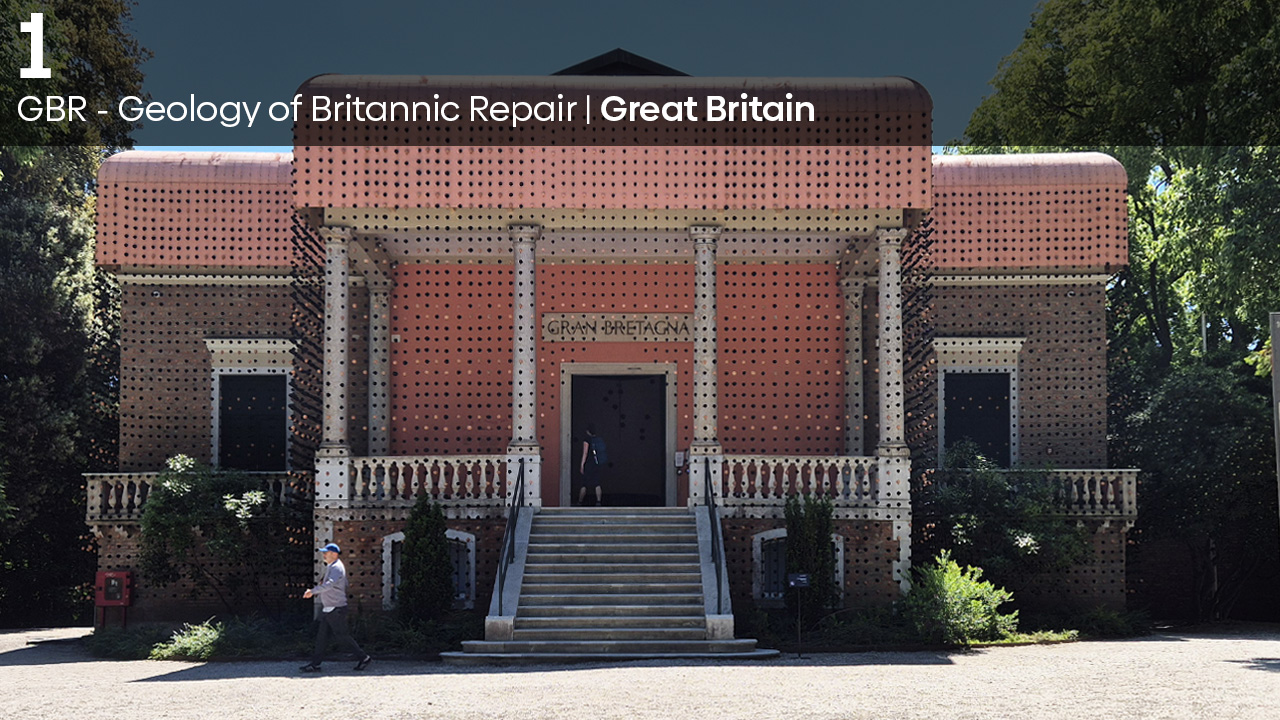
Of all the national contributions at the 2025 Venice Architecture Biennale, the British Pavilion is, in our view, the most accomplished. GBR – Geology of Britannic Repair offers a striking fusion of scholarly precision, poetic materiality, and profound political reflection. Curated by a UK-Kenyan team including Owen Hopkins, Kathryn Yusoff with Stella Mutegi and Kabage Karanja of Nairobi based cave_bureau, the installation reframes architecture not as a discipline of invention but as one of repair. It is a restorative proposition, one that confronts architecture’s role in colonialism and climate degradation, and instead embraces strategies rooted in local knowledge, land-based practice, and ecological justice. The building itself becomes the introduction to the exhibition. Draped in a veil of charcoal briquettes, clay beads, and glass ornaments – materials sourced and crafted through Kenyan artisanal networks, the neo-classical pavilion is visually and symbolically transformed. This architectural skin references the Maasai manyatta and repurposes the building as an active participant in the exhibition’s message, highlighting suppressed material cultures.
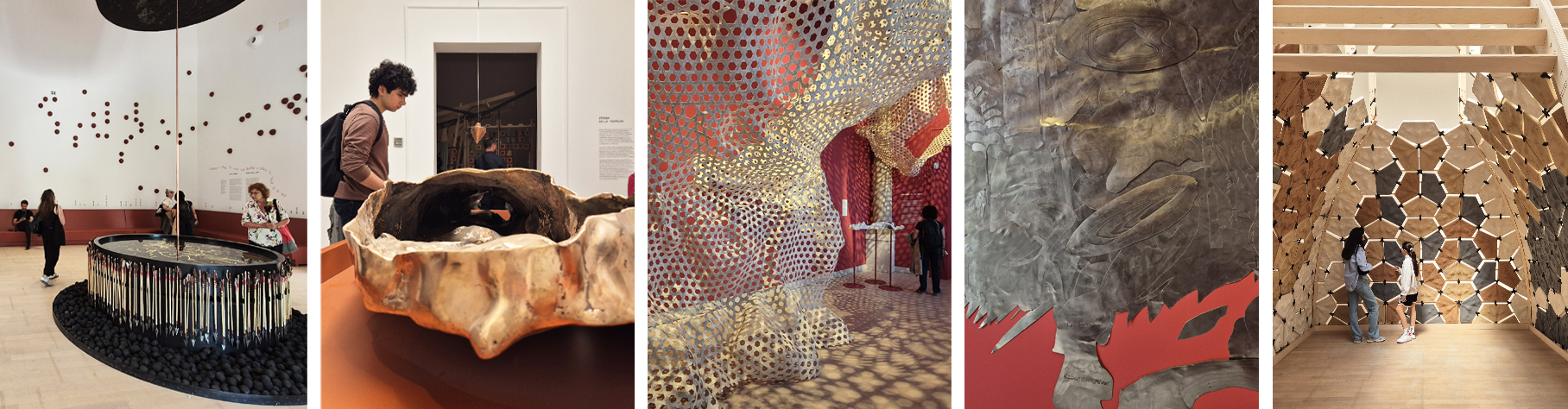
Once inside, at the heart of the pavilion, The Earth Compass, acts as a notional vestibule, and offers a deft and deliberate act of spatial reorientation. Above: the night sky over Nairobi on 12 December 1963 – the moment Kenya reclaimed its independence. Below: a vibrating oil drum disturbs the sky over London on that same date, a rhythmic counter-memory pulsing through the architecture. Inside, the exhibition unfolds through a series of beautifully executed installations: Rift Room, Objects of Repair, Shimoni Slave Caves, and Lumumba’s Grave. We are taken from the Rift Valley to the ruins of Gaza, from subterranean coral caves to orbital debris in space, all threaded together by a commitment to unearth the neglected, the erased, and the resilient. What sets GBR apart is its refusal to separate style from substance. The visual identity – earthy reds, granular textures, and graphic clarity – amplifies the content without overshadowing it. Every object, from bio-fabricated panels to laser-mapped cave geometries that once provided refuge for escaped slaves, is meaningful. Every story, from Kenya to Palestine, from the colonial maproom to the greenhouse at Kew, is situated with care.
As part of the British Council’s UK/Kenya Season 2025, the project is a model of cross-cultural curation that doesn’t dilute complexity but deepens it. It doesn’t offer solutions, it offers tools, atmospheres, and questions that matter. In a Biennale where many pavilions retreat into abstraction or spectacle, GBR: Geology of Britannic Repair demonstrates how deeply rooted research, beautifully executed design, and ethical clarity can converge – and does so through a collection of beautifully crafted objects, each representing something tangible, real formal narratives that are moving and profound.
What this selection reveals is that the most successful installations weren’t necessarily the most complex, but the ones that communicated with precision, beauty, and intent. Whether through graphic intensity, sculptural clarity, or cinematic scale, these projects spoke to us with uncommon coherence. They moved us, made us think, or simply made us smile. In a Biennale often awash with conceptual overload, these were the moments where message and medium met, and where architecture didn’t just theorise, but made its point felt, seen, and understood.
The 2025 Venice Architecture Biennale runs from Saturday, May 24 to Sunday, November 23, across various locations in Venice including the Giardini and the Arsenale. Tickets can be purchased online via the official Biennale website: www.labiennale.org