


by Selva Campos
Architectures for an Overheated Planet: Brazil as a Territory of Urgency, Memory, and Transformation
In this interview and retrospective review, curator Clévio Rabelo reflects on how the 14th São Paulo Architecture Biennale redefined architecture’s role amid climate crisis and inequality
Hosted from September 18 to October 19, 2025, the 14th International Architecture Biennale of São Paulo (BIAsp) transformed Niemeyer’s Oca Pavilion in Ibirapuera Park into a forum for reimagining architecture’s role amid climate crisis and inequality.
Under the theme “Architectures for an Overheated Planet,” the Biennale gathered architects, artists, and communities from across Brazil and the Global South to explore how building for a changing world begins with care, ancestral wisdom, and ecological justice. Through a conversation with curator Clévio Rabelo, Beedier’s Thalles Cance and Selva Campos reflect on how this edition redefined what it means to design with – rather than against – the planet.

Oca Pavilion at Ibirapuera Park – Oscar Niemeyer Project (1951). Photo: Rafa D’Andrea
Brazil stands at a crossroads of cultural and environmental reinvention, and few events capture this transformation as powerfully as the 14th International Architecture Biennale of São Paulo (BIA), the largest architecture biennale in Latin America and the second largest in the world, surpassed only by Venice.
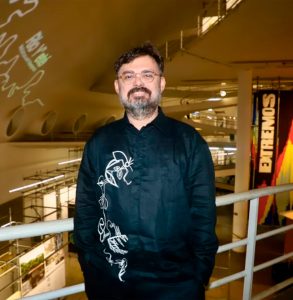
Clévio Rabelo | Curator of the biennial. Photo: Denise Andrade
Born in 1973 to give architecture a space of its own, distinct from the São Paulo Art Biennale, the event has since evolved into a laboratory of ideas where culture, ecology, and technology intersect. In its 14th edition, BIA returned to Parque Ibirapuera, under the guidance of a curatorial team that represents Brazil’s geographic and social diversity. Among them is Clévio Rabelo, an architect and urbanist from Quixadá, Ceará, whose work brings the sharp, grounded perspective of those designing from the Global South.
Architecture in Crisis and as Response
Under the theme “Architectures for an Overheated Planet”, this year’s Biennale tackled the urgency of our time head-on. According to Clévio, Climate change is no longer a distant threat, it has become our everyday landscape. Heatwaves, floods, droughts, and deforestation now cut across Brazil, affecting its people unequally. Rabelo states, “We are an international biennale, but we speak from the Global South.”
That stance challenges traditional hierarchies and centres of authority, asserting that climate responses are never neutral. They arise from specific contexts and most crucially, from communities who have long endured and adapted to the extremes of climate. “There is no climate change without people, without the communities most affected by it.”
This year’s Biennale became a shared act of responsibility. If architecture has contributed to the crisis through its intensive consumption of materials and land, it must also lead the repair: by advancing urban reforestation, adaptive reuse, circular economies, renewable energy, and fair housing.

Exposition view. Photo: Thalles Cance
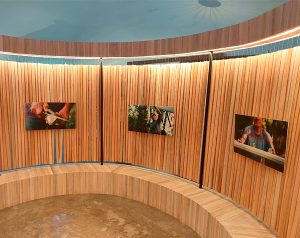
Miriti wooden pavilion | Guá Arquitetura in collaboration with Atelier Miriti Sustentabilidade. Photo: Thalles Cance
Tradition Meets Innovation
The Biennale’s exhibitions and laboratories explored how ancestral wisdom and technological innovation can meet to reimagine sustainable building. Across its pavilions, 21 experimental structures showcased materials and methods that could define the future of construction.
Among them is the Miriti wooden pavilion, inspired by an Amazonian practice that avoids tree felling by using fallen branches.
This dialogue between knowledge systems continued in the biomaterials laboratory, created in partnership with the European Institute of Design (IED). Visitors discovered cobogós made with 60% construction debris, tiles from agricultural waste, and panels crafted from eggshells and jabuticaba residue, materials that embody a new aesthetic of low-carbon ingenuity.
Housing, Justice, and the Right to Exist
Of the Biennale’s five thematic axes, one struck a vital social chord: “Ensuring Climate Justice and Social Housing”. It framed architecture not as a luxury or formality, but as a political and ethical practice bound to survival and equity.
“Architecture cannot ignore who lives where, and under what conditions,” Rabelo observes.
This theme unites professionals, communities, and policymakers around a fundamental question: who builds, who decides, and who benefits? Collaborations between industry and academy underline the point, such as ITA Engenharia’s timber beam project: stronger than steel and more affordable, recently presented at a symposium in Switzerland. “These experiments prove sustainability and market potential can coexist.”
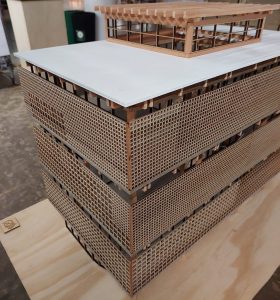
Façade clad in ceramic cobogó screen that filters light and protects the library’s collection. Photo: Thalles Cance
Returning to the Earth: Vernacular Wisdom and Climate Intelligence
In Brazil’s Northeast, particularly in Ceará and Pernambuco, architects are rediscovering the genius of vernacular materials. Two icons stood out: the cobogó and rammed earth (taipa de pilão).
The cobogó, born in Recife in the 1920s, is a perforated element that diffuses light and air providing natural ventilation and privacy while maintaining comfort. Rammed earth, an ancient method of compacting soil within wooden moulds, creates thick, insulating, and sustainable walls.
“These solutions never disappeared from popular housing,” Clévio notes. “They express the intelligence of those who have always known how to live in hot climates.”
Between Market, Community, and Public Policy
Beyond its exhibitions, the Biennale acted as a meeting ground for architects, researchers, industries, and communities. Though still in early development, this network signaled a path toward climate financing and technical training capable of strengthening architectural practice nationwide.
“We already have national legislation requiring municipal climate plans,” Clévio reminds us. “This is a learning field for studios to design not just for the market, but for the planet.”
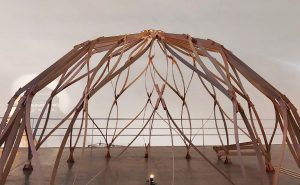
Domo Pompéia. Cohort 3 of the postgraduate course “Timber Architecture: Design and Technology”. Photo: Thalles Cance
Communicating Impact: Architecture as Social Narrative
In the age of digital storytelling, architecture’s influence depends on its message and meaning.
“It’s far more important to discuss the social and environmental impact of a project than the project itself.”
Engagement with communities, Clévio adds, begins with listening and generosity:
“Sometimes you have to donate your time, or even a project to transform your practice.”
Architecture as Time and Legacy
Architecture’s rhythms are slow, measured, and collective. “Unlike design, which moves in short cycles, architecture demands time to gather people, to finance, to plan, to build,” Clévio says.
The Biennale embraced this pace, positioning itself as an act of collective resilience, a gesture that planted seeds of change today for harvest in years to come. “We did this Biennale so that some fruits appear tomorrow, but many will only appear in ten years.”
What We Want to Build
As the largest architecture biennale in Latin America and a global reference, the São Paulo Biennale continues to shape the architectural imagination far beyond Brazil. It stands as a living laboratory, transforming its exhibition halls into spaces for reflection on climate, justice, technology, and belonging.
By bridging science, tradition, and community, it reaffirmed the enduring power of architecture to imagine and construct futures that are fairer, more resilient, and profoundly beautiful.
And Brazil, with its extraordinary diversity of climates, landscapes, and knowledge, offered the world a luminous message: It is possible to design not against the overheated planet, but with it.

Model of Guarani Mbya Indigenous people architecture. Photo: Thalles Cance
This interview and article were organised by Beedier editors Thalles Cance (Business Development Researcher) and Selva Campos (Events Researcher), São Paulo-based communications professionals. Clévio Rabelo is one of the Curators of the 14th São Paulo International Architecture Biennale and research professor at the Federal University of Ceará (UFC). He coordinates Arquitetura Bicha, a collective that researches projects and representations of architecture by LGBTQIA+ people.
In Memoriam: Kongjian Yu and the Legacy of Sponge Cities: With deep sadness, we honour the late Kongjian Yu, the visionary Chinese landscape architect whose theory of “sponge cities” revolutionised sustainable urbanism. His concept of cities that absorb, filter, and store water through natural infrastructure resonated deeply in São Paulo, inspiring a new generation to reimagine the relationship between nature and the urban realm. Kongjian Yu’s vision endures as both a lesson in humility and hope, a reminder that every city can learn to breathe, to heal, and to give back to the earth.

Exposition presentation of Kongjian Yu and his project of Sponge Cities. Photo: Thalles Cance