


بواسطة
Guggenheim Abu Dhabi turns its architecture into content
After two decades in development, Frank Gehry’s 84,000m² museum is entering its final delivery phase, with its design story forming part of the opening programme
Guggenheim Abu Dhabi is approaching its 11 December opening with an unusual addition to its inaugural programme: an exhibition explaining how the museum itself was designed. As the Frank Gehry-designed building enters its final delivery phase, sketches, physical models and archival material documenting its development will become part of the visitor experience rather than remaining behind the scenes.
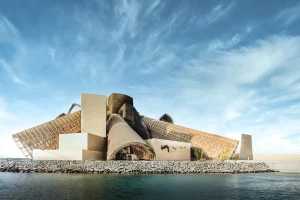
Guggenheim Abu Dhabi | photo © Courtesy of Guggenheim Abu Dhabi
The museum, commissioned by Abu Dhabi’s Department of Culture and Tourism and developed with the Solomon R. Guggenheim Foundation, forms part of the Saadiyat Cultural District. At approximately 84,000m², it contains 28 galleries, including 11,600m² of indoor gallery space, alongside 23,000m² of outdoor exhibition areas.
Its most recognisable elements are a series of monumental cones integrated into terraces and courtyards. Beyond their sculptural role, the forms respond to Abu Dhabi’s climate by creating shade and encouraging passive airflow, drawing warmer air upwards while directing cooler breezes through public spaces. Gehry Partners developed the building through extensive physical modelling and studies of the emirate’s climate, coastline and patterns of movement.
After two decades in development, the museum’s design process is becoming part of the cultural programme rather than disappearing into the project archive.
That decision makes the opening significant beyond the completion of another major cultural building. One of the inaugural exhibitions will present the evolution of Gehry’s design through original sketches, early hand-built models and archival material, explaining how the architecture responded to Abu Dhabi over the course of its development.
For architects, there is a useful communications lesson here. Large projects generate years of research, environmental analysis, models, material studies and design decisions, but much of that material traditionally remains within practice archives once construction ends. Guggenheim Abu Dhabi instead turns that process into public-facing content.
Design development can be more than evidence of how a building was made; it can become part of how the completed project is understood and communicated.
The approach is particularly relevant as cultural clients increasingly position architecture as part of a wider visitor and place-making strategy. For practices working on long-term public projects, preserving and communicating the development process may therefore have value well beyond conventional project photography at completion. Abu Dhabi is demonstrating how the architectural archive itself can help launch a building, explain its ambitions and extend the story of a major commission.
معلومات إضافية
Department of Culture and Tourism Abu Dhabi / Emirates News Agency, 6 October 2026
 English
  Spanish
  Portuguese
  French
  German
  Italian
  Japanese
  Arabic
  Chinese