


بواسطة
Bidi Bidi expansion plan links refugee housing to long-term investment and local economic development
BIG and to.org propose accommodating 155,000 additional residents in Uganda’s Bidi Bidi settlement through housing, shared infrastructure and productive facilities, with a long-term investment model still seeking financing
BIG and to.org have unveiled a plan to accommodate another 155,000 residents at Bidi Bidi, Uganda, by connecting housing with employment and shared infrastructure. Announced on 29 October, Refugee Future Cities would expand a settlement that already houses approximately 230,000 refugees, according to BIG.
The proposal addresses the mismatch between temporary humanitarian provision and communities whose needs extend over decades. Located in Yumbe District, the masterplan would connect two existing settlement zones, drawing on research visits in 2025 and the expertise of Ugandan practice LocalWorks.
A 250m² family plot is the starting point for a plan that links homes to a wider economy.
Six plots would share a courtyard, with larger clusters forming neighbourhoods around markets, schools, healthcare and public space. Earth brick, laterite and bamboo are proposed alongside improvements to ventilation, weather protection and mosquito control.
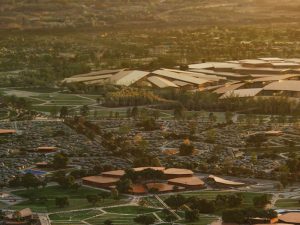 The repeating layout is intended to allow construction in phases, so that services and housing can develop incrementally. Its use of local materials and building methods also places regional construction capacity within the delivery model.
The economic ambition extends to workshops, food production and a solar-powered industrial hub combining energy generation, water treatment and waste processing. These facilities are intended to support livelihoods and help sustain the settlement as it grows, making productive infrastructure central to the housing proposition.
The wider initiative seeks institutional investment, with commercial activity intended to generate returns over decades. A single-family prototype is planned at the existing Bidi Bidi Performing Arts Centre, but BIG lists the masterplan as in design. Full-scale delivery still requires early capital, land commitments and government arrangements.
The proposed investment model makes the operation of a settlement part of the architectural brief.
For practices elsewhere, this points towards commissions involving humanitarian organisations, public authorities, investors and local construction partners.
The next test is whether the prototype can lead to funded delivery, with clear responsibilities for ownership, maintenance and resident participation. That transition would need to show how facilities are financed and managed as neighbourhoods expand, including when schools, health services and utilities become available relative to the construction of new homes.
معلومات إضافية
 English
 Spanish
 Portuguese
 French
 German
 Italian
 Japanese
 Arabic
 Chinese