


por Robert 2 Park
The Minha Casa, Minha Vida boom
Once understood primarily as social housing policy, Brazil's government-backed programme has become a driving force behind the extraordinary residential development transforming the city of São Paulo today
Brazil has a housing deficit measured in millions of households, while São Paulo is experiencing one of the largest apartment-building booms in its history. These facts are not in tension. They are connected, and the connection has a name: Minha Casa, Minha Vida.
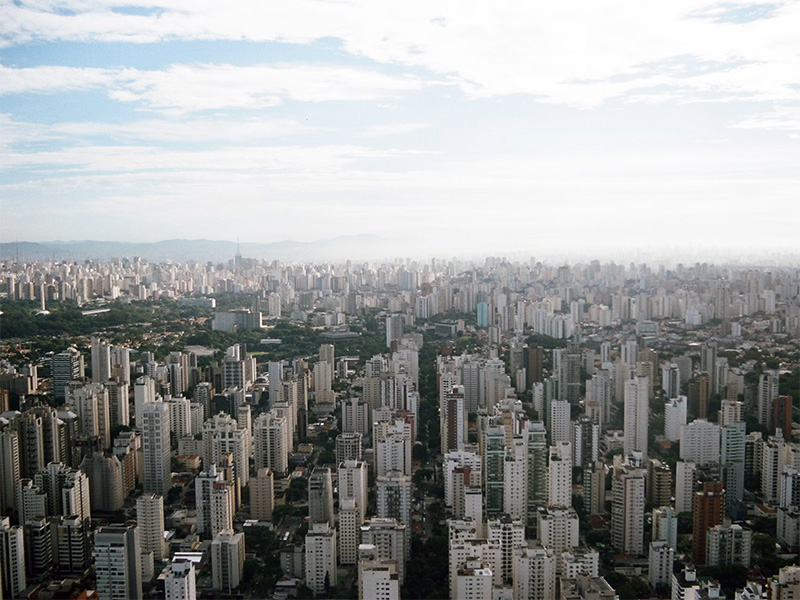
São Paulo, Brasil | Lucas Marcomini, Unsplash
For architects and developers outside Brazil, MCMV – literally “My House, My Life” – tends to be filed under social housing policy. That is now an incomplete view. In the 12 months to March 2026, developers launched 138,200 homes in São Paulo city. 86,200 of these (62%) fell within the MCMV segment measured by industry body Secovi-SP. By May, the city’s annual total had reached 144,700 launches, while MCMV accounted for 70% of that month’s launches and 71% of sales.
Secovi-SP’s classification is narrower than the programme itself: its market statistics counts Faixas 1, 2 and 3, but excludes the expanded Faixa 4, wich are the necessary income brackets for someone to buy a house through the MCMV programme. Even on that narrowed measure, MCMV is no longer operating at the margins of São Paulo’s commercial property industry; it has become one of its principal markets.
From the favela to the condominium
Three housing types help explain the transformation. The first is the favela: self-built, incremental and frequently informal, where homes expand as families acquire the means to expand them and infrastructure may arrive after the houses rather than before.
The second is the public housing estate. Post-war Brazil produced ambitious modernist social housing before the Banco Nacional de Habitação (BNH) turned mass housing into national policy from 1964. The Fundo de Garantia do Tempo de Serviço (FGTS), created in 1966, subsequently became one of the foundations of the national housing-finance system. Much of the housing produced through this era was built cheaply on peripheral land, however, often more remote from employment, transport and services.
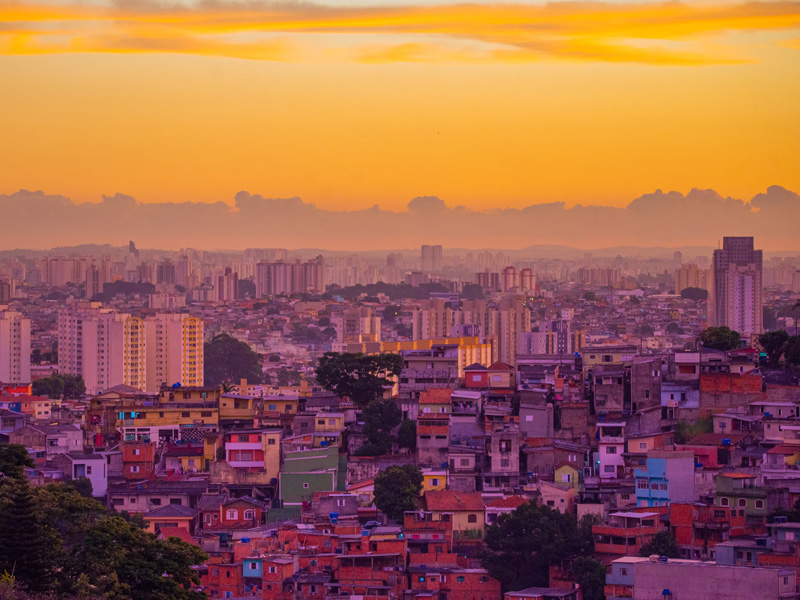
From the favela to the condominium | Will Guima, Unsplash
The third is the contemporary condominium. Across São Paulo city and its metropolitan region, apartment towers rise behind controlled entrances and perimeter walls, with pools, gyms, barbecue terraces, party rooms and landscaped communal areas marketed alongside compact apartments. Once associated primarily with Brazil’s middle classes, this is the model MCMV is pushing further down the income spectrum.
Launched in 2009 and re-established by the federal government in 2023, MCMV bridges the gap between household incomes and formal housing costs. At the lowest-income end, public resources can directly support housing production, further up, private developers build for sale while eligible purchasers receive preferential mortgages and, for lower-income households, discounts funded through the FGTS.
The programme’s 2026 urban income bands extend from Faixa 1, for households earning up to R$3,200 a month, through Faixa 2 (R$3,200 – R$5,000) and Faixa 3 (R$5,000 – R$9,000), to an extended band reaching R$13,000. In the city of São Paulo, the property-price ceilings used in Secovi-SP’s May survey were R$275,000 for Faixas 1 and 2, R$400,000 for Faixa 3 and R$600,000 for Faixa 4. MCMV therefore reaches beyond Brazil’s poorest households into lower-middle and middle-income markets.
Public money, private development
The programme is underpinned by an unusual financial model. Brazilian employers make compulsory contributions to FGTS accounts linked to their employees. Collectively, the fund has become a major source of long-term housing capital. The FGTS’s approved 2026 operational contracting budget allocates R$144.5 billion to housing, including R$125.5 billion for popular housing and R$15 billion for extended income band. A further R$12.5 billion is allocated to discounts on finance for individuals. These are approved budget figures, not final expenditure, and may be revised during the year.
Caixa Econômica Federal and Banco do Brasil originate mortgages; state and municipal governments can provide additional assistance; purchasers may draw on their own FGTS balances; and private developers acquire land and construct the homes.
For anyone accustomed to European affordable housing delivered through grants, housing associations or planning obligations, it is a strikingly different model: public financial infrastructure sustaining an enormous private development market.
More importantly, it has created a buyer. High interest rates have made conventional Brazilian mortgages expensive, slowing parts of the middle and upper-middle markets, while MCMV purchasers are partly insulated by preferential finance and public support. Developers have followed that demand. In the 12 months to March 2024, São Paulo city recorded approximately 78,400 launches, of which 40,100 were classified as MCMV. By March 2026, the respective totals had risen to 138,200 and 86,200. In two years, the MCMV segment more than doubled.
The companies building São Paulo
The result is a formidable development industry. Among the leading names are affordable-housing specialists Cury, Plano & Plano, MRV, Tenda and Econ, alongside broader residential developers including Cyrela, One Innovation, Diálogo, Grupo Kallas and EZTEC.
Their business models vary, but the largest increasingly operate less like conventional clients commissioning individual buildings and more like integrated housing producers. Cury concentrates its activities in metropolitan São Paulo and Rio de Janeiro, prioritising sites close to public transport, services and infrastructure. Its preferred construction system is load-bearing concrete-block masonry, although it also uses precast systems and concrete walls. In the first half of 2026 alone, it launched 14,550 homes and produced 10,371.
Plano & Plano describes itself as fully integrated across land acquisition, development, project planning cost management, construction and sales. MRV operates a broader housing platform spanning affordable and mid-market homes, serviced plots and purpose-built rental housing. Tenda’s model is more explicitly industrialised: standardised two-bedroom apartments, typically around 40 sq m, are produced using concrete walls cast in reusable aluminium formwork, supported by its own sales operation and early integration with MCMV finance.
This changes the architectural brief. A developer may already know its buyer, price point, construction method, apartment mix and amenity package before the architect begins. The question is no longer simply what should be designed on a site, but how an established product can be adapted, improved and made viable there.
The market itself was not simply discovered; it was institutionally produced. In a 2016 ethnography of architects, economists and planners, anthropologist Moisés Kopper showed how MCMV encouraged developers to reorganise land acquisition, construction systems, standardised plans and pricing around newly defined income groups. Although much of that fieldwork concerned an earlier phase of the programme and the market in the city of Porto Alegre, its central argument remains instructive: housing policy did not merely subsidise demand, but helped shape the product, the consumer and the market itself.
As the apartment contracts, the condominium expands
The consequences are visible in the the city’s architecture. When selling prices are tightly constrained, land value, structural systems, façade area, lift numbers, circulation, construction speed and repeatability all determine whether a scheme works financially. Every additional square metre has a cost. In May 2026, homes priced between R$275,000 R$400,000 accounted for 45% of launches and 47% of sales in São Paulo city.
Compact housing is not a marginal segment of São Paulo’s new-build market. In May 2026, homes measuring 30-45 sq m accounted for 52% of launches and 64% of sales, while two-bedroom homes represented 65% of all new units sold.
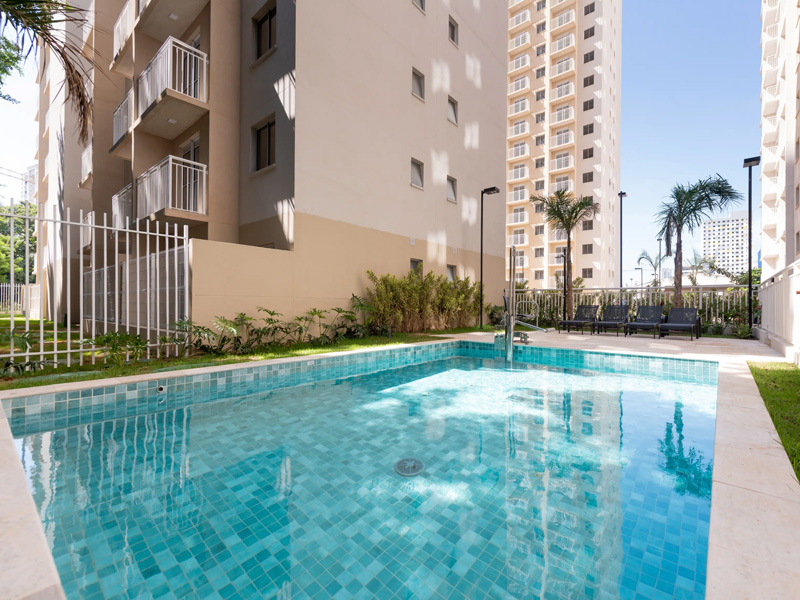
Plano&Reserva Barra Funda
At Plano&Reserva Barra Funda, designed by Rodrigo Sobreiro for Plano & Plano, three 20-storey towers contain 753 apartments. The developer’s published plans include one-bedroom layouts beginning at 24.30 sq m, alongside larger one- and two-bedroom configurations. The private space is compact, but residents share pools, fitness and study rooms, play areas, barbecue terraces and other communal facilities.
At Plano&Mais Itaquera – Marabá, 542 two-bedroom apartments are distributed across two 22-storey towers. Plano & Plano confirms the unit and tower totals, while a published project schedule gives private areas of 31 – 32.11 sq m and attributes the design to FG4 Arquitetura. Cury applies comparable principles across São Paulo metropolitan region, including Vila Nova Urupês, designed by Wilson Marchi EGC Arquitetura.
This is more interesting than a simple story about shrinking flats. Laundry, working, exercise, entertaining and children’s play increasingly migrate out of the dwelling into managed communal spaces. As the apartment contracts, the condominium expands; the development, rather than the individual flat, increasingly becomes the unit of design.
This model also has a longer history of standardisation. Research on earlier phases of MCMV found that repeatable plans and construction systems allowed developers to control costs and operate at scale, while playgrounds, barbecue areas and other shared amenities become part of the product’s appeal. Their selection was not only a design or marketing decision, it also reflected assumptions about household life residents’ ability to meet future maintenance costs.
It also raises a more nuanced question about quality. A compact apartment close to a metro station, employment and services may offer a household considerably greater opportunity than a larger home on the distant periphery.
The architectural challenge is therefore not simply to maximise floor area, but to decide what belongs inside the home, what can successfully be shared and how density can produce a functioning neighbourhood rather than merely more units.
Evidence about resident’s experiences is less conclusive than production figures may suggest. A 2019 review reported that relatively few studies have evaluated completed homes systematically from the user’s perspective, and that findings on infrastructure, security and household costs were sometimes contradictory. Recurring concerns nevertheless included small units for larger families, thermal comfort, privacy and repetitive design. These are findings from earlier phases rather than a universal judgement on today’s São Paulo schemes, but they identify questions that post-occupancy research should continue to test.
The other Brazilian architects
Here the story challenges the international image of Brazilian architecture. The country is known abroad through an extraordinary architectural canon, but the designers shaping some of its greatest volumes of contemporary housing rarely appear in international design magazines.
Design leadership sits unusually close to the developer and sometimes inside it. Current recruitment material from Cury shows architects working on legal design, massing studies, licensing, BIM models, coordination and show apartments, alongside externally commissioned consultants. Architects within integrated housebuilders collaborate with land teams, engineers, financial modellers and sales departments, determining how many apartments a site can carry, what can be standardised, where efficiencies can be found and which shared amenities make compact private homes attractive. Architecture becomes inseparable from product development, finance and industrialised construction.
There is no comprehensive public dataset showing which Brazilian architects have designed the most affordable homes. That absence is revealing; the industry meticulously records which developer launches the most units and which contractor constructs the greatest floor area, but rarely asks which architect designed the most homes.
A housing boom is not the same as solving housing
For all its scale, MCMV cannot solve every dimension of Brazil’s housing problem. The João Pinheiro Foundation estimated a national housing deficit of approximately 5.77 million homes in 2024, equivalent to 7.4% of occupied private households. São Paulo state had the country’s largest absolut deficit, at approximately 1.25 million homes, even as its capital experienced exceptional residential production.
The composition of its deficit also matters. Excessive expenditure on urban rent accounted for approximately 3.59 million households nationally in 2024, making it the largest component. Separately, approximately 28 million existing homes were classed as inadequate, most commonly because of deficient urban infrastructure. Building another privately owned apartment does not repair sanitation in an existing neighbourhood, resolve insecure tenure or make rent affordable.
MCMV is simultaneously social policy, widening access to formal housing, and economic policy, sustaining construction, lending and home ownership. The relaunched programme aims to place affordable homes closer to transport, employment and public infrastructure rather than on the cheapest peripheral land. In São Paulo city however, well-connected land is expensive, making density and compact apartments part of the viability equation.
The emerging model often exchanges more space further out for less space in a better-connected location. For many households that may be a rational trade, but its success depends on transport, schools, public space and neighborhood infrastructure keeping pace, and on shared amenities still functioning decades from now, maintained by residents on modest incomes.
Who gets to shape the boom?
Minha Casa, Minha Vida has demonstrated the extraordinary power of housing policy to create a market. Households previously excluded from new-build ownership become buyers; developers respond; capital flows and construction follows. At São Paulo city’s current scale, that process is changing the physical character of the city.
Some of the most consequential Brazilian architecture of the 2020s may therefore not be the houses, museums and cultural buildings circulating internationally, but the housing being repeated tens of thousands of times beside metro stations, along arterial roads and across developing neighbourhoods.
For architects, MCMV is consequently more than a housing story. It is a test of the profession’s position within increasingly integrated systems of public finance, private development and industrialised construction. As housing becomes more standardised and product-driven, the question is no longer simply who designs the building, but who gets to influence the decisions that define it.
Research by Thalles Cance, a São Paulo-based design professional and full-time Beedier contributor with backgrounds in architecture, urbanism, economics and politics.
 English
  Spanish
  Portuguese
  French
  German
  Italian
  Japanese
  Arabic
  Chinese